post

“Golf Dings A'”

This year  may not have been the greatest for golf, professional and otherwise, but it was a great year for golf poetry.  This Blog got more than 20,000 page views and the subject of golf poetry was featured in a May Wall St. Journal article.

Hopefully, 2011 will be an even bigger year with the publication of my book, Golf Course of Rhymes — Links Between Golf and Poetry Through the Ages, by Golfiana Press.

Some of the golf poetry of old was written by Scottish golfers who read or sung their poetry at club meetings. One of those golfers was David Jackson, Captain of the Thistle Golf Club, in Levin. He published his “songs and recitations” in a short book of 32 pages in 1886. Last August I wrote a Post that featured one of his poems. Jackson and the other club house poets wrote about golf with an enthusiasm, love and respect and a kind of innocence that was unique to that time. Jackson’s “Gouff Dings A'” loosely translated as “Golf Surpasses All” is a good example. Subtitled, “Sung at a Convivial Meeting,” here, to begin with, is the Chorus:

For Gouff dings a’, my boys, Gouff will aye ding a’
With joy we’ll swing our Clubs and Cleek, and drive the bounding Ba’;
Then over bunkers, braes (hills), and bent, we’ll gang (go) out twa (two) by twa,
With hearts elate and mind content–oh, Gouff dings a’.

And here are a few of the stanzas. Remember this was sung in the 1880’s:

Oh, hoo (how) are ye a’ the nicht (night), my friends? I hope I see ye weel (well),
Yer Clubs a’ in guid (good) order; yer Cleeks and Irons like steel.
I’ve just looked in for half-an-hour to ha’e a joke or twa
About our jolly game o’ Gouff–for Gouff dings a’.

…..Chorus

The Gouff belongs to Scotland, but its spreading sure and far;
You’ll find a Golfing-Course, my boys, wherever Scotsmen are;
In Africa,in India, in America, ’tis the same,
Australia and our Colonies pay homage to the game.

…..Chorus

King James the Fourth, he loved the game; but had to put it down,
In case his men forgot the way to fight for King and Crown.
No wonder that he banned it, boys–if a’ that’s said be true,
They played the game through a’ the week, and on the Sunday, too.

…..Chorus

I met a chap the other nicht, he was looking unco (strangely) blue;
Said I, “My boy, what can annoy a lively lad like you?”
“‘Tis a’ about the Golf,” he said, while tears ran ower his cheeks,
“The wife and I have had a row, and she’s burnt my Clubs and Cleeks.”

…..Chorus

Then, let us swell the mighty throng of Princes, Lords, and Kings
Who have enjoyed the game of Golf above all other things
And wish success to every one, let him be great or sma’,
Who loves the jolly game o’ Gouff–for Gouff dings a’.

So next Friday night when you “take a cup of kindness yet,/ for auld lang syne,” take one as well for  David Jackson and the game he describes so lovingly.

post

Another Poem for a Winter’s Day

Last December I published a post titled “Golf Poetry for a Winter’s Day.” It included a poem called “Retrospection.” If you want a succinct description of the essence of golf, I encourage you to click here and read (better recite) the last two stanzas.

This December’s poem for a winter’s day is called “A Dirge for Summer.” It was written by Robert Risk, a Scottish poet and golfer, and appeared in his book, Songs of the Links, published in 1919.

A DIRGE FOR SUMMER

Gone are the days when by the swinging sea
We lounged and smoked between two sunny rounds,
Gone are the times of loitering by the tee;
The summer has been driven out of bounds–
No penalty is writ in white and black,
Whereby we are allowed to call it back.

Gone are the jocund evenings when we start,
High-tea’d and confident of light and weather,
Forgetful of the office and the mart,
Of debts and duns and the Golf-maniac’s blether;
Those perfect evenings, clear, and dry, and bright,
Have vanished wholly in the Ewigkeit. [eternity]

Gone is the crowd about the starter’s box,
And no one waits to-day at those short holes,
Where the procrastinating putter mocks
The men behind and harrows up their souls;
Void the grey town o’scarlet down and cleek
(I’ve half a mind to go there for a week).

For now, we must from Saturday to Saturday
Neglect our game–a week’s a weary time–
And each one brings a coorser and a watter day
(Kindly excuse a Caledonian rhyme),
For we are entered on the Golfer’s Lent,
The season of his deepest discontent.

Yet on the dim horizon looms afar,
No larger than the neatest niblick head,
A little scintillating, faithful star,
Though over all the heavens is darkness spread;
Through all the winter waste it sends a greeting,
The constellation of Next Year’s Spring Meeting.

When I read this poem it makes me think that over the last 100 years the game has changed much more than its players.

post

Read Golf Poetry Out Loud!

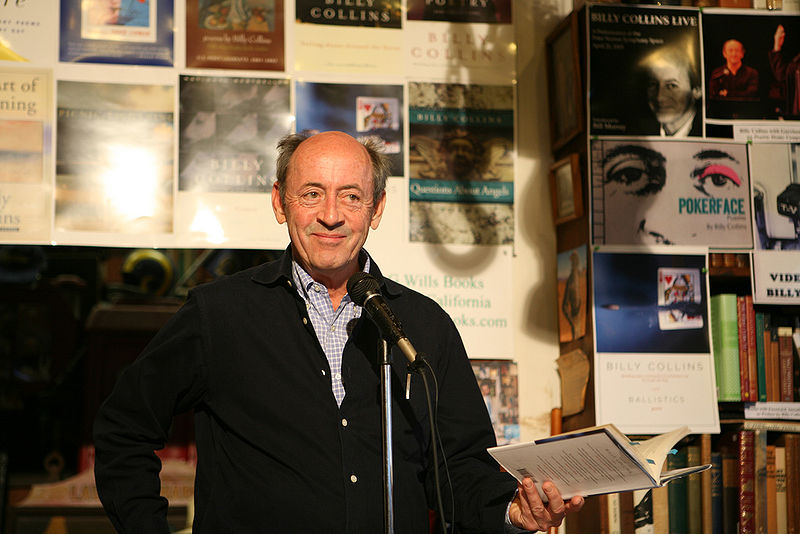
[Note: the picture is of Billy Collins, a former United States Poet Laureate and an avid golfer. If you ever have the chance to hear Professor Collins read his poetry out loud (he has two CDs out), you will be convinced quicky that poetry must be read out loud to be fully enjoyed.]

Though it is hard for me to believe, I have now been writing this Blog for almost two years. The Blog now includes more than 100 Posts and close to 100 golf poems. The good news is that golfers interested in finding poetry about golf are finding this site. The Blog has recorded more than 37,000 page views. The bad news is that the Blog is 100 years late in getting started. As I have mentioned in these pages, golf poetry was routinely included in all the golf magazines published early in the 20th century. And books of golf poetry were bought and enjoyed. Moreover, poetry was recited at club meetings by poetry writing members.

My purpose in writing this Blog has been to make this golf poetry of the past (and a few poems of the present) available to a generation of golfers who have had no access to this literature. But poetry, different than prose, puts an extra demand on its readers: it asks that you read it out loud. Though you are easily convinced that yelling “Fore” is a good idea when an errant ball is hit, you may be less sure about the value of reading poetry out loud. Even more so, when you rarely come across any kind of poetry, let alone golf poetry. So my only hope of convincing you may be  to write a poem with the right incentive:

READ GOLF POETRY OUT LOUD

Read golf poetry out loud,
It will lower your score;
And if one poem doesn’t do it,
Read two or three more!

If you believe all of those equipment ads, maybe this poem will work as well. But if not, search around the Blog and find a poem that appeals to you…and then gather up your courage and read it out loud. Maybe even more than once. I hope this exercise will convince you that reading poetry out loud adds greatly to your understanding and enjoyment of the poem. If you are inclined, leave a comment and let me know what you think.

post

An Australian Golf Poem from 1897

Last week I received an email from a friend from the Netherlands who was kind enough to forward to me this week’s poem, “The Wreck of the Golfer.” The poem was written by Andrew Barton “Banjo” Paterson (1864 – 1941), a famous Australian poet, journalist and author. One of Paterson’s most famous poems is “Waltzing Matilda,” which was set to music and became one of Australian’s most famous songs. Paterson’s image appeared on an Australian postage stamp in 1981 and today graces Australia’s 10 dollar note.

Without some background, “The Wreck of the Golfer” makes strange reading. But once it is understand that the poem is a parody of Henry Wadsworth Longfellow’s poem, “The Wreck of the Hesperus,” (1842) then at least we can understand its structure and ending. Longfellow’s poem begins,

It was the schooner Hesperus,
That sailed the wintery sea;
And the skipper had taken his little daughter,
To bear him company.

You can read the entire poem at http://en.wikisource.org/wiki/The_Wreck_of_the_Hesperus. Paterson’s poem is as follows:

The Wreck of the Golfer

It was the Bondi golfing man
 Drove off from the golf house tee,
 And he had taken his little daughter
 To bear him company.

 "Oh, Father, why do you swing the club
 And flourish it such a lot?"
 "You watch it fly o'er the fences high!"
 And he tried with a brassey shot.

 "Oh, Father, why did you hit the fence
 Just there where the brambles twine?"
 And the father he answered never a word,
 But he got on the green in nine.

 "Oh, Father, hark from behind those trees,
 What dismal yells arrive!"
 "'Tis a man I ween on the second green,
 And I've landed him with my drive."

 "Oh, Father, why does the poor Chinee
 Fall down on his knees and cry?"
 "He taketh me for his Excellency,
 And he thinks once hit twice shy."

 So on they fared to the waterhole,
 And he drove with a lot of dash,
 But his balls full soon in the dread lagoon
 Fell down with a woeful splash.

 "Oh, Father, why do you beat the sand
 Till it flies like the carded wool?"
 And the father he answered never a word,
 For his heart was much too full.

 "Oh, Father, why are they shouting 'fore'
 And screaming so lustily?"
 But the father he answered never a word,
 A pallid corpse was he.

 For a well-swung drive on the back of his head
 Had landed and laid him low.
 Lord save us all from a fate like this
 When next to the links we go.

The Sydney Mail, 4 September 1897

As a reference point, the first golf club in Australia, the Australian Golf Club in Sydney, was established in 1882. However, Paterson’s relationship to golf has yet to be determined. I have written to a researcher in Australia and if she turns up something I will pass it on.   Any comments regarding Paterson’s links to golf would be appreciated.

In the mean time, we have our first historic golf poem from Australia.

post

Poetry From The Golfer Magazine, 1897

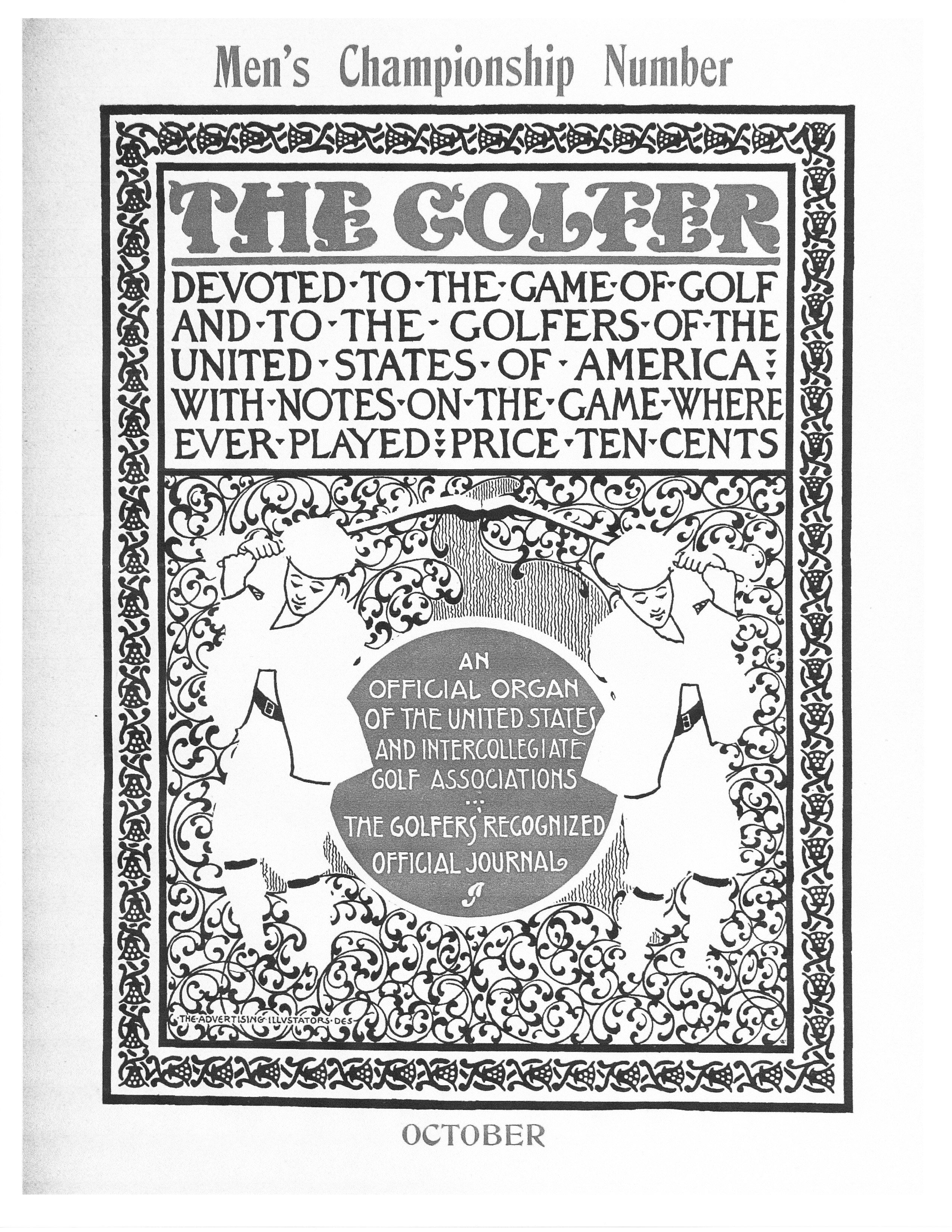
I just found this unsigned poem in the “Notes by the Wayside” section of the October 1897 issue of The Golfer magazine (offices at 154 Pearl St., Boston). It’s a little late chronologically, but still timely.

OCTOBER’S HERE

October’s here: I hear her tread,
Upon the hilltops, glad and free;
And also in my weary head,
I have a cold that’s killing me.

October’s here: but I don’t care,
I still get in my game;
I care not for the air so rare
Nor do I look for fame.

October’s here: but what of that,
Why prate I of the weather;
My only thought is now of what
My score’ll be altogether.

October’s here: her robes are red,
And yellow, sprinkled thick with gems;
The summer days have surely fled,
The talk is now of Repubs and Dems.

A month before in the same section of The Golfer:

SONG OF THE LINKS

Newport, Lenox, Lakewood,
Saratoga, Troy,
York Harbor and Knollwood,
Long Branch, Pomeroy.

Richfield Springs, Saranac,
Stamford, Hallowell,
Seabright, Bath, Pontiac,
Greenwich, New Rochelle.

Bar Harbor, Shelter Islands,
Ardsley, Asburee,
Larchmont, Atlantic Highlands,
Manchester-by-the-Sea.

How many of these courses still exist?

post

Golf Poetry and the Promotion of Pain Remedies

In the 1650 edition of his book  Hesperides, the English poet Robert Herrick included this short poem.

NO PAINS, NO GAINS.

If little labour, little are our gains:
Man’s fortunes are according to his pains

“No pain, no gain,” right or wrong, has been celebrated in all sports. In golf consider Mark Reason’s comment on Tiger Wood’s 2008 U.S. Open win:

It is surely the single greatest sporting achievement of all time. The man could barely stand. His left knee was like tangled spaghetti. His tibia was fractured in two places. Yet Woods beat the world’s best standing on one leg.

But pain not only brings gain, it also brings products to treat it and training methods to avoid it. Here is part of a Q & A with the professional golfer Ray Floyd in November 1996:

Q. At the Vantage you said you were pain-free for the first time in a long time. Is that still the case?

RAYMOND FLOYD: Absolutely. I am now taking just my three Advil a day and that is terrific.

However, Advil has its detractors. This is from a recent Internet ad for Flexcin, a joint inflammation treatment for “golfer’s elbow,” among other ailments:

Are you popping Ibuprofen or Aleve just to keep participating? You know it’s not good for you. . . . Now with Flexcin, there’s an alternative that is permanent! Try Flexcin and become active again.

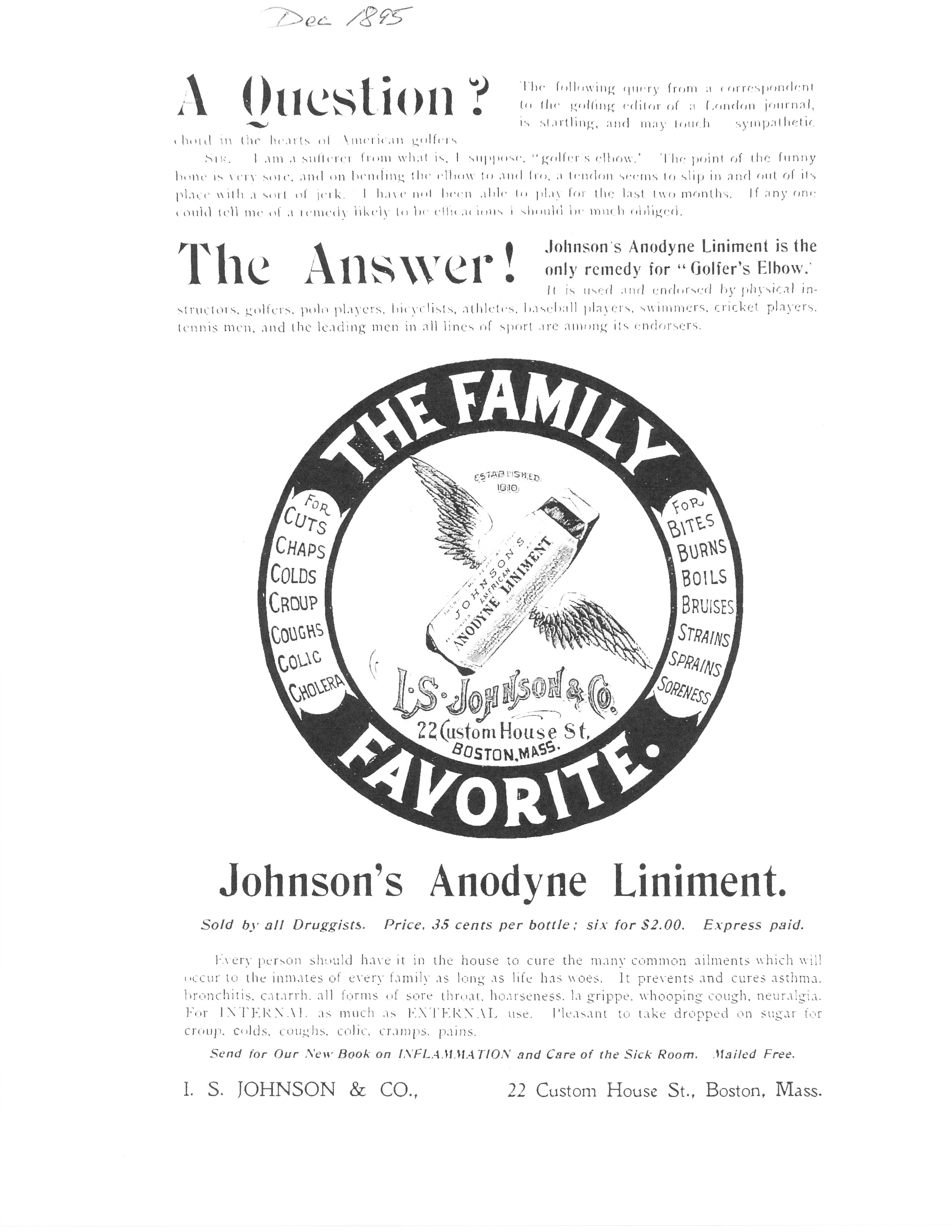
Golfers who played over 100 years ago and read The Golfer magazine (10 cents an issue, a dollar a year), were regularly regaled with ads, some of them in verse, for Johnson’s Anodyne Liniment (that also targeted “golfer’s elbow” as in the ad above). (See  an earlier Post for details.) Now I have found that Johnson’s went even further to promote its product. The April 1898 issue of The Golfer included a full page poem by an anonymous poet, which can only be described as an unabashed endorsement for Johnson’s Liniment! This “epic poem” matches “Grim Pain” against “The Knight of the Links.” Read on (preferably out-loud) to find out who this heroic Knight was.

The Knight of the Links

Grim Pain appeared on the Links one day,
To find a foe who could say him nay;
He had fought with many, had conquered all,
And now he would tackle, the “gay Golf ball.”

But an old-time warrior who bore the seal,
Of public approval on burnished steel;
Threw down the gauntlet to Pain and said,
“You will fight with me this day instead.”

“I have only to cross his steel, thought Pain,
When he will be numbered among the slain;
He may try to win, but I shall write
One conquest more on my tablet to-night.”

Pain had harrowed Golfers with fever of fire,
He had vexed their joints in his devilish ire,
Had strained their muscles, and made them sore
With bruise “Golf arm” and aches by the score.

Now where e’er he struck, this Knight of old
Parried his thrusts and defied his hold;
Then Golfers arose and laughed him to scorn,
“Hail, Knight of the Links! Pain’s power is gone.”

Then Pain gave up the unequal fight,
For the Golfer’s arm was cured quite,
The Knight which kind fortune to him had sent,
Was called “Johnson’s Anodyne Liniment.”

Apparently Johnson’s lived on for many years. However, in 1932 its advertising claims were found to be fraudulent by the Food and Drug Administration. The Knight was finally stripped of its armour.

post

Golf Opposites

One suggestion often given to new golfers is to learn by studying what a good professional does when practicing or playing. Learning from the pros extends to poetry. I often get ideas from the best poets. For example, I recently began to read the poetry of Richard Wilbur, one of the great 20th century American poets. Among the many, many poems Wilbur has written, he wrote a series of word-play poems having to do with opposites. Here is a short example (more can be found in his book, Collected Poems 1943 – 2004):

The opposite of doughnut? Wait
A minute while I meditate.
This isn’t easy. Ah, I’ve found it!
A cookie with a hole around it.

Taking Wilbur’s idea as a starting point, I wrote two golf “opposite” poems.

CLUB AND BALL

What is the opposite of club?
It might be ball, but there’s a rub.
If you don’t hit it well enough,
The opposite of club is muff!

HOME AND AWAY

The opposite of away is home;
That wouldn’t crack a putter’s dome.
But if you’re away and in a match,
Then I would say there is a catch.
You putt first and so recast,
The opposite of away is last!

Leon S. White, PhD

post

Match Play Golf Poetry

The Ryder Cup is a match play event. Several earlier Posts deal with match play poetically. For example, The Language of Match Play in 1504 and More Match Play Poetry. For others, go to the search box and enter “match play.”


post

A Poem for the Avid Golfer

Here is a poem that should make any avid golfer smile and nod in agreement:

A LITTLE

A little learning so ’tis said,
Is dangerous for any head. .
A little wisdom, tipped with wit,
Will rarely fail to make a hit.
A little golf, ’twas said of late,
Will benefit the delicate.
At which some wise one had his fling:
“A little golf? There’s no such thing.”

Francis B. Keene.

For the avid golfer, the feelings expressed in these eight lines are easy to identify with. What might be surprising is that Francis Keene published this poem in the March 1900 issue of the magazine Golf.

Golf has change a lot in the last 110 years. No one will argue with that statement. But what the old poems featured in this Blog show, often with eloquence and wit, is that the feelings of a true golfer, who loves playing the game, have changed very little over time.


post

New Post Frequency

I have decided to add a new Post about every two weeks instead of weekly. With more than 90 poems on the Blog at this point, there is plenty to read (and recite). And to be honest, it is getting harder to find interesting old golf poems that I have not put in my book or on this Blog already. Also this fall I will be spending more time preparing my book manuscript for publication in 2011.

I want to thank all of you who visit the Blog from time to time. For those interested, the current Top Post is “Golf Ball Poetry.” Others high on the list include, “A Poem You Can Relate To,” “Attitudes Toward Women Golfers in the Early Days,” and “Lying in Golf Poetry.”

I will continue to announce new Posts on Twitter as well as publish Twitter Twines from time to time.

Look for the next new Post around September 20th. Thanks again for your interest.