post

The Language of Golf

The Foreword to Peter Davies’ impressive book The Historical Dictionary of Golfing Terms  − From 1500 to the Present begins:

No game has a richer array of terms than golf. Five hundred years of golfing have built up an extraordinary vocabulary.

Mr. Davies goes on to say,

…before 1850 when the Scots had the game to themselves: bunker, caddie, divot, links, putt, stance, stymie and tee [were] purely Scottish words…

Robert K. Risk, a Scottish writer, poet and golfer in his book Songs of the Links, first published in 1919, identifies a presumably non-Scottish writer who,

…in a magazine alleges that the terminology of golf is peculiarly repulsive, and instances “top,” “foozle,” “tee,” “stymie,” “divot,” and “bunker,” as the cacophonous offspring of a degraded invention.

Risk responded with “A Protest,”

A PROTEST

Imprimis, I would here protest
That any who mislikes our phrases,
Our stymies, foozles, and the rest
May, go, for all I care, to blazes,
Or any more select location
Where golf terms cannot cause vexation;

Secundo, when he sets his hand
Upon so sweet a bloom as stymie,
I’d have him clearly understand
Few words so keenly gratify me;
Stymie—it pleases me to say it
Almost as much as when I lay it.

Stymie—dear word most musical:
And what man will deny that putter,
Pronounced without a “t” at all,
Is smoother far than melted butter;
And when its “t’s” are forced to duty
Putter has still a poignant beauty.

And as for foozle—what could be
More deftly onomatopoeic?
Hearing the word, assuredly
Even one who knew not Golf, would see quick
Anger, futility, despair
As of a man who beats the air.

And divot—any duffer knows—
Is the by-product of a foozle:
When to a sounder game he grows,
And pitching-clubs cease to bamboozle,
Divot, when it is cut or said
Means a half-iron shot laid dead.

And what about those minor games—
Billiards and tennis, football, cricket—
Could one invent much uglier names
Than pot and screw and lob and wicket,
Off-side and deuce and maul and sett?
More loathly words I’ve never met.

Therefore, when in a magazine,
A writer airs such views as these,
I diagnose a touch of spleen
Or failure absolute to please
The Goddess who demands our duty—
Great are Golfina’s works and ways,
And passing sweet her every phrase,
And all her words are words of beauty.


post

Where is Johnson’s Anodyne Liniment When Tiger Needs It?

The cartoon above filled the upper half of a full page ad that appeared in the April 1896 issue of The Golfer magazine. (Notice that “Anodyne” was misspelled. The word “anodyne” means anything that relieves distress or pain.) To sell the product the Johnson’s folks included the following eight line poem that appeared below the cartoon: (Spalding also used poetry to sell golf balls. See the Post called “Golf Ball Poetry.”)

When players versed in golfing lore,
Discuss the technique of their score,
And talk of putting, bunker, fore,
Let us suggest to them one more.

“Tis Golfer’s Elbow…and ten to nine,
We can make a cure
That is prompt and sure,—
A Liniment called Johnson’s Anodyne.

Below the poetry was the following statement:

It soothes every ache, every bruise, every cramp, every irritation, every lameness, every swelling everywhere, and speedily relieves and cures every ailment caused by inflammation. It is for INTERNAL as much as EXTERNAL use. It was originated in 1810, by Dr. A. Johnson, an old family physician, for his own practice. It is used and endorsed by athletes everywhere.

So Tiger, now that you have your MRI results, just get a few bottles of Johnson’s Anodyne, rub some on your neck, drink the rest and you should be hitting them long and straight in no time!

(Actually, according to an entry in the American Medical Association Journal (Vol. 101 # 4), Johnson’s Anodyne Liniment contained ” Alcohol (14.8 per cent), a fatty oil, oils of turpentine and camphor, ammonia, ether and water.” And its advertising claims were found to be fraudulent by the Food and Drug Administration in 1932.  So Tiger, maybe forget the advice and good luck with your treatment.)

post

The Prime Minister (to be) is on the First Tee

Arthur J. Balfour (1848 – 1930) was a lifetime professional politician and a long time avid amateur golfer, which left him little time for anything else. He was Captain of the North Berwick club, 1891-92 and Captain of the Royal and Ancient Club of St. Andrews a few years later. He was called by some “the father of English golf,” most likely for his strenuous efforts to promote the game. The high point of his 50 year political career was his time as Prime Minister of the U.K. from 1902 – 1905. Earlier as the cartoon indicates, he was Irish Secretary. He was first known as a renowned philosopher, publishing A Defence of Philosophic DoubtThe Foundations of Belief , and Theism and Humanism .

Balfour the golfer (and philosopher) once wrote:

A tolerable day, a tolerable green, a tolerable opponent, supply, or ought to supply, all that any reasonably constituted human being should require in the way of entertainment. With a fine sea-view, and a clear course in front of him, the golfer should find no difficulty in dismissing all worries from his mind, and regarding golf, even , it may be, very indifferent golf, as the true and adequate end of man’s existence.

In 1894 when Captain of the R & A and following its traditions, Balfour drove off the opening ball at the Autumn Golf Meeting with his friend Tom Morris nearby. Balfour commemorated this event with a poem that will appeal to all golfers who harbor first tee trepidations.

A REAL POLITICAL CRISIS

The crisis came, at that wave-beaten place
Men called Saint Andrews in the golfing years;
Tom Morris watched me with an anxious face,
I, full of nervous fears.

Addressed the ball: the crowd had swelled in size:
Behind the ropes I saw; though scarce alive,
The stern tweed-coated men, with golfish eyes,
Waiting to see me drive.

The feat is far less easy than it seems,
Despite the rival politician’s scoff;
Indeed I marvelled what ambitious dreams
Had tempted me to golf.

For I remembered tee-shots toed and topped,
Sad moments, when the driver firmly clutched
Had done its utmost, yet the ball had stopped
Upon the tee, untouched.

This, after all, is merit’s actual test,
I thought, and other laurels matter not,
For no distinguished man can look his best
After a foozled shot.

Still, let me strike, I said, and gathered heart;
Then, with my eye fixed firmly on the ball—
That earliest canon of the Royal Art—
Drove off—and that was all.

post

Early Days of Golf – The “Good Wife’s” Point of View

In the early days, the preponderance of golfers were men. Below are two poems that took the “good wife’s” point of view.

The first poem was published in The American Golfer on April 21, 1923 and “celebrated” the start of golf season. (It had been published earlier in the Chicago Post.)

Dementia Linksensis

The good wife awoke in the night with a start,
She gave a wild shriek with her hand on her heart,
And fright caused her hair to stand on her head,
For their stood her Hub, at the foot of the bed.

He’d wrenched a brass rod from the bed in his trance
And there at the footboard had taken his stance.
The little brass ball at the corner he took
For the pill and was ready to give it a hook.

Quite wildly he swung with his improvised club
And banged his own head like the veriest dub;
But he showed he was an old hand, when he swore
And swung once again with a shrill cry of “Fore!”

Four was right — four light bulbs he’d broke”
When the chandelier stopped his magnificent stroke.
This stopped his endeavor; he crawled back in bed,
And while yet half awake to his wifey he said:

“I know it’s unpleasant and that sort of thing
But I always get this way along in the spring.”

The second poem continues our series “celebrating” the golf widow. This poem, “The G. W.” was written by Miriam Teichner, an American author and journalist, who early in her career wrote a daily column of verse and humor in the Detroit News. The poem appeared in the June 1916 issue of The American Golfer.

THE G. W.

Who sits alone on sunny days
And fills her time in irksome ways?
Whose eyes are dull with sorrow’s glaze?
The G. W.

Who seems to have no place to go?
Whose holidays are filled with woe?
To whom are Sundays all too slow?
The G. W.

Who sighs, what time the days of spring
Their warm and pleasant sunshine bring.
And blossoms white their petals fling?
The G. W.

Who sits alone within the house,
Forlorn as any little mouse?
Who has been cheated of her spouse?
The G. W.

Who is the most neglected soul”
On earth, while husband—selfish mole—
In bogie makes the eighteenth hole?
The golf widow.

Of course, these poems represent historical artifacts of a time gone by. Or do they?

post

Michelle Wie and other Clerihews

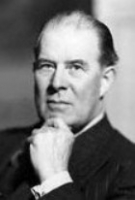
E. C. Bentley

Clerihews are four line poems in the form aabb, were the first two lines rhyme as do lines three and four. Furthermore, the first line of a Clerihew begins or ends with a person’s name and the poem focuses on some aspect of his or her life. Of course, there can be variations of this idea. As I explained in an earlier Post, Clerihews are named for their inventor, Edmund Clerihew Bentley (1875 -1956), an English journalist and writer.

As examples, here are a few Clerihews that I wrote:

Harvey Penick

Harvey Penick
(Rhymes with scenic)
His claim to fame:
“Take dead aim.”

Jack Nicklaus

Jack Nicklaus (the Golden Bear)
Pudgy in profile with blondish hair
Left opponents in the dust
With his putting, most robust.

Vardon, Taylor and Braid

Vardon, Taylor and Braid
“The great Triumvirate” so portrayed
In tournaments, to their competitors’ chagrin
One of the three would usually win.

Miclelle Wie

Michelle Wie
May still want to see
If there is a chance
To beat pros who wear pants.

If you are so inclined, try your hand at writing a golf Clerihew and leave it as a comment below.

post

Golf History, Golf Poetry and the Making of the Featherie

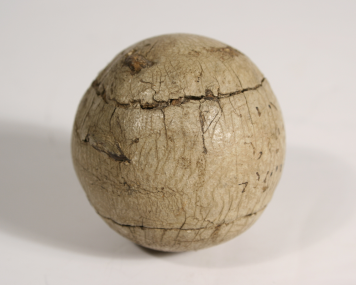
A Featherie Ball

aFor many American golfers, the history of golf begins with the 1913 U.S. Open won in a playoff by Francis Ouimet over Harry Vardon and Ted Ray. The author Mark Frost marks this event as “the birth of Modern Golf” in his bookThe Greatest Game Ever Played. But what about the birth of the game? To get a better idea as to the origins of golf and its early history I would suggest a book called A Swing Through Time — Golf in Scotland 1457-1744 by Olive M Geddes (revised edition published in 2007).  Quoting from the book’s introduction,

This book takes a close look at the earliest written records of golf in Scotland, from the 1457 Act of Parliament banning the game to the first ‘Rules’ of golf — the ‘Articles and Law’ of 1744 drawn up by the Company of Gentlemen Golfers for the competition for the Silver Cup played over Leith Links.

Interestingly, some of these “written records” were recorded in verse. For example, Ms. Geddes devotes a chapter to a discussion of the first book entirely devoted to golf, called The Goff, first published in 1743. It was a mock-heroic epic poem, 358 lines long, written by an Edinburgh lawyer (who later became a Minister) named Thomas Mathison.  A second edition was published in 1763 and a third 30 years later. In 1981 the United States Golf Association published facsimiles of all three editions under one cover in a limited edition of 1400 copies. One of few surviving third edition copes was sold for $80,500 in 1998.

The Goff tells the story of a golf match on the Leith Links played between Castalio and Pygmalion, the heroic combatants of the tale. But the poem also makes reference to some golf related activities of the time. In one interesting section of eight lines, Mathison describes in some detail how featherie golf balls were made:

The work of Bobson; who with matchless art
Shapes the firm hide, connecting ev’ry part,”
Then in a socket sets the well-stitch’d void,
And thro’ the eyelet drives the downy tide;
Crowds urging crowds the forceful brogue impels,
The feathers harden and the Leather swells;
He crams and sweats, yet crams and urges more,
Till scarce the turgid globe contains its store.

Ms. Geddes remarks that “Bobson” probably referred to a St. Andrews ball-maker named Robertson (likely an ancestor of Davie and Allen Robertson). The implication is that although balls were made in Leith at the time, the best balls came from St. Andrews. (Featherie balls dated back to 1618 and were only replaced by Gutta-Percha balls in 1848!) I hope that those of you who might be interested in golf’s early history will have the opportunity to consult A Swing Through Time.

post

Ted Ray’s Golf Swing


The question “What’s wrong with his/her golf swing?”  is often answered today by looking at slow motion video. But the question goes back long before video analysis. It was raised with regard to Ted Ray’s swing shortly after he had participated in the famous 1913 U.S. Open won by Francis Ouimet.

The November 1913 issue of The American Golfer included the following short item titled “Ray’s ‘Sway'”:

Ray comes to us with the reputation of swaying on his up-stroke. Ray does not sway—and we have observed him very closely. What he does is this: Just after the backswing starts the weight is transferred to the right leg; then, about half way up the swing the left shoulder is dropped more or less—a movement in contradistinction to, and offsetting, the first, but to the uninitiated eye, giving every appearance of a sway. The first puts the body weight where it properly belongs—back of the ball—the second enables the arms to complete the upswing. The bending of the knees, more especially the right one, outwardly, creates the false impression of a body sway. It is a sort of leaning in to the ball. Not “according to Hoyle” perhaps, but mighty effective—in Ray’s case.

If you didn’t know, you would have thought that Johnny Miller wrote this! But this was a note in a 1913 golf magazine. And so, not unexpectedly, a short poem was also included:

OH! SAY

Oh! tell us Teddy—Teddy Ray,
Tell us truly, we do pray—
If as some are wont to say,
You do really, really sway.

We ourselves incline that way;
But that is not the proper way,
Our friends inform us day by day
When at the 19th hole we pay.

HIP-HIP-HOO-RAY

Does Ray sway?
Ray does not sway.
He leans; which means
Ray does not sway.

Ray was known for his portly build and prodigious length off the tee, though his ball often landed in awful lies. His recovery powers were said to be phenomenal and cartoonists usually caricatured him with a niblick in hand, festooned with clumps of heather and saplings, with an inseparable pipe clamped between his teeth. During his career he won the 1912 British Open and the 1920 U.S. Open.

post

Casey, Tiger and Two New Seasons

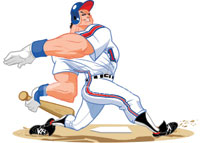
A while ago I wrote a parody on the poem “Casey at the Bat” by Earnest Thayer called “Tiger on the Mat.” When I wrote the poem I naively believed that everyone knew the original, but sadly I was wrong. Now with baseball season beginning and Tiger returning, I thought I would give golf/baseball fans another chance to read (better yet recite) one of the greatest sports poems ever written.  In addition, I found a poem by Gantland Rice written in response to a fan who had never heard of the Casey poem. Rice whose golf poems have appeared several times in my Blog, gives you an idea of how engaging sports poetry can be in his response to the “cove who never heard of “Casey at the Bat.”

So, given this momentous week, Go Red Sox, and yes, Go Tiger.  I hope they both look better this November than last.

He Never Heard of Casey!by Grantland Rice ©
Published: New York Herald Tribune (06-01-1926)
I knew a cove who’d never heard of Washington and Lee,
Of Caesar and Napoleon from the ancient jamboree,
But, bli’me, there are queerer things than anything like that,
For here’s a cove who never heard of “Casey at the Bat”!

He never heard of Mudville and its wild and eerie call,
“When Flynn let drive a single, to the wonderment of all,”
For the stormy roar of welcome that “recoiled upon the flat
As Casey, mighty Casey, was advancing to the bat.”

“There was easy in Casey’s manner,” from the Ernest Thayer style,
“There was pride in Casey’s bearing,” and his tanned face wore a smile,
And when they thundered “Attaboy!” of course he tipped his hat,
But here’s a cove who never heard of “Casey at the Bat”!

“Who is Casey?” Can you beat it? Can a thing like this be true?
Is there one who’s missed the drama that ripped Mudville through and through?
Is there a fan with soul so dead he never felt the sway
Of these famous lines by Thayer in the good old Thayer way?

“Ten thousand eyes were on him as he rubbed his hands with dirt;
Five thousand tongues applauded as he wiped them on his shirt;
Then while the writhing pitcher ground the ball into his hip,
Defiance gleamed in Casey’s eye, a sneer curled Casey’s lip.”

The drama grew in force and flame, and Berserk went the mob,
With Casey representing more than Hornsby, Ruth, or Cobb;
And as the pitcher cut one loose as if fired from a gat –
Say, here’s a guy who never heard of “Casey at the Bat!”

“The sneer is gone from Casey’s lip, his teeth are clenched in hate;
He pounds with cruel violence his bat upon the plate.”
And as the pitcher shot one through to meet the final test
There’s one low and benighted fan who never heard the rest.

Ten million never heard of Keats, or Shelley, Burns, or Poe;
But they know “the air was shattered by the force of Casey’s blow”;
They never heard of Shakespeare, nor of Dickens, like as not,
But they know the somber drama from old Mudville’s haunted lot.

He never heard of Casey! Am I dreaming? Is it true?
Is fame but wind-blown ashes when the summer day is through?
Does greatness fade so quickly and is grandeur doomed to die
That bloomed in early morning, ere the dusk rides down the sky?

Is there nothing left immortal in this somber vale called Earth?
Is there nothing that’s enduring in its guarding shell of worth?
Is everything forgotten as the new age stumbles on
And the things that we once cherished make their way to helengon?

Is drifting life but dust and dreams to fade within a flash,
Where one forgets the drama of the Master and the Ash?
Where one has missed the saga with its misty flow of tears,
Upon that day of tragedy beyond the trampling years?

“Oh! Somewhere in this favored land the sun is shining bright;
The band is playing somewhere, and somewhere hearts are light;
And somewhere men are laughing, and somewhere children shout,
But there is no joy in Mudville – mighty Casey has struck out!”

Rise, De Wolf Hopper, in your wrath, and cut the blighter down!
Although Wang may be forgotten in the passing of renown,
There’s a grave crime committed which should take you to the mat,
For here’s a cove who never heard of “Casey at the Bat”!

I had an epic written which I thought would never die,
Where they’d build a statue for me with its head against the sky;
I said “This will live forever” – but I’ve canned it in the vat,
For here’s a guy who never heard of “Casey at the Bat”!

He Never Heard of Casey! by Grantland Rice ©
post

A Springtime Exchange Between a Golf Poet and his Editor

Robert K. Risk's book, Songs of the Links (1919), includes the following timely exchange between Risk, the golf poet, and and Garden G. Smith (1860-1913) the editor of Golf Illustrated, the British weekly, for many years and an important contributor to the literature of the game. (Risk's poem has been slightly shortened.)

TO THE EDITOR

Bid me write and I will write
Of club and ball and tee,
Trusting the matter I indite
Will be approved by thee.

Bid me to stay my pen and I
Will muzzle it with grace,
Regarding not impatiently
Regretted "lack of space."

But when you hint that I should do
Some verse concerning Spring,
That, I must frankly caution you,
Is quite another thing.

Although not disinclined to sing,
No poet can ignore
That all that can be sung of Spring
Has been well sung before.

Therefore, should I to platitude
And outworn phrase incline,
The brickbats thrown by readers rude
Are yours, dear sir, not mine.

In Spring we walk the daisied links
Where lively lambkins leap—
Too few of them, one sadly thinks,
Will ever grow to sheep.

In Spring a brighter glitter shines
On the well-burnished cleek,
But still we do 5-holes in 9's
Though playing thrice a week.

In Spring the chronic topper dreams
Of getting down to scratch,
Of being picked in all Club teams,
And winning every match.

In Spring we cease to argufy
About the "best-length hole,"
Which simply means the one that I
Enjoy—and you can't hole.

......

'Tis Spring that whets our appetite
For Three weeks' solid golf,
Though ere the third week is in sight
We shall be direly "off."

In Spring the poet is supposed
Keenly his lyre to tune;
But here these verses are foreclosed,
For I am off to Troon.

And here is the editor Garden G. Smith's response:

THE EDITOR

WITH APOLOGIES TO HIS READERS

'Tis bitter sad the poets should
There work neglect for sport,
Wile Mr. Risk plays golf at Troon,
I am two verses short.

May bunkers trap his longest shots,
May rabbit holes annoy him;
And if this here occurs again
I'm blowed if I'll employ him.

post

Six Tweets to Better Putting

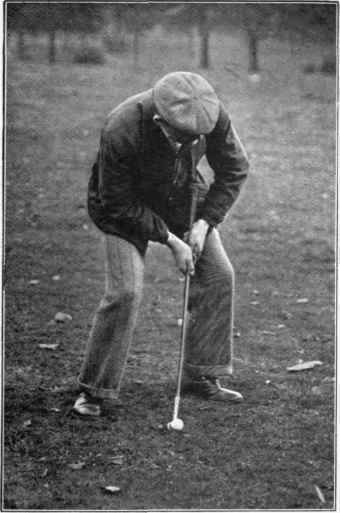
J. H. Taylor putting

There seems to be general agreement that the first printed book of golf instruction was The Golfer’s Manual, By a Keen Hand, written by H. B. Farnie and published in 1857. Since then instruction has grown to be one of the major products of the golf industry. These days it is still packaged in books, but also in magazines, newspapers, advertisements, blogs, videos, YouTube clips and tips. In addition, instruction is sold to individuals and groups by thousands of teaching pros.

But in today’s busy world, there is a need for the “short and sweet” in golf instruction. With that in mind I offer a 12 line verse that packages the essence of what you need to know to become a better putter. And if you are put off by poetry, just think of this guide as six putting tweets.

Six Tweets to Better Putting

Line up and trust when putting
Head still a must when putting

A rhythmic swing
Is just the thing when putting

Get rid of fear
At least be near when putting

All are agreed
The first rule is speed when putting

Consistency
The foremost key when putting

The best advice
Don’t think twice when putting.

Leon S. White, March 2010