post

The Rules of Golf

All of the recent golf rules violations inspired me to write the following poem:

THE RULE OF GOLF

The Rules of Golf are not to be broken;
Nevertheless, sometimes they are,
By Pros who should know when to invoke them,
Even when they are close to bizarre.

There are Rules for playing the ball as it lies,
And Rules that relate to the putting green,
Rules for a ball, moved, deflected or stopped,
And others related to “lift, place and clean.”

The Rule Book’s first subject, Etiquette,
Says bunker raking should be in your plans,
But that brings up a delicate subject:
What if no rake and the prints made by fans?

Remember that towel? An unneeded addition,
Placed on the ground somewhat in advance
Of a shot hit from a kneeling position,
For which Stadler got caught for “building a stance.”

And what of the famous scorecard debacle,
When De Vicenzo got himself in a jam.
Caught up in the moment, he missed the error,
His quote when informed, “What a stupid I am…”

After Inkster, call it the doughnut rule,
Which has nothing to do with bringing ’em.
But if you’re a Pro, waiting out a delay,
Better refrain from swinging ’em!

“Local” rules may also exist.
Just like the rest, they couldn’t be clearer,
Except when the Pros fail to peruse them,
Because they are posted on some bathroom mirror.

Surely the Pros know the rules in the Rule Book
Still they get DQ’ed for the craziest things.
The lastest poor Furyk, late for a Pro/Am
When his cell phone alarm logged zero rings!

Penalties are sometimes imposed by officials,
Walking along and right on the scene.
But now they are aided by enterprising viewers,
Vigilantes with Rule Books watching the screen.

Has all this complexity made the game better?
Maybe the Rules need some serious rethinking.
In the early days, thirteen were plenty,
A judicious review might lead to some shrinking!

Leon S White, PhD
September, 2010

post

Tiger Twines

Over the last nine months or so, I have “covered” the Tiger stories with Twines, two line poems for Twitter. Now that at least one story has ended, I put nine of the Twines together:

Second thoughts Twine:

Had Tiger come clean before being hounded,
Could he have escaped without being pounded?

Where’s Tiger Indefinitely Twine:

Tiger’s missing from the scene,
What does “indefinite” really mean?

Endless Tiger Story Twine:

The media still feeds off Tiger’s sad tale,
But the word stew they offer is turning quite stale.

A Tiger Hater Twine:

He swings at Tiger as he would a golf ball,
What drives him has no sweet spot at all.

Tiger Returns Twine:

With Tiger’s announcement the suspense is suspended,
His “indefinite” leave is definitely ended.

Masters 2010 Twine:

The joy of golf is finally back,
Tiger’s in and again chasing Jack

The Canadian Doctor and Swing Doctor Twine:

Tiger’s bulging, Haney’s out
Twitterers have more to twit about.

Tiger’s On Course Troubles Twine:

Speculation is the game, sports writers love to play
And with Tiger now a duffer, they are having a field day.

Tiger Divorce Twine:

Now it’s over, the marriage’s busted
What’s Tiger left with – a swing untrusted.

All in all, a sad story.

post

D.J. and M.K. at the 2010 PGA Championship – Two Clerihews

As all golf fans know, Dustin Johnson, the talented but inexperienced professional, has had his problems with the Majors this year. In June, at the U.S. Open, he led going into the last round and then skied to an 82, losing his chance to win. And in this year’s last major, the PGA Championship, leading by a shot on the last hole, he incurred a two stroke penalty for grounding his club in a bunker, and again lost any chance to win.

Johnson’s Major travails deserve to be remembered in a Clerihew. A Clerihew is  particular kind of a four line poem, named for its inventor, Edmund Clerihew Bentley. In an earlier Post, I described the characteristics of a Clerihew:

Clerihews are four line verses of the form aabb, in other words, the first and second lines rhyme as do the third and fourth. Beyond their rhyming scheme, Clerihews have a particular structure and purpose. Each focuses on one or more aspects of  the life and/or the works of a famous person while allowing for, better yet encouraging, overstatement, distortion and humor. It is also a requirement that the first line of a Clerihew begin or end with the person’s name.

So here is my Clerihew for Dustin Johnson:

D.J. at the PGA Championship

Dustin Johnson, D.J.to some,
Is likely feeling pretty glum.
He grounded his club in a trap unknown,
The result – another Major blown!

But what about the winner, Martin Kaymer? He deserves a Clerihew as well . . . and may need it to be remembered! So here is his:

Martin Kaymer – The Guy who Won

Martin Kaymer,
A Major first timer.
His win eclipsed by an unfortunate flap,
When the leader on 18 was caught in a trap!

Hopefully, both with have unclouded Major victories in the future.

post

Two Up on Grantland Rice

Grantland Rice, in his book, the duffer’s handbook of golf, includes a page of  humorous “sayings” under the title, “Short Approaches.” I took two of them, “If at first you don’t succeed, try looking at the ball,” and “He who swings and lifts his head, will say things better left unsaid,” and made four line verses out of them.

GOLF OR BOWLING

If at first you don’t succeed,
Try looking at the ball.
But if that doesn’t work for you
Try bowling or the crawl.

NOT FOR ATTRIBUTION

He who swings and lifts his head
Will say things better left unsaid.
He whose putting’s for the birds
Will likely echo the former’s words.

If you would like to try your hand at extending a Twine (a two line poem), try the following:

To be in the hole and not in a rut
With a short one left, don’t rush your putt.

Add a comment with your finishing two lines and thanks.

post

A Wife’s Place in the Golf World of 1886

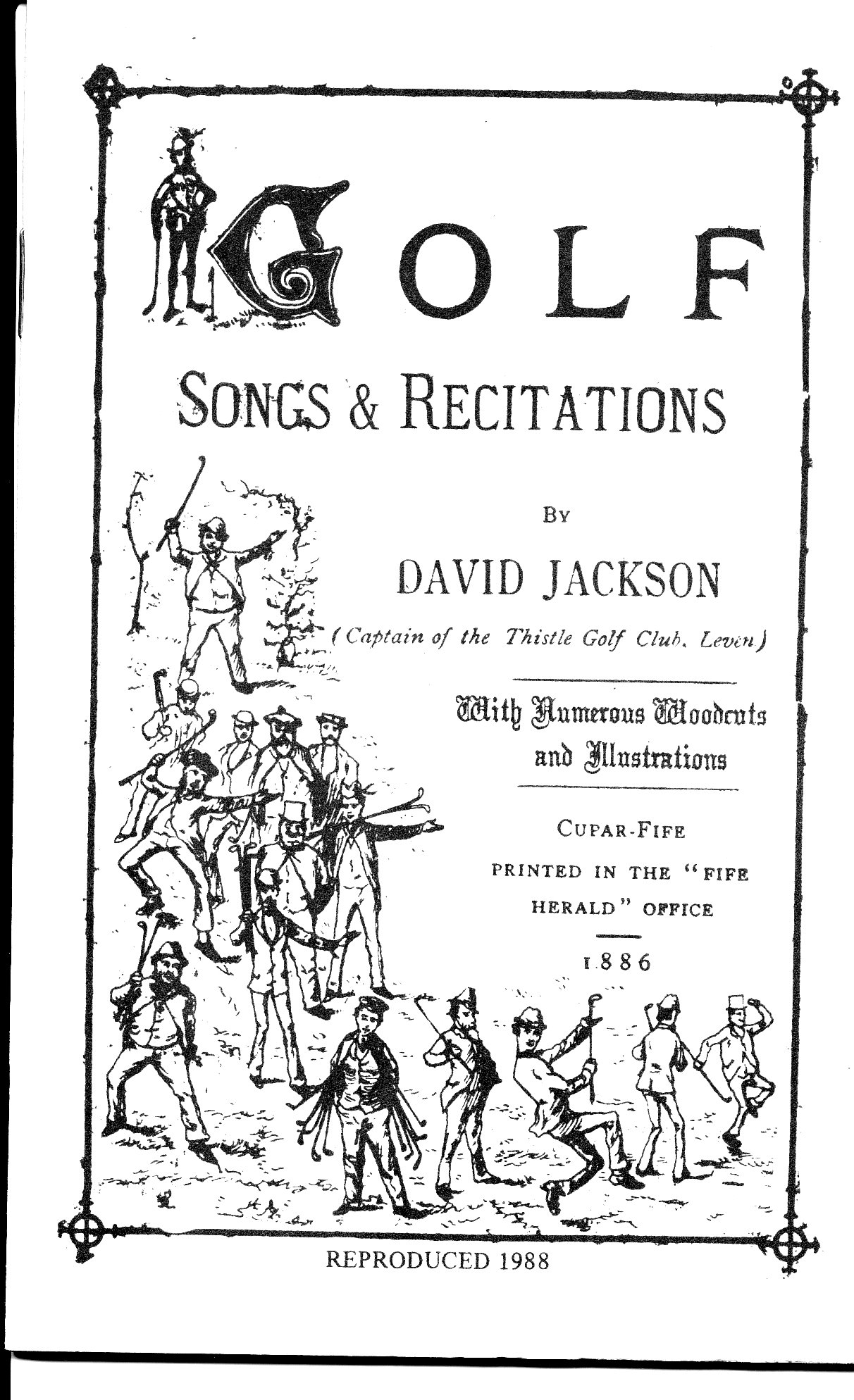
Last November I wrote a Post that included a poem from the Captain of the Thistle Golf Club, David Jackson. The poem came from a 32 page book called Golf Songs & Recitations published in 1886. In my November Post I said that the book was not available in any library. I have since learned that one copy exists in the library of the University of British Columbia. I managed to find a 1988 reproduction of the book.

I picked up Jackson’s book again recently and found a relatively short epic poem called “The Breaking O’ the Clubs.” The poem describes the tensions that golf created between a man and his wife in the 1880’s when golf was becoming more popular among the rank and file. In writing the poem, Jackson used some Scottish dialect which I have tried to translate using Internet sources. The poem is interesting both for its lively content and its “happy” ending.

THE BREAKING O’ THE CLUBS

Ae nicht (One night) I had a round at Gouff wi’ my cronies, Bob and Tam,
When we were through, to weet our mou’, some ane (one) proposed a dram;
Sae down we sat, and had a chat about our Drives and Putting—
Wi’ (with) joke and sang, it wisna lang till it was time for shutting.
Then hame I goes on my tiptoes, but ah! the wife was waken.
“The morn,” she cries, “afore ye rise, I’ll ha’e yer Clubs a’ (all) broken;
Ye gang tae (go to) Gouff, it’s a’ your houff, and then ye maun (must) be drinking,
Some morning when ye canna rise, ye’ll get the sack, I’m thinking;
Whaur wull you be, the bairns (children) and me—oh, man, ye should think shame,
If I should rise and break yer Clubs, I woudna be to blame.”
To bed I sprung, and held my tongue, thinks I before the morrie,
For a’ this lung and words high-strung she surely will be sorry.

When morning dawned, I wakened, yawned, was pulling on a stockin’,
When horrors, a’! what was I saw – my Clubs and Cleeks a’ broken.
As guid (good) a Club as e’er was swung, I won at last Spring Meetin’,
My driving Cleek, my lofting Iron, a’ tools that ne’er were beaten,
How aft I’ve praised their style o’ mak’, and rubbed wi’ oil their handle,
It’s quite enough to drive me mad, and raise a perfit scandal.
I fumed and swore, and loud did roar, and kicked up such a shindy
The neebors gathered round the door, and some glowered through the window.

“Shall I give up the Gouff for this, and frae (from) my Clubmates sever,
I tell ye plainly to yer face ye needna think it—never;
Fareweel to a’, for I’m awa, my peace wi’ you is ended,
Unless ye gang (go) this very day, and get thae Clubs a’ mended.”
I left the house in awful scorn, their cries to come back spurning,
My heart wi’ grief and anger torn, my brain wi’ rage near turning.
That was a dull and dreary day, to breathe seemed quite a labour,
I coudna sing a lilt, or say a word to my next neebor.
When I came hame frae wark that night, my heart a’ wives reviling
Wha’s (Whose) was the first that met my sicht—my ain (own) and she was smiling.
“Oh, come awa, I’m awfu’ glad that this long day is ended,
For I ha’e been at Patrick’s, lad, and got yer Clubs a’ mended;
And there’s a Club I bought for you – he said ’twas special made, man,
The wale (choice) o’ wud, a powerfu’ shaft, and bonnie driving head, man.
Forgi’e me noo.” “I will, my doo.” And bright her face did shine;
And ever since ye coudna ha’e a better wife than mine.

Though somewhat over the top, this story is probably representative of male golfers’ attitudes in the 1880’s.

post

“Just step up and give it a swat”

Golf tips have become ubiquitous. Pick up a golf magazine, turn on the golf Channel, or check your favorite golf Internet sites and you are likely to be offered lots of concisely packaged ideas to improve your game. This observation led me to Tweet the following two liner a few months ago:

Golf Tip Twine

A thousand tips from Jan to December,
But when you need one, will you remember?

I do not deny that tips are seductive. But they are also often conflicting or incomplete. Sometimes they solve one problem only to create another. They are most similar to whispered betting advice, leading possibly to a few winners, but not many.

When I began playing golf, I benefited from hours of golf instruction given by PGA professionals. From there I went on to study, practice and swear. And now, many years later as a senior golfer, I just try to remember a few fundamentals as I play. At least for me, golf has become more of a game to be enjoyed and less of an application of lessons learned and tips remembered.  In short, the pressure is off.

An anonymous poet, whose poem “The Reason” in included in Lyrics of the Links (1921) by Henry Litchfield West, seems to agree with me.

The Reason

“You are old, Father William,” the young man said,
“And your swing has become very flat,
And yet you incessantly lay the ball dead.
Pray what is the reason for that?”

“In my youth,” Father William replied, “it is that
I studied and practised and swore;
But now I just step up and give it a swat—
What reason for anything more?”

post

Haskell on the Brain

The golf ball has gone through relatively few fundamental changes in the last 460 years. The first ball to be documented was wooden and was played in 1550. The feather golf ball, or “featherie” was introduced in 1618. In 1848, the Gutta Percha ball or “Guttie,” made from the rubber like sap of the Gutta tree began to be played at St. Andrews and then more widely. In 1898, Coburn Haskell introduced the one-piece rubber cored ball. By 1901 it was universally accepted. Finally in 1972 Spalding began selling the first two-piece ball, the Executive, which was the first basic improvement on Haskell’s design. Now it seems like there is a new and better ball every week, leading to the Twine:

If last week’s ball by this week’s is outdone,
We’ll soon be reaching every green in one!

Getting back to the fundamental progression in golf ball technology, the early changes at least led to conflict and controversy. The change from featherie to guttie, caused a split between Allan Robertson and Tom Morris. Morris who worked making featheries in Robertson’s shop, played a guttie one day. When Robertson got word that Morris was playing the new ball, he fired him.

The Haskell was the first new ball to be made in America. And this caused at least one British golf poet to write some verses in protest. The poem as it appeared in the magazine Punch in November 1902 is as follows:

A GROWL FROM GOLFLAND

Bores there are of various species, of the platform, of the quill,
Bores obsessed by Christian Science or the Education Bill,
But the most exasperating and intolerable bore
Is the man who talks of nothing but the latest “rubber core.”

Place him in the Great Sahara, plant him on an Arctic floe,
Or a desert island, fifteen thousand miles from Westward Ho!
Pick him up a twelvemonth later, and I’ll wager that you find
Rubber filling versus gutty still and solely on his mind.

O American invaders, I accept your beef, your boots,
Your historical romances, and your Californian fruits;
But in tones of humble protest I am tempted to exclaim,
“Can’t you draw the line at commerce, can’t you spare one British game?”

I am but a simple duffer; I am quite prepared to state
That my lowest round on record was a paltry 88;
That my partner in a foursome needs the patience of a Job,
That in moments of excitement I am apt to miss the globe.

With my brassy and my putter I am very far to seek,
Generally slice to cover with my iron and my cleek;
But I boast a single virtue: I can honestly maintain
I’ve escaped the fatal fever known as Haskell on the brain.

post

After a Foozle, Remember…

There are lots of things to remember when playing a round of golf. Maybe the most important is that golf is a game in which you must only pretend seriousness. It is not an easy lesson to learn. And yet we all want to play as well as we can. So we are forever trying to bring to mind the right tip or the right thought at the right time.

I wrote a Twine (a two line golf poem for Twitter) a while ago that dealt with some of this,

Ubiquitous Golf Instruction Twine: A thousand tips from Jan to December/ But when you need one, will you remember?

As my golf has improved over the years, I try to think less, relying more on ingrained basics. Yet there are a few maxims that I do keep in mind. One is embodied in the following four lines:

Remember

When a golf shot turns out wrong,
The foozle leaves you feeling low.
That’s the time to recall the line:
Don’t hit two bad shots in a row.

LSW

post

‘Now, mind, keep your e’e on the ba’

The following appears in a description of the book A DUFFER’S HANDBOOK OF GOLF by Grantland Rice and Clare Briggs, on the Classics of Golf website.

There is no doubt “duffer” is a pejorative term. While the word’s origin is unknown, it appears in the 1800s as slang for an incompetent, ineffectual, or clumsy person. What better word to describe a neophyte attempting golf? The first “wave” of new golfers occurred when the gutta percha ball became available in the 1850s. Its lower cost and superior durability enticed many citizens to gather a few clubs and try their hand at the sport, some woefully ignorant of the rudiments of the game. “Duffer” first appears in the golf lexicon in 1875 in Clark’s Golf: A Royal and Ancient Game, in a poem by “Two Long Spoons.”

The poem was titled “Duffers Yet,” and was written by Lord Stormonth Darling (1844-1912), a judge, a Scottish Member of Parliament for Edinburgh and St Andrews Universities from 1888 to 1890, and also a golfer. Lord Darling wrote other golf related songs and verses including one called “Keep Your E’e on the Ba’.” It is subtitled, “Ballad of the Beginner,” and tells the story of when on Musselboro’s “famous old green,” Lord Darling, then no doubt a duffer, first “sought for the key to the game.”

The caddie that fell to my lot
Was old, hard of hearing, and wise;
His face had a hue that was not
Entirely the work of the skies:
He knew how the young player tries
To remember each tip all at once,
And, forgetting the vital one, sighs,
And despairs of himself as a dunce.

So, deep in his mind he had set
A rule that pervades all the rest;
‘Tis the maxim you ne’er can forget,
If you w’sh in you game to be blest:
‘Tis the greatest, the first, and the best,
The beginning and end of golf-law;
And ‘twas thus by my caddie expressed ─
‘Now, mind, keep your e’e on the ba’.’

Darling, not satisfied that he had a complete answer, asked other questions. Was he standing properly? What about his grip? Should he worry about the bunker ahead?

To each query the answer I got
Was that rigid, inflexible saw
(Of deafness and wisdom begot),
‘Now, mind, keep your e’e on the ba’.’

Lord Darling concludes,

Whate’er be the mark to be hit,
This truth from the caddie I draw ─
In life, as in golf, you’ll be fit
If you aye keep your e’e on the ba’

Although written more than a hundred years ago, Lord Darling’s words of advice are hard to improve upon!

post

The Language of Golf

The Foreword to Peter Davies’ impressive book The Historical Dictionary of Golfing Terms  − From 1500 to the Present begins:

No game has a richer array of terms than golf. Five hundred years of golfing have built up an extraordinary vocabulary.

Mr. Davies goes on to say,

…before 1850 when the Scots had the game to themselves: bunker, caddie, divot, links, putt, stance, stymie and tee [were] purely Scottish words…

Robert K. Risk, a Scottish writer, poet and golfer in his book Songs of the Links, first published in 1919, identifies a presumably non-Scottish writer who,

…in a magazine alleges that the terminology of golf is peculiarly repulsive, and instances “top,” “foozle,” “tee,” “stymie,” “divot,” and “bunker,” as the cacophonous offspring of a degraded invention.

Risk responded with “A Protest,”

A PROTEST

Imprimis, I would here protest
That any who mislikes our phrases,
Our stymies, foozles, and the rest
May, go, for all I care, to blazes,
Or any more select location
Where golf terms cannot cause vexation;

Secundo, when he sets his hand
Upon so sweet a bloom as stymie,
I’d have him clearly understand
Few words so keenly gratify me;
Stymie—it pleases me to say it
Almost as much as when I lay it.

Stymie—dear word most musical:
And what man will deny that putter,
Pronounced without a “t” at all,
Is smoother far than melted butter;
And when its “t’s” are forced to duty
Putter has still a poignant beauty.

And as for foozle—what could be
More deftly onomatopoeic?
Hearing the word, assuredly
Even one who knew not Golf, would see quick
Anger, futility, despair
As of a man who beats the air.

And divot—any duffer knows—
Is the by-product of a foozle:
When to a sounder game he grows,
And pitching-clubs cease to bamboozle,
Divot, when it is cut or said
Means a half-iron shot laid dead.

And what about those minor games—
Billiards and tennis, football, cricket—
Could one invent much uglier names
Than pot and screw and lob and wicket,
Off-side and deuce and maul and sett?
More loathly words I’ve never met.

Therefore, when in a magazine,
A writer airs such views as these,
I diagnose a touch of spleen
Or failure absolute to please
The Goddess who demands our duty—
Great are Golfina’s works and ways,
And passing sweet her every phrase,
And all her words are words of beauty.