post

The Origin of The Royal and Ancient Game of Golf

image0-4

With the site of the British Open at Turnberry in Scotland next month, it’s an appropriate time to review what is known about golf’s beginnings.

We know that the earliest written reference to golf in Scotland was in the famous Act of Parliament of 1457. We know as well, as Robert Browning writes in his book A History of Golf (1955), that

“from the Peace of Glasgow in 1502 to the Revolution of 1688, every reigning monarch of the Stuart line — two kings and one queen of Scotland, four kings of the United Kingdom — was a golfer.”

It’s not called “The Royal and Ancient Game of Golf” for nothing!

But what of golf’s actual origin, its “big bang?” Sir Walter G. Simpson in his book The Art of Golf, published in 1887, suggests the following “two shepherds theory:”

“A shepherd tending his sheep would often chance upon a round pebble, and having his crook in his hand, he would strike it away…On pastures green this led to nothing : but one on a time (probably) a shepherd, feeding his sheep on a links—perhaps those of St. Andrews—rolled one of these stones into a rabbit scrape. “

The shepherd then hailed another who attempts to duplicate the feat, but fails. They then deepen the rabbit scrape and begin practicing. Simpson continues, [Read more…]

post

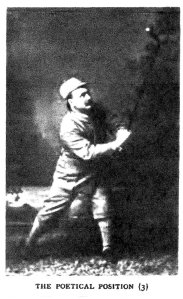
Golf Instruction With Illustrated Poetical Positions!

image0-1image0

image0-2

FORE

Fore, lads! Keep out o’ the line o’ fire,
And I’ll teach ye to drive a ba’,
That’ll flee to the clud, and fa’ wi’ a thud,
Twa hundred yards awa’.

Ye maunna (must not) be stridin’ your legs ower wide,
Like a puddock (frog), across the green,
Nor be haudin’ your elbows pinned to your side,
And lettin’ your nails be seen.

And dinna be bendin’ your chin to your knees,
At an angle o’ forty-five,
Nor wrigglin’, as if ye were treadin’ on peas:
Keep your energy a’ for your drive.

Fix your e’e on the gutta, stride fair, feet square,
Elbows free, gie (give) your back a bit thraw (a small turn)
Heel up; swing your club round the nape o’ your neck,
Whish, click, and the ba’s awa’!

The above, in a slightly different format, appears on page 503 of the Rev. John Kerr’s The Golf-Book of East Lothian published in Edinburgh in 1896. This is clearly an early example of illustrated golf instruction so common in today’s golf magazines and instruction books. But it is surely unique in its description of the three “poetical” positions. The poet was A. P. Aitken, D. Sc., lecturer on Agricultural Chemistry at the U. of Edinburgh and member of the Gullane Golfers, an East Lothian golf club formed in 1868.

Kerr’s book was the first to be written about a golfing area or club. Decent first edition copies are rare, often selling for well over $1000 when available. Joseph Murdoch points out in his book, The Library of Golf 1743-1966, that the first action pictures (not posed) appeared in How to Play Golf by H. J. Whigham published in Chicago in 1897.

post

Longer Drives – Can a Poem Help?

club-or-ball1

In 1680 John Patersone, an Edinburgh shoemaker, partnered with the Duke of York (later King James II of England) to win the first international golf match. The following year Patersone built a house in the Cannongate of Edinburgh and on the front he affixed a plaque (supplied by the Duke) that read “Far and Sure.” And so began the focus on distance and accuracy.

[Read more…]

post

The Golf Girl – 1899 Version

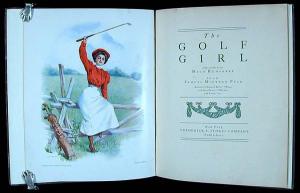
The Golf Girl from PBA Catalogue

The Golf Girl from PBA Catalogue

The first “golf girl” may have been Mary, Queen of Scots. Mary was born in Scotland in 1542 and is said to have played golf as a teenager in France. She definitely played when she returned to Scotland. The ill-fated Queen is remembered best for showing bad form when at age 27 she was seen playing “in the fields beside Seton” a few days after the murder of her second husband, Lord Darnley.

Unfortunately, in1586, after a long period of “match play” with her cousin, Queen Elizabeth I, Mary lost her head! A rather poor start for women’s golf.

Women’s golf, however, does carry at least one historical literary distinction. [Read more…]

post

Where Have All My Good Drives Gone?

where-have-all1

From the Minute Books of the Bruntsfield Links Golf Club:

“Bruntsfield Links, 28th Sep. 1839

During the evening the Secretary sang the following impromptu:—

Come, all you Golfers stout and strong,
Who putt so sure and drive so long,
And I will sing you a good song,
About old Captain Aitken.”

I will spare you the remaining verses.

The Scottish and English Golf Clubs have always included songs in their rituals. For example a song called “The Golfer’s Garland” included in Robert Clark’s book, Golf: A Royal and Ancient Game, was said to be “composed for the Blackheath Golf Club, and often sung with great spirit …” Clark includes other songs in his book.

These golfing songs were often poems that where written to be sung using the melodies of familiar tunes. With that in mind, I penned the following song to be sung to the tune “Where have all the flowers gone?,” in hopes of continuing the tradition at some existing golf club. Those of you who remember the tune are encouraged to sing along. [Read more…]

post

“When Travis Played the President”


President Taft

President Taft

As we welcome a new golfer-President, it should be remembered that William Howard Taft, our first true golfing President, became the 27th leader of our country March 4, 1909, one hundred years ago. Taft began playing golf in 1896 and was the first President of the Cincinnati Golf Club before going to Washington. While President of the United States, Taft often played golf with Walter J. Travis, founder of the magazine “The American Golfer” and for many years a very fine amateur golfer.

This is how Travis, in the June 1909 issue of his magazine, described the play of Taft,

“If the President will pardon me, I do not really think he would have much chance of qualifying in one of our amateur championships, but for all that he plays a very sound game, one free from bad faults of any kind … far better than the average ‘duffer,’ both in style and results.”

Travis goes on to write that, “Taft, in his modesty, some little time ago described his game as being of the bumble-puppy order.” Travis disagreed saying that the President “has nothing to ‘unlearn’ or correct and needs only some steady practice to develop a strong game.” Don’t we all!

Travis and Taft were sometimes partners in four-ball and best-ball matches. Apparently they played matches against each other as well. In fact, they were immortalized as being opponents in a poem called “A New Ballad of Chevy Chase,” by a poet who signed with only his initials “J McC T.” The poem also appeared in the June 1909 issue of “The American Golfer.” [Read more…]

post

“The Apple-faced Sage” and Two Enduring Swing Principles

In an earlier post, I included several stanzas from a poem by  Lord Darling called “Keep Your E’e on the Ba’.” While Darling limited his advice to a few lines of verse, Horace Hutchinson (1859-1932), 15 years Darling’s junior, published the first popular book of golf instruction, Hints on Golf in 1886. The book is described on the Classics of Golf website as “The first mass-produced instruction book in the history of golf, the 14 editions of this book are credited with popularizing the written word as a viable means of teaching.” In the Classic of Golf edition, Hutchinson is described as “undoubtedly the first Englishman to become an important figure in the game of golf,” by Herbert Warren Wind, American’s greatest golf writer.Besides being first, Hints on Golf may be the only instruction book ever to employ verse to emphasize important swing principles. Hutchinson writes,

HH 1903

Horace Hutchinson 1903

“The head must necessarily be steady, for it is most important that you should keep your eye fixedly on the ball from the moment that the club -head is lifted from the ground until the ball is actually struck. [Then following Darling} ‘Keep your eye on the ball,’ should be your companion text to ‘Slow Back.’ A golfing poet writes of

The apple-faced sage, with his nostrum for all,
‘Dinna hurry the swing! keep your e’e on the ball!'”

Next time you step up to the tee you might startle the members of your group by reciting the words of “The apple-faced sage”as part of your pre-shot routine!

But two questions remain: Who was this Scottish mentor? And who was the “golfing poet” who immortalized his versified advice? With the help of Google I can report the following: [Read more…]

post

The Language of Match Play in 1504

The poem below, from a book called Lyrics of the Links compiled by Henry Litchfield West and published in 1921, ends with a clever play on words. However, to appreciate the poet’s skill requires an understanding of the language of match play scoring. By way of reference, according to Robert Browning, a noted golf historian, stroke play began in 1759. The first match play of record was between King James IV and the “Erle” of Bothuile on Feburary 3, 1504, about 605 years ago! [Read more…]

post

The Importance of Golf – A Sentimental View from the Past

A hundred years ago, golf was a game to embrace for its personal challenges, competitive qualities and unique history. It was not yet a big time professional sport. Nor was it a huge business dependent on tour sponsors, equipment sales and resort travel. It was just golf played for enjoyment, “for [its] vigor without violence, for life-long joy of youth.” The relationship of the average golfer to golf was straight forward. He was a duffer trying to improve without much help from his golf clubs or the few sources of instruction then available. Golf poetry at that time provided an interesting window into the minds of ardent golfers. [Read more…]

post

Welcome to Golf Course of Rhymes

Golf’s long and colorful history is well documented. It origins, however have always been uncertain. Sir Walter Simpson, an early golf historian, writes in The Art of Golf, published in 1887, that golf at St. Andrews probably began when a shepherd idly hit a stone into a hole with his crook. An anonymous nineteenth century poet gives us a charming poetic version of this apocryphal story. [Read more…]