As those of you who have been following this blog know, one of my primary purposes is to introduce today’s golfers to some golf history that has gotten lost over time — the links that existed between golf and poetry. Thanks to Michael Whitmer, the Boston Globe golf writer and Suzanne Kreiter, an award-winning Globe photographer, I am getting some help. Take a look at http://www.boston.com/sports/golf/articles/2009/04/16/taking_a_shine_to_the_rhyme/ And I did make that chip!

Another Golf Season Begins
April 13, 2009 by 2 Comments

Poems don’t need to be long to be moving. In fact, often the brevity of a poem is what gives it impact. But good short poems are not like short putts; they are not that easy to make.
Last week The Masters officially ushered in spring for those of us who live where the seasons still exist. The pictures of Augusta National on television almost called for a poem. Four lines by Joyce Kilmer, with one obvious change, might fill the bill. (Kilmer is most famous for his poem “Trees.”)
Longer Drives – Can a Poem Help?
April 6, 2009 by Leave a Comment

In 1680 John Patersone, an Edinburgh shoemaker, partnered with the Duke of York (later King James II of England) to win the first international golf match. The following year Patersone built a house in the Cannongate of Edinburgh and on the front he affixed a plaque (supplied by the Duke) that read “Far and Sure.” And so began the focus on distance and accuracy.
The Golf Girl – 1899 Version
March 30, 2009 by 1 Comment
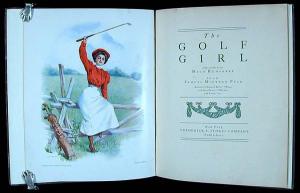
The Golf Girl from PBA Catalogue
The first “golf girl” may have been Mary, Queen of Scots. Mary was born in Scotland in 1542 and is said to have played golf as a teenager in France. She definitely played when she returned to Scotland. The ill-fated Queen is remembered best for showing bad form when at age 27 she was seen playing “in the fields beside Seton” a few days after the murder of her second husband, Lord Darnley.
Unfortunately, in1586, after a long period of “match play” with her cousin, Queen Elizabeth I, Mary lost her head! A rather poor start for women’s golf.
Women’s golf, however, does carry at least one historical literary distinction. [Read more…]
Where Have All My Good Drives Gone?
March 23, 2009 by Leave a Comment

From the Minute Books of the Bruntsfield Links Golf Club:
“Bruntsfield Links, 28th Sep. 1839
During the evening the Secretary sang the following impromptu:—
Come, all you Golfers stout and strong,
Who putt so sure and drive so long,
And I will sing you a good song,
About old Captain Aitken.”
I will spare you the remaining verses.
The Scottish and English Golf Clubs have always included songs in their rituals. For example a song called “The Golfer’s Garland” included in Robert Clark’s book, Golf: A Royal and Ancient Game, was said to be “composed for the Blackheath Golf Club, and often sung with great spirit …” Clark includes other songs in his book.
These golfing songs were often poems that where written to be sung using the melodies of familiar tunes. With that in mind, I penned the following song to be sung to the tune “Where have all the flowers gone?,” in hopes of continuing the tradition at some existing golf club. Those of you who remember the tune are encouraged to sing along. [Read more…]
The Poetry of Match Play
March 16, 2009 by Leave a Comment
The following is the one of the closest links between golf and poetry that I have ever found. The story and poem appeared in the November 1913 issue of The American Golfer.
“Two Californians, Dr. Walter S. Power and Mr. Mark Sibley Severance, “a well known author and an ardent golfer” finished a match all even. The following day Dr. Power sent Mr. Severance a challenge “couched in a rather indifferent rhyme.” Here is Mr. Severance’s reply. [Read more…]
A Poet’s Approach to Fixing a Slice
March 9, 2009 by 1 Comment

When you look up “slice swing,” Google provides 1,540,000 results! But, then, the number of slicers is still far larger. So this Post is aimed, sympathetically, at all of you who seek to straighten out your swings.
The truth is that golfers have always been frustrated with balls that veered sharply right (for a right-hander). And instruction books from the beginning have tried to help duffers find a cure. Take, for example, the famous book The Badminton Library: Golf, written and edited by Horace G. Hutchinson and first published in 1890. In a chapter titled “Out of Form,” Sir Walter Simpson, member and once captain of The Honourable Company of Edinburgh Golfers, writes,
“Whether in the case of a beginner or an old player, the ball when driven has a great tendency to curve off to the right. There is perhaps nothing more difficult to get rid of than this form of bad driving. … It is very evident that to enable him to correct the result the player must know what is its cause or combination of causes.” [Read more…]
Golf Ball Poetry
March 1, 2009 by 9 Comments
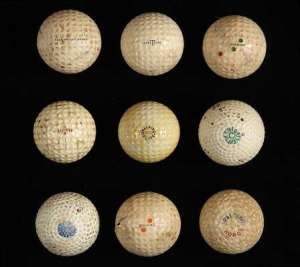
Spalding Balls from a PBA Galleries Auction
If you think that selecting a golf ball is complicated in today’s market with multiple brands each with several balls, then consider what one company, A. G. Spalding & Bros., was offering in 1914. A Spalding advertisement in the September 1914 issue of Golf magazine (from the USGA’s Seagle library) offered readers “Large size balls,” either “light weight” or “heavy weight;” “Medium size balls,” again light or heavy weight; or “Small size balls,” this time “medium weight” or heavy. Each ball was designed for a particular group of players. For example, the small heavy ball was for “extreme distance…and for long players particularly,” the medium light ball was for “ladies and light hitters…,” while the large light ball was for “moderate hitters….” [Read more…]
Who Wrote Harry Vardon’s Poetry?
February 15, 2009 by 1 Comment
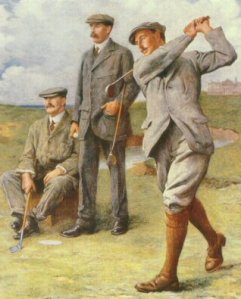
Taylor, Braid and Vardon
The “Foreign Notes” section of the March 1917 issue of The American Golfer includes an unexpected connection between several famous English golfers, the First World War and golf poetry. The British correspondent to the magazine, Henry Leach, wrote that four of England’s greatest golfers, Harry Vardon, J. H. (John Henry) Taylor, James Braid, and Alexander Herd (who beat Vardon and Braid to win the 1902 British Open championship), were asked to write four line poems that as a group would be “disposed of in the way of a lottery for the benefit of one of the war funds.” The poems were written, framed and delivered to the Mid-Surrey Golf Club where the lottery took place.
During a 21 year period, from 1894 to 1914, one or another of these four golfers won the Open a total of 17 times, Vardon six, Taylor and Braid each five, and Herd once. However, as golfer-poets, none of the four would have made the cut.
But Vardon’s poem proves interesting in a different way. [Read more…]
“When Travis Played the President”
February 9, 2009 by 3 Comments

President Taft
As we welcome a new golfer-President, it should be remembered that William Howard Taft, our first true golfing President, became the 27th leader of our country March 4, 1909, one hundred years ago. Taft began playing golf in 1896 and was the first President of the Cincinnati Golf Club before going to Washington. While President of the United States, Taft often played golf with Walter J. Travis, founder of the magazine “The American Golfer” and for many years a very fine amateur golfer.
This is how Travis, in the June 1909 issue of his magazine, described the play of Taft,
“If the President will pardon me, I do not really think he would have much chance of qualifying in one of our amateur championships, but for all that he plays a very sound game, one free from bad faults of any kind … far better than the average ‘duffer,’ both in style and results.”
Travis goes on to write that, “Taft, in his modesty, some little time ago described his game as being of the bumble-puppy order.” Travis disagreed saying that the President “has nothing to ‘unlearn’ or correct and needs only some steady practice to develop a strong game.” Don’t we all!
Travis and Taft were sometimes partners in four-ball and best-ball matches. Apparently they played matches against each other as well. In fact, they were immortalized as being opponents in a poem called “A New Ballad of Chevy Chase,” by a poet who signed with only his initials “J McC T.” The poem also appeared in the June 1909 issue of “The American Golfer.” [Read more…]

 Golf Course of Rhymes
Recent Comments