post

A Poet’s Approach to Fixing a Slice

golf-slice

When you look up “slice swing,” Google provides 1,540,000 results! But, then, the number of slicers is still far larger. So this Post is aimed, sympathetically, at all of you who seek to straighten out your swings.

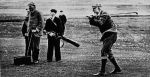
The truth is that golfers have always been frustrated with balls that veered sharply right (for a right-hander). And instruction books from the beginning have tried to help duffers find a cure. Take, for example, the famous book The Badminton Library: Golf, written and edited by Horace G. Hutchinson and first published in 1890. In a chapter titled “Out of Form,” Sir Walter Simpson, member and once captain of The Honourable Company of Edinburgh Golfers, writes,

“Whether in the case of a beginner or an old player, the ball when driven has a great tendency to curve off to the right. There is perhaps nothing more difficult to get rid of than this form of bad driving. … It is very evident that to enable him to correct the result the player must know what is its cause or combination of causes.” [Read more…]
post

Golf Ball Poetry

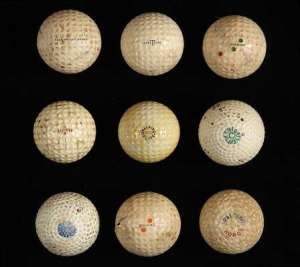
Spalding Balls from PBA Galleries Auction

Spalding Balls from a PBA Galleries Auction

If you think that selecting a golf ball is complicated in today’s market with multiple brands each with several balls, then consider what one company, A. G. Spalding & Bros., was offering in 1914. A Spalding advertisement in the September 1914 issue of Golf magazine (from the USGA’s Seagle library) offered readers “Large size balls,” either “light weight” or “heavy weight;” “Medium size balls,” again light or heavy weight; or “Small size balls,” this time “medium weight” or heavy. Each ball was designed for a particular group of players. For example, the small heavy ball was for “extreme distance…and for long players particularly,” the medium light ball was for “ladies and light hitters…,” while the large light ball was for “moderate hitters….” [Read more…]

post

“When Travis Played the President”


President Taft

President Taft

As we welcome a new golfer-President, it should be remembered that William Howard Taft, our first true golfing President, became the 27th leader of our country March 4, 1909, one hundred years ago. Taft began playing golf in 1896 and was the first President of the Cincinnati Golf Club before going to Washington. While President of the United States, Taft often played golf with Walter J. Travis, founder of the magazine “The American Golfer” and for many years a very fine amateur golfer.

This is how Travis, in the June 1909 issue of his magazine, described the play of Taft,

“If the President will pardon me, I do not really think he would have much chance of qualifying in one of our amateur championships, but for all that he plays a very sound game, one free from bad faults of any kind … far better than the average ‘duffer,’ both in style and results.”

Travis goes on to write that, “Taft, in his modesty, some little time ago described his game as being of the bumble-puppy order.” Travis disagreed saying that the President “has nothing to ‘unlearn’ or correct and needs only some steady practice to develop a strong game.” Don’t we all!

Travis and Taft were sometimes partners in four-ball and best-ball matches. Apparently they played matches against each other as well. In fact, they were immortalized as being opponents in a poem called “A New Ballad of Chevy Chase,” by a poet who signed with only his initials “J McC T.” The poem also appeared in the June 1909 issue of “The American Golfer.” [Read more…]

post

“The Apple-faced Sage” and Two Enduring Swing Principles

In an earlier post, I included several stanzas from a poem by  Lord Darling called “Keep Your E’e on the Ba’.” While Darling limited his advice to a few lines of verse, Horace Hutchinson (1859-1932), 15 years Darling’s junior, published the first popular book of golf instruction, Hints on Golf in 1886. The book is described on the Classics of Golf website as “The first mass-produced instruction book in the history of golf, the 14 editions of this book are credited with popularizing the written word as a viable means of teaching.” In the Classic of Golf edition, Hutchinson is described as “undoubtedly the first Englishman to become an important figure in the game of golf,” by Herbert Warren Wind, American’s greatest golf writer.Besides being first, Hints on Golf may be the only instruction book ever to employ verse to emphasize important swing principles. Hutchinson writes,

HH 1903

Horace Hutchinson 1903

“The head must necessarily be steady, for it is most important that you should keep your eye fixedly on the ball from the moment that the club -head is lifted from the ground until the ball is actually struck. [Then following Darling} ‘Keep your eye on the ball,’ should be your companion text to ‘Slow Back.’ A golfing poet writes of

The apple-faced sage, with his nostrum for all,
‘Dinna hurry the swing! keep your e’e on the ball!'”

Next time you step up to the tee you might startle the members of your group by reciting the words of “The apple-faced sage”as part of your pre-shot routine!

But two questions remain: Who was this Scottish mentor? And who was the “golfing poet” who immortalized his versified advice? With the help of Google I can report the following: [Read more…]

post

Willie Leith’s Records in Teaching Golf

Golf professionals today use a wide array of high tech and low tech gadgetry in their never-ending quest to help us improve every aspect of our games. Video replay, interactive DVD’s, shotmaking simulators, putting arcs, whippy drivers, impact balls and hundreds of other teaching and training aids all have their advocates.

So what did golf pros offer before this industry developed? [Read more…]

post

Welcome to Golf Course of Rhymes

Golf’s long and colorful history is well documented. It origins, however have always been uncertain. Sir Walter Simpson, an early golf historian, writes in The Art of Golf, published in 1887, that golf at St. Andrews probably began when a shepherd idly hit a stone into a hole with his crook. An anonymous nineteenth century poet gives us a charming poetic version of this apocryphal story. [Read more…]