post

The Straight Truth

“The Straight Truth” is straight forward. In simple words and exceedingly short lines, this rhyme of woe narrowly defines the duffer’s usual game. It is best read on a winter’s day, but only with reference to previous golfing adventures. Next season things will be different!

THE STRAIGHT TRUTH
(A Duffer’s Lament)

Off I
go
hopes too
high

Tee the
ball
let it
fly

Where it
lands
one of the
keys

In the
grass
not in the
trees

Good starts
help
to calm the
mind

Bad starts
cause
a menal
bind

Hybrids
now
crowd the
bag

Still fairway
shots
too often
lag

Sometimes
chips
turn out
fine

Then easy
putts
avoid the
line

Eighteen
holes
a challenge
vast

Flaws and
failings
show up
fast

Numbers
high
across the
card

Proof once
more
that golf is
hard.

Leon S. White
2/18/10

post

Sunday Golf

The New York Times headline read “Ban on Sunday Golf May Wreck A Club.” The date May 22, 1905. The story concerned membership loss at the North Valley Golf Club of Greenwich. Because it had been closed on Sundays since it began in 1900, 35 of its 50 members had resigned. The paper noted that “A resolution forbidding the use of the grounds Sunday was passed (in 1902) and several good churchmen joined, among them a clergyman.” But by 1905 the club was in dire straits.

In Scotland, in 1618, the official (royal) line, first voiced by King James VI, was that golf on the Sabbath was acceptable, so long as it was not during the times of service, because Sunday was the only day the great mass of people would have free to play. It was not a view shared by the Kirk [the Church of Scotland]. Indeed Sunday golf at St Andrews only began at all during the Second World War and is still not permitted on the Old Course, though this now has more to do with preserving the course rather than religious strictures.

From a Google search, it looks like today only a handful of golf courses in the U.S., Canada and Great Britain are still closed on Sundays.

A poem, “Sunday Golf,” in the August 1903 issue of “The Golfer” magazine provides a colorful perspective of an irreverent golf poet on Sunday play more than 100 years ago.

Sunday Golf

A Sabbath well spent brings a week of content,
And health for the work of tomorrow;
But a Sabbath profaned whatever be gained,
Is a certain forerunner of sorrow

***************************************

An excellent rule for the wise and the fool,
An object right worthy attainment;
But the point as you see, where we don’t quite agree,
Is the question, What is profanement?

When the Sabbath began, twas created for man,
In the Bible this clearly is stated;
But our Puritan throng think this must be all wrong,
The man was for the Sabbath created.

It makes a man smile that except for this isle,
There is nobody going to Heaven;
Yet, if some folks are right, ’tis the inference trite,
To which we’re remorselessly driven.

For you’ll nowhere else find people so strict of mind
In the matters of Sunday observance;
And an innocent game nowhere else meets with blame,
Or excites any social disturbance.

Then, aye, let us pray that there may come a day,
When the bitter dispute may be ended;
And Sunday employment in wholesale enjoyment,
Be no longer condemned but commended.

The poem was signed “Common Sense.”

post

A Poetic Response to the Rise of Medal Play in 1912

Controversies in golf are usually associated with change in the rules, equipment or form of play. Currently, the groove rule change is front and center. In early times, controversies arose when the switch began from the feathery to the gutta percha ball in 1848 and with the switch from hickory to steel shafts in the 1920’s. The R & A banned the Schenectady putter in 1911. This was the putter that Walter Travis used to become the first American to win the British Amateur Championship in 1904.

Golf controversies today are reported by the traditional media, newspapers and magazines, but also by the traditional media’s dot.com outlets and by the social media, blogs and tweets. The impact of Internet golf reporting has shifted the focus to reporting stories bit by bit in real time with immediate commentary by “followers.” The opportunities to place a hot story in its historical context and search for humorous and ironical dimensions are few. Twitter has trumped poetry as the means for story telling.

But, of course, this has not always been true. For example, in the early 20th century most amateur golf in Great Britain was played under the rules of match play. But the introduction of the score card and pencil stub made medal or stroke play scores easy to record. And by 1912 medal play was on the rise. Robert K. Risk, a Scottish poet and writer and a golf traditionalist, believed that match play defined golf and that this shift harmed the character of the game.

In voicing his opposition to the increase in medal play he was not limited to a time deadline or to 140 characters. Instead, he took his time and fashioned a poem of depth and imagination and biting wit. His poetical protest did not stem the tide of medal play, but does survive as an interesting contrast to how golf controversies are aired today.

“Medalitis,” Risk’s poem, was originally published in the English humor magazine Punch on October 2, 1912. Please be patient as you read it. If you have time, a second reading will help to fully enjoy Risk’s work.

Medalitis

In the full height and glory of the year,
When husbandmen are housing golden sheaves,
Before the jealous frost has come to shear
From the bright woodland its reluctant leaves,
I pass within a gateway, where the trees,
Tall, stately, multi-coloured, manifold,
Draw the eye on as to some Chersonese,
Spanning the pathway with their arch of gold.

A river sings and loiters through the grass,
Girdling a pleasance scythed and trimly shorn;
And here I watch men vanish and repass
To the last hour of eve from early morn;
Dryads peer out at them, and goat-foot Pan
Plays on his pipe to their unheeding ears;
They pass, like pilgrims in a caravan,
Towards some Mecca in the far-off years.

Blind to the woodland’s autumn livery,
Blind to the emerald pathway that they tread,
Deaf to the river’s low-pitched lullaby,
Their limbs are quick and yet their souls are dead;
Nothing to them the song of any bird,
For them in vain were horns of Elfland wound,
Blind, deaf and stockfish-mute; for,in a word,
They are engaged upon a Medal Round.

Making an anxious torment of a game
Whose humours now intrigue them not at all,
They chase the flying wraith of printed fame,
With card and pencil arithmetical;
With features pinched into a painful frown
Looming misfortunes they anticipate,
Or, as the fatal record is set down,
Brood darkly on a detrimental 8.

These are in thrall to Satan, who devised
Pencil and card to tempt weak men to sin,
Whereby their prowess might be advertised —
Say, 37 Out and 40 In;
Rarely does any victim break his chains
And from his nape the lethal burden doff —
The man with medal virus in his veins
Seldom outlives it and gets back to Golf.

post

Golf Poetry in a 1921 New York City Restaurant Ad

The American Golfer must have had a lot of New York City subscribers in 1921. Otherwise, why would the Rogers Restaurant (45th and 6th Ave, Tel. 2070 Bryant) have run an ad on page 29 of the March 26th edition? And why did the ad promote Rogers with a rhyme? We did see that Spalding ran an ad with poetry seven years earlier. And I have pointed out in previous Posts that poetry was included in most of the early issues of golf magazines.

So here is what the Rogers ad said.

You’ll never be doon
If ye’ll take yer spoon
When drinkin’ soup at Rogers
Na need to seek with mashie or cleek
Or the rest of yer artful dodgers
And I’m telling ye Mack
Yer lips ye’ll smack
At the grand food they’ll provide; er
Clams, yams, and Virginia hams
They’ll make ye a powerful driver.

The poem was signed “Sandy,” presumably Sandy Rogers. The poem/ad seems to be a poor attempt to speak in a Scottish dialect to the local golfers. But I can’t imagine that “clams, yams, and Virginia hams” brought many golfers to the door!

Historical Note: Near to Rogers, on 45th street, was the site of the Hesper Club, a gambling house run by Herman “Beansie” Rosenthal, a mobster who in 1912 blew the whistle on the extortion attempts of Lt. Charles Becker of the NYPD. Becker had Rosenthal killed in a notorious hit that sent Becker to the chair in 1915.

I’m not sure of the Hesper Club survived Rosenthal’s death or if Rosenthal had been a golfer. But I assume that by 1921 the neighborhood was a little safer.

post

The “Rubaiyat’s” Contribution to Golf Poetry

To write a parody of a poem, you would take the basic characteristics of the verse (for example, its rhyming scheme and basic idea) and then rework them for comic or ironic effect.

Now suppose that you are a young golfer and poet around the turn of the 20th century. Being literate, you are aware that Omar Khayyam’s poem, Rubaiyat, is being parodied left and right. So one day, after being around the golf course until early evening, you pick up a copy of the poem (it was easy to do then). Reading through the verses, you are struck by the stanza 27,

Myself when young did eagerly frequent
Doctor and Saint, and heard great Argument
.     About it and about;  but evermore
Came out by the same Door where in I went.

If your name was Henry Boynton, a graduate of Amherst with a Masters of Arts, then, looking at the stanza you might have thought about all the controversies regarding the fundamental of golf being discussed by golfers such as Jamie Anderson and Jamie Braid and all the other Jamies of the time. And this might have led you to write (as part of a book, The Golfer’s Rubaiyat),

Myself when young did eagerly frequent
Jamie and His, and heard great argument
.     Of Grip and Stance and Swing; but evermore
Found at the Exit but a Dollar spent.

Little did Boynton know, but he himself would be parodied by later golfing poets.

In the July 1910 issue of  The American Golfer, a poet named Jack Warbasse wrote,

Myself when young did eagerly frequent
Travis and Braid, and read great argument
.     About the Grip and Stance; but evermore
Play’d out by the same Stump where in I went.

And then in 1919, a Scottish writer, poet and drama critic Robert K. Risk published a book of collected poems, Songs of the Links, that included the poem “The Golfaiyat of Dufar Hy-Yam.” In that poem we have,

Myself when you did eagerly frequent,
Club-makers’ Shops, and heard great Argument
.     Of Grip and Stance and Swing; but evermore
Learned and Bought little I did not repent.

Finally, in 1946, J. A. Hammerton, a Scottish statesman and author, published a book, The Rubiayat of a Golfer, in which he wrote,

Myself when young would hopefully frequent
Where Pros and Plus Men had great argument
.     On Grips that overlapped, on Swing and Stance
But came away less hopeful than I went.

So what have we learned? First, that there are limits to the golfing parodies of stanza 27 of the Rubaiyat. And second, Instruction about grip, stance and swing has been confusing for a long time!

post

Links Between Golf and Life

Robert Chambers was a Scottish author, poet, journal editor and publisher, born in 1802. He was the anonymous author of the Vestiges of the Natural History of Creation, published in 1844  and described as bringing together,

“various ideas of stellar evolution and progressive transmutation of species governed by God-given laws in an accessible narrative which tied together numerous speculative scientific theories of the age. ” (from Wikipedia)

Chambers, who was also a golfer, wrote a number of other books including one titled, A Few Rambling Remarks on Golf. Also, he and his brother William for many years edited CHAMBER’S JOURNAL of POPULAR LITERATURE,L SCIENCE, AND ART. One entry in 1877 titled “The Royal Game of Golf” included the following,

The fascinations of the game have enlisted in the ranks of its votaries men of all classes, many of them famous on other fields, who have made their reminiscences of their beloved pursuit mediums for many a bright word-picture in prose and verse.

Robert Chambers was clearly one of these men.

Late in his life, Chambers moved to St. Andrews where he enjoyed a “luxurious and  ‘learned leisure.’ All task-work was at an end.” While living in the shadows of the Old Course, Chambers envisioned a series of “half-comic, half-moralizing sonnets, which were intended to be nine in number,” one for each of the first nine holes. He completed only three before he died in 1871. However, his son and a friend added the other six. The entire poem, “The Nine Holes of St. Andrews in a Series of Sonnets” can be found in Robert Clark’s book Golf: A Royal and Ancient Game. Below is the first hole sonnet written by Robert Chambers.

I. THE FIRST OR BRIDGE HOLE.

Sacred to hope and promise is the spot —
To  Philp’s and to the Union Parlour- near,
To every golfer, every caddie dear —
Where we strike off — oh, ne’er to be forgot.
Although in lands most distant we sojourn.
But not without its perils is the place ;
Mark the opposing caddie’s  sly grimace,
Whispering :”‘He’s on the road !”  “He’s in the burn !”

So is it often in the grander game
Of life, when, eager, hoping for the palm,
Breathing of honour, joy, and love, and fame,
Conscious of nothing like a doubt or qualm.
We start, and cry :  “Salute us, muse of fire !”
And the first footstep lands us in the mire.

[Philp was Hugh Philp a still famous club maker with a shop near the first hole and the Union Parlour was the clubhouse at the time.]

post

Lost Golf Balls

A recent story of the CNN website describes lost golf balls as “humanity’s signature litter.” The article begins,

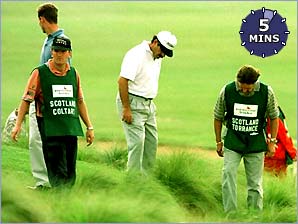
Research teams at the Danish Golf Union have discovered it takes between 100 to 1,000 years for a golf ball to decompose naturally. A startling fact when it is also estimated 300 million balls are lost or discarded in the United States alone, every year. It seems the simple plastic golf ball is increasingly becoming a major litter problem.

Some balls, of course, are recovered. Many are washed, repackaged and sold on eBay, or other sites such as lostgolfballs.com.

To help golfers find their lost balls, two nuclear scientists, apparently in their off hours, have invented ball-finding glasses. According to website, visiballusa.com,

Visiball Golf Ball Finding Glasses have become golf’s must have accessory, with more than 250,000 golfers saving time, money, strokes and frustration. Developed and patented by two nuclear scientists, Visiball Golf Ball Finding Glasses incorporate special optical filters that make white objects appear to glow.

But I’m most impressed with Natalie Rogers’ lament, titled “It’s a Shame,” that appeared in the March 1966 issue of Golf Magazine.

It’s a Shame

We live in an age of computers and space ships,
With daily a new guided missile,
But why doesn’t someone invent a golf ball
That will come from the woods when you whistle”

Now there’s a real challenge for those two nuclear scientists.


post

Twines — Two Line Golf Poems from Twitter

Last year I “joined” Twitter to publicize this Blog. I started by tweeting announcements of each new Post. But then I began thinking about golf poetry and Twitter. Since Tweets are limited to 140 characters, I concluded that Twitter poems would have to be short,  [Tw]o-l[ine] verses. Thus, the birth of the Twitter Twine.

So in early November, I started putting Golf Twines on Twitter from time to time. In case you missed some or all of them, here are the better ones (in my opinion):

Firs,t a Twine that describes the Blog:

Golf Course of Rhymes, where stories are told,
The prose mostly current, the poetry old.

A Twine about Michelle Wie tweeted just before she won her first LPGA tournament.

A Wie win,
Would be big.

And it was.

A Boston Twine that is even more meaningful with six inches of snow on the ground.

Golf and Winter, total frustration,
Unless you are living far south of South Station!

And here are a couple of Twines that I did not write.

From tee to green he may reap the crop —
But what’s the use when his putts won’t drop. (Grantland Rice)

There’s many a man now swinging a club,
Who ought to be mowing a lawn. (W. H. Webling)

And here are a few more that I wrote.

Had Tiger come clean before being hounded,
Could he have escaped without being pounded?

A loud guy riding and smoking a stogie,
Is not my first choice to beat Colonel Bogey.

If at first you don’t succeed,
Golf’s for you, it’s guaranteed!

Please consider a comment or a Golf Twine of your own below.

post

Golf Poetry for a Winter’s Day


Winter has arrived. We got about 10 inches of snow not long ago. It is melting now, but surely more is on the way. Also, in a few days, both the year and the decade end. It is definitely time to look back, time for retrospection.

Retrospection is, in fact, what W. Hastings Webling (1866 – 1946?), a Canadian writer and poet, wrote about in verses published in the magazine Golf in January 1915. Though he was only looking back to the last golf season, and though some of his words are dated, the sentiments he expresses still ring true.

I hope you will enjoy reading the poem even though it’s long. But if you fear a long poem as much as a short putt, at least read the first, second to last and last stanzas. And please feel free to share any thoughts you have about Webling’s poem or more generally about golf poetry.

RETROSPECTION

by Hastings Webling

The days are short, the winds are chill,
The turf has lost its verdant hue,
And those who played the good old game
Have slowly disappeared from view.
No longer may we watch the flight
Of golf balls as they gaily soar,
Or hear the chaff of merry wit,
Or echo of some lusty “Fore!”

Ah, well! we cannot all expect
To play the game from year to year;
To hike, like some, to southern climes
And play in balmy atmosphere.
‘Tis better so; for we can rest
And reminisce, while fancy free,
Recall the games of yesterday,
Defeats, and proud-won victory.

And we can sit around the fire
And dream of things we might have done;
Of matches that we thought a cinch
And cups that well might we have won;
And then those scores of “seventy eight,”
Only missed by some short putt,
It all will tend to stimulate
Our fond desire for future luck.

And as to “birdies”—well might I
Write of these in doleful tone;
For they have caused such deep distress
More than I would like to own.
Ah! oft I held them in my grasp
With joy to think how well they’d pay
When someone “holes a ten-foot putt”
And swift my “birdie” flies away.

But such is life, and so is golf,
The things we think so really sure;
The holes we count before they’re won
Are apt to give us one guess more.
But, after all, it is for this
We seek the prizes that may be,
And find the charm both in the game
And in its great uncertainty.

My boy! if skies were ever fair,
If winds should always favor you,
And all your “lies” were perfect “lies,”
And all your putts were straight and true—
If all your drives were far and sure,
Approaches on the green were “dead,”
The joy of combat would be lost
And vict’rys charm forever shed.

post

The Golfpoet’s Take on Tiger

This Post marks the beginning of the second year of Golf Course of Rhymes. I would like to thank all of my fellow bloggers who have made their readers aware of this site. And most of all I would like to thank all of my readers who have logged more than 17,000 page views in the first year. And who said, “Golf poetry?”

To begin year two, I offer a poetic parody on the golf story of the year. The original, “Casey at the Bat,” can be found at the Poetry Foundation site.

Tiger on the Mat
(With thanks and
apologies to Ernest
Lawrence Thayer)

The outlook isn’t brilliant for the Pro Golf Tour this year;
At least at the beginning, there’ll be one less pro to cheer.
No his name it isn’t Casey, but he’s known to be a swinger,
And his story much like Casey’s must be classed as one humdinger!

[Skipping the 10 stanzas that tell Tiger’s sad story which you already
know (or think you know), we move to the last eight lines.]

The smile is gone from Tiger’s face, his teeth banged up from hate,
Was he pounded with cruel violence, a club upon his plate?
And now his sponsors keep their cash as he has dropped the ball,
And now the golf world’s shattered by the length of Tiger’s fall.

Oh, somewhere on a golf course, the sun is shinning bright;
A foursome’s playing somewhere, and somewhere hearts are light,
And somewhere dubs are laughing, and somewhere “fore” is shouted;
But there is no joy in Vedra-ville – mighty Tiger has been outed.

by the Golfpoet (Leon S. White)