post

The “Rubaiyat’s” Contribution to Golf Poetry

To write a parody of a poem, you would take the basic characteristics of the verse (for example, its rhyming scheme and basic idea) and then rework them for comic or ironic effect.

Now suppose that you are a young golfer and poet around the turn of the 20th century. Being literate, you are aware that Omar Khayyam’s poem, Rubaiyat, is being parodied left and right. So one day, after being around the golf course until early evening, you pick up a copy of the poem (it was easy to do then). Reading through the verses, you are struck by the stanza 27,

Myself when young did eagerly frequent
Doctor and Saint, and heard great Argument
.     About it and about;  but evermore
Came out by the same Door where in I went.

If your name was Henry Boynton, a graduate of Amherst with a Masters of Arts, then, looking at the stanza you might have thought about all the controversies regarding the fundamental of golf being discussed by golfers such as Jamie Anderson and Jamie Braid and all the other Jamies of the time. And this might have led you to write (as part of a book, The Golfer’s Rubaiyat),

Myself when young did eagerly frequent
Jamie and His, and heard great argument
.     Of Grip and Stance and Swing; but evermore
Found at the Exit but a Dollar spent.

Little did Boynton know, but he himself would be parodied by later golfing poets.

In the July 1910 issue of  The American Golfer, a poet named Jack Warbasse wrote,

Myself when young did eagerly frequent
Travis and Braid, and read great argument
.     About the Grip and Stance; but evermore
Play’d out by the same Stump where in I went.

And then in 1919, a Scottish writer, poet and drama critic Robert K. Risk published a book of collected poems, Songs of the Links, that included the poem “The Golfaiyat of Dufar Hy-Yam.” In that poem we have,

Myself when you did eagerly frequent,
Club-makers’ Shops, and heard great Argument
.     Of Grip and Stance and Swing; but evermore
Learned and Bought little I did not repent.

Finally, in 1946, J. A. Hammerton, a Scottish statesman and author, published a book, The Rubiayat of a Golfer, in which he wrote,

Myself when young would hopefully frequent
Where Pros and Plus Men had great argument
.     On Grips that overlapped, on Swing and Stance
But came away less hopeful than I went.

So what have we learned? First, that there are limits to the golfing parodies of stanza 27 of the Rubaiyat. And second, Instruction about grip, stance and swing has been confusing for a long time!
post

Links Between Golf and Life

Robert Chambers was a Scottish author, poet, journal editor and publisher, born in 1802. He was the anonymous author of the Vestiges of the Natural History of Creation, published in 1844  and described as bringing together,

“various ideas of stellar evolution and progressive transmutation of species governed by God-given laws in an accessible narrative which tied together numerous speculative scientific theories of the age. ” (from Wikipedia)

Chambers, who was also a golfer, wrote a number of other books including one titled, A Few Rambling Remarks on Golf. Also, he and his brother William for many years edited CHAMBER’S JOURNAL of POPULAR LITERATURE,L SCIENCE, AND ART. One entry in 1877 titled “The Royal Game of Golf” included the following,

The fascinations of the game have enlisted in the ranks of its votaries men of all classes, many of them famous on other fields, who have made their reminiscences of their beloved pursuit mediums for many a bright word-picture in prose and verse.

Robert Chambers was clearly one of these men.

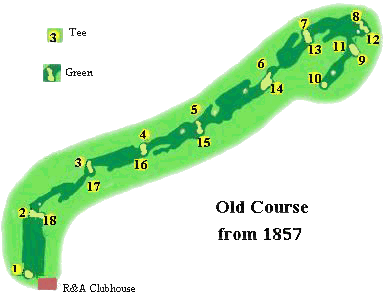
Late in his life, Chambers moved to St. Andrews where he enjoyed a “luxurious and  ‘learned leisure.’ All task-work was at an end.” While living in the shadows of the Old Course, Chambers envisioned a series of “half-comic, half-moralizing sonnets, which were intended to be nine in number,” one for each of the first nine holes. He completed only three before he died in 1871. However, his son and a friend added the other six. The entire poem, “The Nine Holes of St. Andrews in a Series of Sonnets” can be found in Robert Clark’s book Golf: A Royal and Ancient Game. Below is the first hole sonnet written by Robert Chambers.

I. THE FIRST OR BRIDGE HOLE.

Sacred to hope and promise is the spot —
To  Philp’s and to the Union Parlour- near,
To every golfer, every caddie dear —
Where we strike off — oh, ne’er to be forgot.
Although in lands most distant we sojourn.
But not without its perils is the place ;
Mark the opposing caddie’s  sly grimace,
Whispering :”‘He’s on the road !”  “He’s in the burn !”

So is it often in the grander game
Of life, when, eager, hoping for the palm,
Breathing of honour, joy, and love, and fame,
Conscious of nothing like a doubt or qualm.
We start, and cry :  “Salute us, muse of fire !”
And the first footstep lands us in the mire.

[Philp was Hugh Philp a still famous club maker with a shop near the first hole and the Union Parlour was the clubhouse at the time.]

post

Lost Golf Balls

A recent story of the CNN website describes lost golf balls as “humanity’s signature litter.” The article begins,

Research teams at the Danish Golf Union have discovered it takes between 100 to 1,000 years for a golf ball to decompose naturally. A startling fact when it is also estimated 300 million balls are lost or discarded in the United States alone, every year. It seems the simple plastic golf ball is increasingly becoming a major litter problem.

Some balls, of course, are recovered. Many are washed, repackaged and sold on eBay, or other sites such as lostgolfballs.com.

To help golfers find their lost balls, two nuclear scientists, apparently in their off hours, have invented ball-finding glasses. According to website, visiballusa.com,

Visiball Golf Ball Finding Glasses have become golf’s must have accessory, with more than 250,000 golfers saving time, money, strokes and frustration. Developed and patented by two nuclear scientists, Visiball Golf Ball Finding Glasses incorporate special optical filters that make white objects appear to glow.

But I’m most impressed with Natalie Rogers’ lament, titled “It’s a Shame,” that appeared in the March 1966 issue of Golf Magazine.

It’s a Shame

We live in an age of computers and space ships,
With daily a new guided missile,
But why doesn’t someone invent a golf ball
That will come from the woods when you whistle”

Now there’s a real challenge for those two nuclear scientists.


post

Twines — Two Line Golf Poems from Twitter

Last year I “joined” Twitter to publicize this Blog. I started by tweeting announcements of each new Post. But then I began thinking about golf poetry and Twitter. Since Tweets are limited to 140 characters, I concluded that Twitter poems would have to be short,  [Tw]o-l[ine] verses. Thus, the birth of the Twitter Twine.

So in early November, I started putting Golf Twines on Twitter from time to time. In case you missed some or all of them, here are the better ones (in my opinion):

Firs,t a Twine that describes the Blog:

Golf Course of Rhymes, where stories are told,
The prose mostly current, the poetry old.

A Twine about Michelle Wie tweeted just before she won her first LPGA tournament.

A Wie win,
Would be big.

And it was.

A Boston Twine that is even more meaningful with six inches of snow on the ground.

Golf and Winter, total frustration,
Unless you are living far south of South Station!

And here are a couple of Twines that I did not write.

From tee to green he may reap the crop —
But what’s the use when his putts won’t drop. (Grantland Rice)

There’s many a man now swinging a club,
Who ought to be mowing a lawn. (W. H. Webling)

And here are a few more that I wrote.

Had Tiger come clean before being hounded,
Could he have escaped without being pounded?

A loud guy riding and smoking a stogie,
Is not my first choice to beat Colonel Bogey.

If at first you don’t succeed,
Golf’s for you, it’s guaranteed!

Please consider a comment or a Golf Twine of your own below.

post

The Golfpoet’s Take on Tiger

This Post marks the beginning of the second year of Golf Course of Rhymes. I would like to thank all of my fellow bloggers who have made their readers aware of this site. And most of all I would like to thank all of my readers who have logged more than 17,000 page views in the first year. And who said, “Golf poetry?”

To begin year two, I offer a poetic parody on the golf story of the year. The original, “Casey at the Bat,” can be found at the Poetry Foundation site.

Tiger on the Mat
(With thanks and
apologies to Ernest
Lawrence Thayer)

The outlook isn’t brilliant for the Pro Golf Tour this year;
At least at the beginning, there’ll be one less pro to cheer.
No his name it isn’t Casey, but he’s known to be a swinger,
And his story much like Casey’s must be classed as one humdinger!

[Skipping the 10 stanzas that tell Tiger’s sad story which you already
know (or think you know), we move to the last eight lines.]

The smile is gone from Tiger’s face, his teeth banged up from hate,
Was he pounded with cruel violence, a club upon his plate?
And now his sponsors keep their cash as he has dropped the ball,
And now the golf world’s shattered by the length of Tiger’s fall.

Oh, somewhere on a golf course, the sun is shinning bright;
A foursome’s playing somewhere, and somewhere hearts are light,
And somewhere dubs are laughing, and somewhere “fore” is shouted;
But there is no joy in Vedra-ville – mighty Tiger has been outed.

by the Golfpoet (Leon S. White)

post

When Golf Poetry Matters

Jerome Travers, the great amateur golfer of the early 20th century, included a chapter called “‘First Aid’ to a golfer ‘Off his Game,'” in his book Travers’ Golf Book ( New York: The Macmillan Company, 1913). He began, “What a note of tragedy there is in those few words “the golfer is off his game.” Travers went on to write,

The golfer ‘off his game’ cannot drive, approach or putt, he doesn’t know what the matter is and he has completely lost confidence in himself.

Travers’ prose gives us a straight forward description of what it is to be off one’s game in golf. However, it takes a poet to get to the essence of the problem and its ramifications.

In a book called Humors and Emotions of Golf (1905), a poet known only by the initials (E.M.B.) tells us what it’s really like when “He’s off his game.”

He’s off his game.”

Like hollow echoes boding ill,
His heart is wild with tremors chill,
And whispers in a small voice still—
An admonition—ghostly—shrill—
.          “He’s off his game!”

His divots fly like night-bats doure;
His drives are never far and sure;
And bunkers, like Charybdis, lure
His erring ball to depths obscure;
.          “He’s off his game!”

In vain seem all the pro’s sage tips;
His little gutty always lips
Or over-runs the hole; then slips
That naughty D——I must ellipse,
.          He’s off his game!”

Thro’ distant whins and stubborn gorse
With grim expletives gaining force,
He plunges on his zig-zag course,
Until he sighs in deep remorse,
.          “I’m off my game!”

At home his brooding spirit shows
The weighty cares of hidden throes;
Too well his Golfing Widow knows
The anguish of her hubby’s woes—
.          “He’s off his game!”

Andrew Lang (1844-1912), a famous Scottish writer and poet as well as golfer, also wrote a poem of similar anguish called “Off my Game.” Could the agonies and frustrations of golf be fully described without poetry? I think not.

post

Golf Widows in Prose and Poetry (Continued)

GolfWidowColorTs600

The May 1920 issue of The American Golfer included an article with the title “Yes, I’m a Golf Widow.” It was written “By One of Them.” It begins,

It’s my lot to be the wife of a week-end golfer who from early April till late in November permits nothing to interfere with his weekly pleasure. …  I know he works hard during the week and deserves some pleasant recreation on Saturday and Sunday. He can’t get this by sticking around the house. I was first to discover that he needed something in the athletic line in the open air. I suggested golf to him and he finally got interested, but I am sorry now that I every heard the word.

In the April 1917 issue of The American Golfer, The Rev. John B. Kelly wrote an article with the title “The Moral Value of Golf” in which he counseled,

Let the golf widow not bemoan her lonesome fate, but be glad in her solitude. Her husband may be dead to her when he is embalmed in the allurements of golf, but he will be alive and strong to protect her many years after her neighbor is keeping her stay-at-home husband’s memory fresh in the immortelles she places on his grave.

Those are pretty strong words! James J. Montague, an American poet and writer, and  penned an equally strong message in his poem “Lines to a Golf Widow” which appeared in the November 1921 issue of the same magazine.

Lines to a Golf Widow

If you had said eight months ago
When January blizzards blew,
And all the greens were deep with snow,
That I must give up golf or you,
I might have stayed the fatal step,
I might before it was too late,
Have vowed that we should never sep-
Arate.

If, even in the early Spring,
When we were playing winter rules,
When mud flew thick on every swing,
And balls fell “chug!” in casual pools,
You’d been disposed to raise a row
And talked of leaving me again,
I might have listen to you now
And then.

Indeed along in mid July
When sultry blew the listless breeze,
And temperatures ran rather high—
Say ninety-two or -three degrees,
Had you the riot statute read
Till I agreed to quit, I might—
I can’t be sure—I might have said:
“All right!”

But now, when greens are hard and fast,
And fairways like an emerald floor,
When I have got the swing at last
And confidently bawl out “Fore!”
Your threat to part may be a bluff’
Or you may really pack and go,
But I shall not be home enough
To know !