post

“The Golfer’s Waggle” for Jason Dufner, PGA Champion and Champion Waggler

Jason Dufner

Jason Dufner, who last week won his first major, the PGA Championship, has become well known to the golfing public in the last two years for his approach to waggling his club before hitting the ball. Waggling may be as old as the game of golf itself. And an unknown poet almost one hundred years ago provided us with the most detailed analysis of this pre-shot phenomenon. The poem appeared in The American Golfer in September 1915. (The few Scottish expressions are starred and translated.)

The Golfer’s Waggle

Every golfer has a waggle—
A waggle o’ his ain—*                                           of his own
A wiggle-waggle, long and short,
Wi’ flourishes or plain.

The long and quick, the short and quick,
Long, short, and quick and slow;
The variety is infinite
That golfin’ waggles show.

The sprightly waggle of success,
Dull waggle of defeat;
The weary waggle-wasting time,
The waggle of conceit.

The waggle of the swanky pro,
Of “Far and Sure” design;
The feeble waggle of old age,
That preludes “off the line.”

The caddie’s waggle-dry asides,
That golfers whiles maun* suffer;                                   must
And worst o’ waggles on the links,
The waggle of the duffer.

The waggle shows the waggler,
Be the waggle slow or quick;
There is mair* into the waggle,                                      more
Than the waggle o’ the stick.

The poem can be found in my book, Golf Course of Rhymes – Links between Golf and Poetry Through the Ages. (Available on Amazon.com.)

post

Thirteen Ways of Looking at a Putt

Golf_Improve_Swing_Joke (1)

If you want to improve your putting, you might consider studying the form of a great putter such as Brad Faxon. When writing poetry I often look for inspiration to the great poets such as Wallace Stevens. Steven was a major American modernist poet who was born in 1879 and lived through the first half of the 20th century. He was renowned for his philosophic poetry that examined the relationship between an individual’s thoughts and feelings and the surrounding environment. One of his most famous poems was titled “Thirteen Ways of Looking at a Blackbird.” (You will find it here: http://www.poetryfoundation.org/poem/174503.)  Using this poem as a starting point for its format and introspection, I have tried to explore the mysteries of putting with my poem, “Thirteen Ways of Looking at a Putt.” (If you want to see how I made use of Steven’s poem to write mine, you might try toggling between the two.)

Thirteen Ways of Looking at a Putt
(With apologies to Wallace Stevens)

I
Among the hills and valleys of the green
The only objects moving
Were the eyes of the golfer
Surveying his putt.

II
He was of more than one mind
Like the just finished foursome
Now in the clubhouse bar.

III
Standing behind the ball looking
For the line, he then crouched
For a second look
Reading from his putting book.

IV
A golfer and his putter
Are one
But a golfer and his putter and his putt
Are one
Only if the ball goes in.

V
I do not know which to prefer
The beauty of a perfectly struck putt
Or the beauty of a green at sunset
The ball dropping
Or just after.

VI
The golfer moved around
Behind the pin,
The shadow of a blackbird
Crossing his own shadow
As he took up a new position
From which to trace a path
Ball to hole.

VII
Fellow golfer
Why do you imagine a birdie?
Don’t you see the
Difficulties of the putt?
Par is always a good score.

VIII
I know of noble efforts
And of rhythmic swings
But I know too
Not to include all that I know
In preparing for my next putt.

IX
When the ball stopped on the green
It only crossed over the edge
Of the larger circle.

X
At the sight of an unputtable ball
Mired in tall grass beyond a green
The errant golfer
Would like to cry out sharply
And often does.

XI
He rides from green to green
In a golf cart
Often fearful that
What putting skills he has
Will disappear along the path
Between holes.

XII
The putt is rolling off line
His head must have moved.

XIII
Look at a putt thirteen ways,
And you can still miss it.
Or with a quick look
It might go in.

This poem appears in my book, Golf Course of Rhymes – Links between Golf and Poetry Through the Ages.

post

Golf Poetry from the Majors

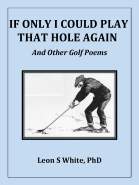
On occasion I have been inspired to write a poem about a Major event. These have previously been published in Posts on this Blog, but I thought that for Masters week I would put them together. These poems are also included in my new Ebook, If Only I Could Play That Hole Again which is available on Amazon for the Kindle and Kindle app.

Starting with last year’s Masters here is how I saw Bubba’s memorable sweeping hook:

♦Bubba’s Master’s Shot

About B.W. let’s be candid
Fortunate that he’s left handed
If he had hit a slice instead
“Our usual shot,” all we’d have said.

Another Master shot that will always be remembered, is Tiger’s 2005 chip show on the 16th hole:

♦A Masters Chip for the Ages

From a difficult lie beyond
the steeply sloped sixteenth green

a steely-eyed Tiger sent his ball
to a spot far above the hole,

the ball coming crisply off his wedge,
flew low, bounced once

and rolled on a yard or two
until gravity took over,

causing it to turn sharply,
and start slowly down the slope

towards the hole, speeding up
then slowing again as it got closer.

“All of a sudden,” Tiger’s words,
“it looked really good.”

“How could it not go in?” and
when it stopped, a single turn short,

“How did it not go in?”,
“And all of a sudden it went in.”

It was as if Tiger’s will
had given gravity an assist.

“In your life,” the tower announcer’s voice,
“have you seen anything like that?”

While around him, the patrons’ roar
rose rocket-like, fueled by sheer wonder.

In July 2012, Na Yeon Choi won the U.S. Women’s Open by four shots over Amy Yang. As the fourth round began, Choi held a six shot lead. And at the turn, she still led Yang by five. Then it got interesting.
Again the newspapers and magazines have told the story of the last nine holes in straight forward prose. I thought it would be fun to re-cast this minor epic in a more traditional form.

♦Na Yeon Choi – U.S. Women’s Open Champion

She was cruising along with a five shot lead
And just nine more to play
But the ever-present golf gods
Had not yet had their say!

As she turned for home with a  big Open lead
Fans saw her name on the cup
Especially now with it down to a match
And she was the one five up.

But the golf gods knew the score as well
And on ten they went into action
Soon enough Na Yeon Choi
Was losing more than just traction.

Her drive went out and couldn’t be found
She was back on the tee for her third
When her putt finally sank she was up only two
But surprisingly undeterred.

A resolute Choi bounced right back
With a birdy on eleven
The golf gods were clearly hard at work
In the depths, then close to heaven.

The down and up would continue
From the next tee into high weeds
But a brilliant wedge put her ball on the green
And she holed with a perfect read.

On thirteen the gods gave one final scare
Her ball hit two rocks, au revoir
But dry it remained miraculously
Choi then made an up and down par.

In the end the golf gods seemed to remember
A dream from way way back
When Na Yeon first said “I just want to be there,”
While watching Se Ri Pak.

Accepting the cheers as she walked up the last,
Her win beyond a doubt
Standing where her hero had stood
She finally putted out.

“I’m here right now and I made it.” she said
After winning ─ though I would wager
The thought that was foremost in her mind —
Like Se Ri, I’ve won this Major.

You may remember at the 2009 British Open at Turnberry, Tom Watson needed a four on the final hole to win his sixth Open championship. Unfortunately he didn’t do it. Thus, he lost his chance to make history as the oldest golfer to win a major. He was 59 at the time. Shortly after, I wrote the following poem to pay tribute to Watson’s heroic but failed effort.

♦Watson At Turnberry – The 2009 Open

From the tee at eighteen
He looked down towards the home hole
Like a pitcher with a one run lead looks
Toward home plate needing one more out.

As he drove his ball
We knew what the magic number was.
When the camera showed a safe white speck
We exhaled in unison and counted one.

Now it was an eight iron to the green
Or was it a nine?
A question to be answered twice,
The first time by Watson alone.

He was thinking nine but hit the eight
And as we watched with growing anxiety
The ball bounced hard and rolled too far.
We held our breath and counted two.

Again a choice: to chip or putt.
“One of the best chippers of all time,”
The words of an old pro in the booth.
But the third stroke would be a putt.

From off the green the ball raced up
Then by the hole a good eight feet.
He said he had seen grain.
Down to one, we saw trouble.

Once more a putt to win the Open,
But this was not a kid with a dream,
This was a Champion Golfer five times over.
Yet now we feared the worst.

While he took two short practice strokes
We lost interest in counting.
And as the ball rolled weakly off his putter
We lost all hope as well.

“I made a lousy putt,” Watson’s words;
“Then it was one bad shot after another.”
A self-stated epitaph marked the close:
“The Old Fogy Almost Did It.”

And so the golf writers lost their story
To an illustrious sage from an earlier time.
It wouldn’t be about Watson winning – or losing,
But how he had played the Game.

In 1970 Doug Sander missed a short putt on the final hole at the British Open that cost him the Championship. Here is a reply,

♦An Open Putt Remembered

The putt was less than three feet long
Just how could anything go wrong?

For sure he knew the stakes were high
But could he really run it by?

Doug looked as cool as cool could be
His poise was there for all to see.

But as his putter made its sweep
And those who watched made not a peep.

The ball escaped its aimed-for goal
And did not end up in the hole.

The question was, how could he miss
An easy putt as short as this?

The answer—simple, known to all:
Pressure putts don’t always fall.

post

For Golfers April is National (Golf) Poetry Month

April is National Poetry Month, but of course for golfers it’s National Golf Poetry Month. True, the Masters gets more attention in April, but we golfers should not lose sight of the fact that while the first Masters was played in 1934, the first poem that included a reference to golf was published in 1638!  Golf poetry was most popular in the early 20th century. The golf magazines of the time included golf poems in almost every issue. A number of golf poets such as Robert K Risk (one of the best)  also published books of their poetry.

As those of you know who follow this Blog, I have tried to revive interest in golf poetry through my Posts, of which this is number 150, and through my two books:

Golf Course Of Rhymes - Links Between Golf And Poetry Through The Ages          Final Briggs Cover for Vook ebook

Both are available on Amazon.com. If Only I Could Play That Hole Again is an eBook that is also available for Nook and the iPad. (For descriptions click in the header above)

I would like to mention two other  golf poetry books that are currently available on Amazon. The first is an eBook called Eighteen Holes and is written by Mike Ellwood. Mike describes the book as “a round of golf in poetry.” It consists of 18 poems with an additional on at the Nineteenth Hole. To quote Mike again, the poetry describes the “the drama, excitement and sheer fun of a round of golf.” The second is called Golf Sonnets and its author is James Long Hale. James describes his book as “A delightful collection of humorous sonnets and illustrations about the Game of Golf.”

With Mother’s Day and then Father’s Day not too far in the future, you might consider a golf poetry book. At least you will know that it will be their first!

I can’t write a Post without at least a few lines of poetry, so here are two four-liners.

THE YIPS PURE AND SIMPLE

You have the yips if you miss- hit your putts
Frequent attacks can drive you nuts
The yips occur when you’re not controlling
The direction or speed of the ball that you’re rolling.

CHANGING ODDS

Heard said that trees are nine-tenth air
If your ball gets over you hardly care;
But if it’s low and lost from view
It’s no more than even that your ball gets through.

post

Golf Poetry for Fun and Discovery

 As I have written in other Posts, the primary purpose of this Blog and my two books (see Banner) is to offer today’s golfer enthusiasts the opportunity to have fun with and learn from poetry. For many of you “poetry” is on the other side of a literary out-of-bounds line. I’m trying to bring it back onto the fairway to give you a shot at it. That’s what this Blog and my two books are about.

In this first Post of 2013, I would like to begin by wishing you (who come to this Blog from more than 100 countries) a happy, healthy and peaceful New Year. And now I’d like to show you how one of my recent  searches for old golf poetry led to the discovery of a non-golf poem that includes well-known lines of inspiration.

In a previous post I included a poem from a book called The Golf Craze – Sketches and Rhymes published in Edinburgh and London in 1905. Between the Table of Contents and the first Chapter of the book, the author (John Hogben writing under the pseudonym Cleeke Shotte, Esq.) included the following verse by W. E. Henley:

“Out on the links, where the wind blows free,
And the surges gush, and the rounding brine
Wanders and sparkles, an air like wine
Fills the senses with pride and glee.”

When I find an old golf poem or verse, I often also try to determine the poet’s connection to the game. So I Goggled Henley’s name and found a very interesting Wikipedia entry.

William Ernest Henley (1849-1903) was an English poet, critic and editor. He was born the son of a poor Victorian Englishman.  From age 12 he suffered from tuberculosis, and when he was in his teens his left leg below the knee was amputated.  After a long recovery, when he was in his early twenties the disease made a comeback.  His doctor proposed amputating his right foot to save Henley’s life.  Refusing to accept the doctor’s advice Henley got a second opinion.  The new doctor saved the foot, but there were two more years of recovery.  While in hospital he met his future wife, as well as Robert Louis Stevenson, who became literary collaborator and friend; and also while there Henley wrote the poem Invictus.

Two things I learned from this search. First, Henley had a wonderful feeling for “the links” without playing them. (Given his physical trials it is unlikely that he ever played golf.) And second, he left us a most inspiring poem with phrases that you have often heard.

                 INVICTUS

Out of the night that covers me,
Black as the Pit from pole to pole,
I thank whatever gods may be
For my unconquerable soul.

In the fell clutch of circumstance
I have not winced nor cried aloud.
Under the bludgeonings of chance
My head is bloody, but unbowed.

Beyond this place of wrath and tears
Looms but the Horror of the shade,
And yet the menace of the years
Finds, and shall find, me unafraid.

It matters not how strait the gate,
How charged with punishments the scroll.
I am the master of my fate:
I am the captain of my soul.

This poem was originally published without a title. A publisher later added it. You can go to this second Wikipedia entry to learn more about the poem and some of its more public influences.

Note: Searching through Henley’s poetry I found the golf related verse above comes from a poem called “Ballade of Aspiration.” Here is the first two stanza which precede the verse which is the first half of the third stanza. Click here for the complete text.

 O to be somewhere by the sea,
Far from the city’s dust and shine,
From Mammon’s priests and from Mammon’s shrine,
From the stony street, and the grim decree
That over an inkstand crooks my spine,
From the books that are and the books to be
And the need that makes of the sacred Nine,
A school of harridans ! – sweetheart mine,
O to be somewhere by the sea !

Under a desk I bend my knee,
Whether the morn be foul or fine.
I envy the tramp, in a ditch supine,
Or footing it over the sunlit lea.
But I struggle and write and make no sign,
For a laboring ox must earn his fee,
And even a journalist has to dine;
But O for a breath of the eglantine!
O to be somewhere by the sea.

So even this non-golfing journalist/poet saw the attractiveness of the links “by the sea.”

post

Two Golf Poems About Opposites

In a previous Post (https://golfpoet.com/2010/10/04/golf-opposites/)  I included two word-play poems based on the idea of “opposites.” The famous American poet and former poet laureate Richard Wilbur is the originator of this idea. Here are two more that I recently wrote:

THE OPPOSITE OF CUP

What is the opposite of cup?
Glass an answer that pops up.
But if the cup is on a green
Though underground and so unseen
It could be paired with holes of sand
Where errant balls are want to land.
Then cup’s opposite’s a clunker
Known to golfers as a bunker
.

THE OPPOSITES IN PUTTING

Fast or slow could be the query
When on a green, mad or cheery.
But then there’s also straight or not
And uphill or down to thicken the plot.
The wind as well, still or breezy
All makes putting hard not easy.

Envoy

The opposites of driving may hold less terror
But still there’s plenty of room for error.

These poems as well as all the others I’ve written in the last few years will be include in an eBook that I will soon complete and publish called If only I could play that hole again – And Other Golf Poems.

post

Golf History (and More) from an Old Golf Poem about Walter J. Travis

 -

I am always on the lookout for old golf poetry books that I can afford. Recently I bid on a book published in England in 1905 called The Golf Craze ─ Sketches and Rhymes  by “Cleeke Shotte, Esq.” It was offered by the PBA Galleries in San Francisco. And I won it. The book was actually written by John Hogben, a member of the Duddingston Golf Club in Edinburgh and its captain in 1921.

Included among the rhymes was one titled “To Mr. W. J. Travis ─ Amateur Golf Champion, 1904.” For our purposes, you need to know that Walter J. Travis was born in Australia in January 1862. He came to New York City at age 23. He began playing golf in October 1896, three months short of his 35th birthday. He soon began playing competitively. Now comes the most remarkable part: In 1900, 1901, and 1903 he won the U.S. Amateur Championship; and, in 1904 he became the first American (he was by now a naturalized citizen) to win the British Amateur Championship. He went on to do many other impressive golf-related things before he died in 1927. You can read more about Travis at http://bit.ly/Q0VKvX.

The poem, though a tribute to Travis, raises a question about the “strange putter” that he used. There is also a reference to staying “the mighty war.”

To W. J. Travis
Amateur Golf Champion, 1904

The cry is still “They come!” for we may say
The lust of conquest reigns in U.S.A.
Another Cup goes Westward; ‘tis a shock
We owe, sir, to that aluminium block

That taught your golf-ball all roads lead to Rome,
And sent it straight, and far, and surely home.
There is no name whereby to call the utter
Amazement that we owe to your strange putter.

It was not thought that in our chosen game
A foreign player could make good his claim
Against the prowess of the Britisher,
Without whom neither golf nor golfer were.

Forgive me, for you know the game is ours;
We sowed the seed; the world has reaped the flowers.
Yet, after all, no grudge we owe you, for
The mimic helps to stay the mighty war.

No Frenchman are you, German, or what not
But of our generous cousin-blood begot─
Nay, I forget, for closer still the ties,
Were you not cradled under Austral skies?

The “strange putter” was the so called Schenectady Putter invented by a General Electric engineer in 1902. Travis made the putter famous when he used it in the 1902 U. S. Amateur Championship. The aluminum Schenectady Putter was mallet-headed and center shafted. Travis used it again to win the 1903 U. S. Amateur and, of course, the British Amateur in 1904. In 1910 the R & A, the ruling body for golf in Great Britain, banned the Schenectady Putter and others of similar design. The U.S.G.A. did not follow suit. But still, in light of the current controversy regarding “anchored” putters, it is interesting to note that there is a precedent for a ruling body to ban a class of putters being played.

The reference to a possible future “mighty war” foreshadows the first world war. Ironically, the one reference to the poet John Hogben that I was able to find describes him in June of 1921 presiding over the unveiling of a memorial tablet to commemorate members of his golf club who had died fighting the great war. (See http://bit.ly/NSFski)

If you have a comment, I would be pleased if you would share it below.

post

Golf Poem to Commemorate George Wright – A Baseball Hall-of-Famer

The Baseball All-Star game will be played this week. I can’t think of a better time to recall a baseball player who had a profound early impact on golf in America. No, it’s not A. G. Spalding although he would qualify. Rather, the player I’m thinking of is George Wright. “Who?”, you say. Here is an excerpt from my book, Golf Course of Rhymes – Links between Golf and Poetry Through the Ages, that will give you the answer.

“… on December 10, 1890, with almost no one watching, George Wright, later a baseball Hall-of-Famer, and three friends played the first round of golf ever in Boston. Wright, baseball player turned golfer, created the first great moment for New England golf. Earlier, in 1871, with his baseball career over, Wright, along with Henry Ditson, formed the sporting goods company, Wright and Ditson. Their company was bought out by A. G. Spalding & Co. in the early 1890’s. Up to the buyout, Wright and Ditson had imported all of its golf merchandise from Scotland. Later, Spalding & Co. began producing its own clubs under both the Spalding and the Wright and Ditson names. George Wright’s accomplishments moved me to write a poem commemorating him:

George Wright (1847–1937)

He never had an equal as a fielder
He ran the bases better than the rest
As a hitter he was feared and fearless
In his time George Wright was unsurpassed.

In ’69 he played for Cincinnati
Standing out at bat and on the field
He revolutionized the play at shortstop
And hit .633 which was unreal.

From Cincinnati he moved on to Boston
The Stockings first, the Red Caps later on
He led the mighty Sox to four straight pennants
Then with the Caps another two he won.

His ball field feats were cheered by all who saw him
He was an early hero of the game
Still it took the voters until thirty-seven
To elect him to the Baseball Hall of Fame.

Wright the player is today all but forgotten
But with regard to fame another claim
Retired from the ball field but still active
He brought to town the great old Scottish game.

A permit from the Boston Parks Commission
Let Wright lay out some holes at Franklin Park
Then on a cold fall day in eighteen ninety
He took along three pals to play ’til dark.

So add the name George Wright to your sports heroes
A pioneer in not one sport but two
The father of the golf game in New England
A double Hall-of-Famer through and through.”

post

Golf Poetry – Who Wrote it; Who Reads It (Part 2)

In 1886 David Jackson, the Captain of the Thistle Golf Club in Scotland, published a 32 page tract of poems and songs at the “repeated request of many members of my own and other Clubs.” Earlier in 1833, George Fullerton Carnegie privately published a long poem called “The Golfiad” which he dedicated the “Members of all Golfing Clubs, and to those of St. Andrews and North Berwick in particular.” They were his readers.

In the first 30 years or so of the 20th century, the audience for golf poetry expanded. The poetry appeared in golf magazines in both the United Kingdom and the United States and in a few newspapers as well.  A number of (real) books of golf poetry were also published But after about 1930, golf poetry lost its place as a part of the literature of golf and all but disappeared. As Grantland Rice saw it, “…good poets suddenly disappeared and readers for some reason lost the old poetic zest.” It may also be that movies, radio and other sources of entertainment began to attract audiences away from poetry in general.

Today poets struggles to attract an audience and golf poetry has few serious adherents. But we can, with the help of the internet, libraries and the digital reprinting of out-of-print books, rediscover the golf poetry of the past, which is what I have attempted to do with this Blog and my book Golf Course of Rhymes – Links between Golf and Poetry Through the Ages. And happily a number of readers have responded.

With the help of WordPress.com, my Blog host, I can tell you that golf poetry today enjoys a wider audience than ever before. Poetry on this Blog has been read (and hopefully enjoyed) by readers in more than 70 countries. Leading the list are the countries most associated with golf’s history, the United States (54% of the page views), the United Kingdom (21%), Canada (6%) and Australia (3.3%). But all of the continents have contributed viewers and the Blog has even had four page views from Iceland and two from Belarus! Page views in total for the three plus years of this Blog have passed 67,000.

Reading and even more so, reciting golf poetry is a new experience for most of today’s golfers. So, if it’s new for you, why not begin by reciting the last four lines from one of David Jackson’s poems, “Gouff Dings A’” loosely translated as “Golf Surpasses All,”

Then, let us swell the mighty throng of Princes, Lords, and Kings
Who have enjoyed the game of Golf above all other things
And wish success to every one, let him be great or sma’,
Who loves the jolly game o’ Gouff–for Gouff dings a’. 

 And sometimes poetry dings prose.

post

Golf Poetry – Who Wrote it; Who Reads It (Part 1)

April is Poetry Month, so why not a Post focusing of some of what I’ve learned about golf poetry.

In doing research for my book, Golf Course of Rhymes – Links between Golf and Poetry Through the Ages, I found that the earliest poem known to include a reference to golf was called “The Muses Threnodie” by Henry Adamson, published in Edinburgh in 1638. Some have argued that Shakespeare preceded Adamson. For example, here is King Lear on pressing: “Striving to better, oft we mar what’s well.” But, I think we’ll stick with Adamson.

Possibly the first poem devoted entirely to golf was found in a 1687 diary entry of an Edinburgh medical student, Thomas Kincaid. In 12 lines, Kincaid establishes himself as golf’s first swing instructor. The poem begins,

Grip fast stand with your left leg first not farr
Incline your back and shoulders but beware
You raise them not when back the club you bring

The complete poem is included in my book. I found it in a wonderful reference book on early golf history called A Swing Through Time by Olive M. Geddes, a Senior Curator in the National Library of Scotland. The “triumvirate” of early golf poems is completed with The Goff,” a 358-line mock-heroic poem written by an Thomas Mathison and published in book form first in Edinburgh in 1743. The Goff is thought to be the first book entirely devoted to golf.

As golf developed in Scotland and then in England, golf poetry developed as well. One of great golf poets of the first half of the 19th century was George Fullerton Carnegie, a member of St. Andrews. His poetry is included in a book edited by Robert Clark called Golf: A Royal & Ancient Game. One of Carnegie’s poems, “Address to St. Andrews” begins,

St. Andrews! They say that thy glories are gone,
That thy streets are deserted, thy castles o’erthrown;
 If they glories be gone, they are only, methinks,
As it were, by enchantment, transferr’d to thy Links.

In 1886, David Jackson, Captain of the Thistle Golf Club, Scotland, published a 32 page pamphlet/book called Golf – Songs & Recitations. You can search this Blog for three Posts that include poems that Jackson wrote. A few years earlier in 1873, Thomas Marsh, described as the poet-laureate of the Royal Blackheath Golf Club in London, privately published a small book called Blackheath Golfing Lays. A rare 1st edition copy recently sold for $8400.

In my opinion, one of the best golf poets of the 19th-early 20th century, was the Scottish writer, poet and drama critic, Robert K. Risk. In 1919 he published a book of 36 golf poems called Songs of the Links with illustrations by H.M. Bateman, a famous British cartoonist. I was fortunate to win a copy of Risk’s book at auction three years ago. Risk was a golfer, as were virtually all of the golf poets of this time  Only a golfer, Risk in this case, could write lines such as these,

Here, with an open course from Tee To Tee,
 A Partner not too dexterous – like Thee—
Beside me swiping o’er Elysian Fields,
And Life is wholly good enough for Me.

Other British golfer-poets of Risk’s time included Sir Arthur Conan Doyle, Rudyard Kipling (born in India), Andrew Lang, better known for his children’s fairy tale books, Robert H. K. Browning (not that Browning) and John Thomson who wrote a wonderful short book called A Golfing Idyll under the pseudonym “Violet Flint.” The book, subtitled The Skipper’s Round with the Deil (Devil) On the Links of St. Andrews, was first published privately in 1892.

In my research I discovered one golf poet of the time, Harry Vardon, who may have borrowed the verse he offered to an auction during World War One. This story can be found in an earlier Post and also in my book.

Golf poetry was also being written in the United State and Canada during the late 19th and early 20th centuries. One of the best American golf poets was Grantland Rice, the first dean of American sports writing. Rice wrote hundreds of poems about many sports, wrote prose and poetry for a number of New York City papers and was editor an early golf magazine, American Golfer, in the 1920’s. Among the many golf poems Rice wrote, here is one of his shortest:

The bloke who lifts his well known dome
Will let it hang when he starts home.
And he who finds missed puts are rife
Is no companion for a wife.

Other American golfer-poets, contemporaries of Rice, include Charles “Chick” Evans, Jr., the great amateur player, Tom Bendelow, an important early American golf architect, who wrote a parody of “Casey at the Bat” called “Hoo Andra Foozled Oot,” Ring Lardner, one of American’s best short story writers, the Chicago Tribune columnist Bert Leston Taylor, and a New York lawyer, Norman Levy.

I also discovered three Canadian poets: Edward Atherton, who wrote a song called “Far and Sure” in 1901; W. Hastings Webling; and a Montreal judge, writer and poet, Robert Stanley Weir, who was most famous for writing in 1908 the first English lyrics to O Canada, Canada’s national anthem.

Outside of Scotland, England, the United States and Canada, I have found only one golf poet. His name was Barton “Banjo” Paterson from Australia. The poem he wrote is called “The Wreak of the Golfer” but he was much more famous for writing “Waltzing Matilda.”

If you know of any golf poetry by poets from other countries, for example, Ireland, India or France, please leave a comment with the reference or poem. And to read poems by most of the poets mentioned above, please consult my book.

Note: Part 2, focuses on the question: who reads golf poetry?