post

Attitudes Toward Women Golfers in the Early Days (Part 2)

Women golfers, circa 1900

Women golfers, circa 1900

As I noted in the last Post, women began playing golf in larger numbers in England, the U.S. and other countries such as Australia, around the turn of the 20th century. However, as Murray G. Phillips points out in an article in the May 1989 issue of Sporting Traditions – Journal of the Australian Society for Sports History,

“Golf was considered a suitable ‘ladies’ sport because it complemented the cultural image of women that was essentially passive, non-aggressive and non-competitive.”

Phillips goes on to say that

“[the] acceptance of golf as a suitable sport for women was also made possible because it did not pose a serious threat to male golfers. To many male players, female golf was nothing more than ‘a gentle counterpoint to tea and gossip’.”

And yet organized women’s golf began, major amateur tournaments were organized and held, and over the years things have improved. And as seen in last week’s Post, some poets did take the women’s side. Below I offer two more examples. [Read more…]

post

Attitudes Toward Women Golfers in the Early Days (Part 1)


From old Life Magazine, 1900 (Life Publishing Co.)

From old Life Magazine, 1900 (Life Publishing Co.)


The period of about 1880 to 1900 marked the first major expansion of golf interest and play among Englishmen. This golf boom was sparked in part by the publication of The Badminton Library: Golf written and edited by Horace G. Hutchinson. Most of the new players were men. However, women’s golf received a boost during this period when the first British Ladies Championship was held at Lytham St. Anne’s in 1893.

Nevertheless, Lord Wellwood may have expressed the prevailing attitude of his fellows when he wrote in Hutchinson’s book,  “If [women] choose to play at times when the male golfers are feeding or resting, no one can object…at other times…they are in the way.” Hutchinson, himself, was even more direct, when he was quoted as saying, “Constitutionally and physically women are unfit for golf.”

In the U.S., the first women’s amateur championship was held in 1895 at the Meadow Brook Club in Hempstead, N.Y. But when golf began in America, the general attitude toward women golfers was anything but supportive. Consider a 1900 cartoon (above) showing a caddie on a knees ostensibly looking for a lost ball but actually looking at a shapely woman golfer nearby. The caption says “ADVICE TO CADDIES – You will save time by keeping your eye on the ball, not on the player.”

Golf poetry, when the subject was a woman golfer, also often focused on the girl and not the golf. Here is an example from Lyrics of the Links, an anthology of golf poems collected by Henry Litchfield West and published in 1921.

[Read more…]

post

What Puts You off Your Game Most? Answers From a 1923 Golf Magazine

From the USGA Digital Library

From the USGA Digital Library

In 1923, The American Golfer, the golf magazine of its day, asked its readers to submit entries to answer the question “What Puts Me off My Game Most?” The April 7th issue included the responses of the three prize winners. The winner of the second prize wrote, in part,

“…I can play with the hare type and with the human tortoise…Sun nor wind nor clouds affect me, I enjoy them all. Nor does a bad hole depress me, for there are many such in my life and I should worry.

But delivery me, oh, delivery me from the fiend who coaches my each and every shot! He usually has about a twenty-four handicap. He has made every hole on the course in par, but never by any chance has he gotten two of them in the same round.

As I step up to drive it starts. My stance is wrong. I should waggle more; my backswing is too short. If I take my midiron for one hundred and twenty-five yards, I am patiently told that I should pitch up with a mashie….”

The second prize winner goes on a while longer, but you get the point.

The first prize winner complains about a similar critic that he calls “NEVER-WILLIE.” In his entry he includes these quotes:

[Read more…]

post

Politics, Golf Courses and the 1913 British Open

 
suffragettes


Frustration is a feeling that is familiar to all golfers. The following is a story of political frustration that spilled over to golf. 

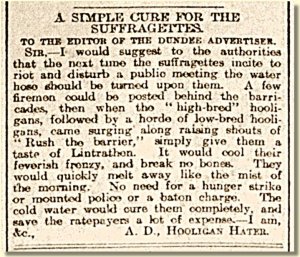
In England, starting in 1866, a women’s movement known as the suffragists began working for the vote. In 1903, a violent offshoot of this movement, called the “suffragettes,” instituted militant means to force the issue. One of their tactics was to destroy the turf at golf courses. It was reported in the May 1913 issue of The American Golfer “that if they could manage it, the ‘wild women,’ as they are being called, meant to do some considerable harm to the [Royal Liverpool Club] and interfere as far as they could with the success of what is expected to be the biggest championship meeting that has ever taken place.”

[Read more…]

post

Golf Poetry and Poet get Boost from the Boston Globe

As those of you who have been following this blog know, one of my primary purposes is to introduce today’s golfers to some golf history that has gotten lost over time — the links that existed between golf and poetry. Thanks to Michael Whitmer, the Boston Globe golf writer and Suzanne Kreiter, an award-winning Globe photographer, I am getting some help. Take a look at http://www.boston.com/sports/golf/articles/2009/04/16/taking_a_shine_to_the_rhyme/ And I did make that chip!

post

Another Golf Season Begins


augusta


Poems don’t need to be long to be moving. In fact, often the brevity of a poem is what gives it impact. But good short poems are not like short putts; they are not that easy to make.

Last week The Masters officially ushered in spring for those of us who live where the seasons still exist. The pictures of Augusta National on television almost called for a poem. Four lines by Joyce Kilmer, with one obvious change, might fill the bill. (Kilmer is most famous for his poem “Trees.”)

[Read more…]

post

Longer Drives – Can a Poem Help?

club-or-ball1

In 1680 John Patersone, an Edinburgh shoemaker, partnered with the Duke of York (later King James II of England) to win the first international golf match. The following year Patersone built a house in the Cannongate of Edinburgh and on the front he affixed a plaque (supplied by the Duke) that read “Far and Sure.” And so began the focus on distance and accuracy.

[Read more…]

post

The Golf Girl – 1899 Version

The Golf Girl from PBA Catalogue

The Golf Girl from PBA Catalogue

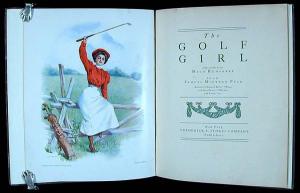
The first “golf girl” may have been Mary, Queen of Scots. Mary was born in Scotland in 1542 and is said to have played golf as a teenager in France. She definitely played when she returned to Scotland. The ill-fated Queen is remembered best for showing bad form when at age 27 she was seen playing “in the fields beside Seton” a few days after the murder of her second husband, Lord Darnley.

Unfortunately, in1586, after a long period of “match play” with her cousin, Queen Elizabeth I, Mary lost her head! A rather poor start for women’s golf.

Women’s golf, however, does carry at least one historical literary distinction. [Read more…]

post

Where Have All My Good Drives Gone?

where-have-all1

From the Minute Books of the Bruntsfield Links Golf Club:

“Bruntsfield Links, 28th Sep. 1839

During the evening the Secretary sang the following impromptu:—

Come, all you Golfers stout and strong,
Who putt so sure and drive so long,
And I will sing you a good song,
About old Captain Aitken.”

I will spare you the remaining verses.

The Scottish and English Golf Clubs have always included songs in their rituals. For example a song called “The Golfer’s Garland” included in Robert Clark’s book, Golf: A Royal and Ancient Game, was said to be “composed for the Blackheath Golf Club, and often sung with great spirit …” Clark includes other songs in his book.

These golfing songs were often poems that where written to be sung using the melodies of familiar tunes. With that in mind, I penned the following song to be sung to the tune “Where have all the flowers gone?,” in hopes of continuing the tradition at some existing golf club. Those of you who remember the tune are encouraged to sing along. [Read more…]

post

The Poetry of Match Play

The following is the one of the closest links between golf and poetry that I have ever found. The story and poem appeared in the November 1913 issue of The American Golfer.

“Two Californians, Dr. Walter S. Power and Mr. Mark Sibley Severance, “a well known author and an ardent golfer” finished a match all even. The following day Dr. Power sent Mr. Severance a challenge “couched in a rather indifferent rhyme.” Here is Mr. Severance’s reply. [Read more…]