post

Another Poem for a Winter’s Day

Last December I published a post titled “Golf Poetry for a Winter’s Day.” It included a poem called “Retrospection.” If you want a succinct description of the essence of golf, I encourage you to click here and read (better recite) the last two stanzas.

This December’s poem for a winter’s day is called “A Dirge for Summer.” It was written by Robert Risk, a Scottish poet and golfer, and appeared in his book, Songs of the Links, published in 1919.

A DIRGE FOR SUMMER

Gone are the days when by the swinging sea
We lounged and smoked between two sunny rounds,
Gone are the times of loitering by the tee;
The summer has been driven out of bounds–
No penalty is writ in white and black,
Whereby we are allowed to call it back.

Gone are the jocund evenings when we start,
High-tea’d and confident of light and weather,
Forgetful of the office and the mart,
Of debts and duns and the Golf-maniac’s blether;
Those perfect evenings, clear, and dry, and bright,
Have vanished wholly in the Ewigkeit. [eternity]

Gone is the crowd about the starter’s box,
And no one waits to-day at those short holes,
Where the procrastinating putter mocks
The men behind and harrows up their souls;
Void the grey town o’scarlet down and cleek
(I’ve half a mind to go there for a week).

For now, we must from Saturday to Saturday
Neglect our game–a week’s a weary time–
And each one brings a coorser and a watter day
(Kindly excuse a Caledonian rhyme),
For we are entered on the Golfer’s Lent,
The season of his deepest discontent.

Yet on the dim horizon looms afar,
No larger than the neatest niblick head,
A little scintillating, faithful star,
Though over all the heavens is darkness spread;
Through all the winter waste it sends a greeting,
The constellation of Next Year’s Spring Meeting.

When I read this poem it makes me think that over the last 100 years the game has changed much more than its players.
post

Read Golf Poetry Out Loud!

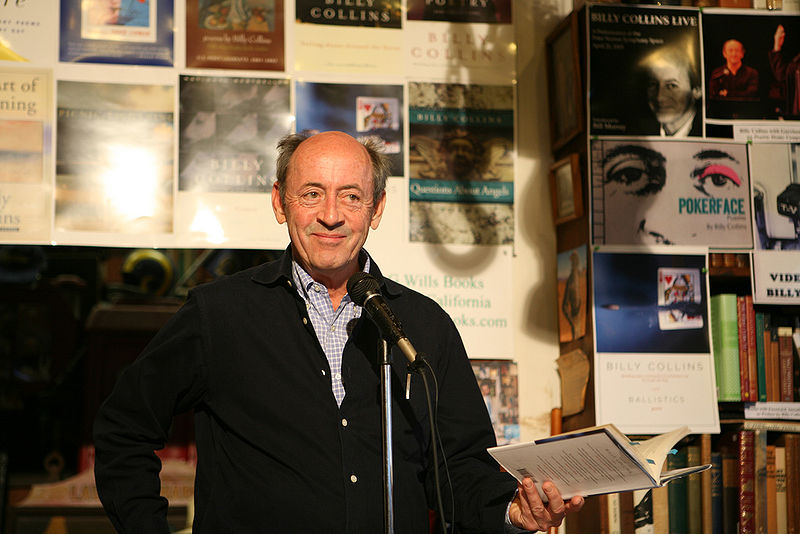
[Note: the picture is of Billy Collins, a former United States Poet Laureate and an avid golfer. If you ever have the chance to hear Professor Collins read his poetry out loud (he has two CDs out), you will be convinced quicky that poetry must be read out loud to be fully enjoyed.]

Though it is hard for me to believe, I have now been writing this Blog for almost two years. The Blog now includes more than 100 Posts and close to 100 golf poems. The good news is that golfers interested in finding poetry about golf are finding this site. The Blog has recorded more than 37,000 page views. The bad news is that the Blog is 100 years late in getting started. As I have mentioned in these pages, golf poetry was routinely included in all the golf magazines published early in the 20th century. And books of golf poetry were bought and enjoyed. Moreover, poetry was recited at club meetings by poetry writing members.

My purpose in writing this Blog has been to make this golf poetry of the past (and a few poems of the present) available to a generation of golfers who have had no access to this literature. But poetry, different than prose, puts an extra demand on its readers: it asks that you read it out loud. Though you are easily convinced that yelling “Fore” is a good idea when an errant ball is hit, you may be less sure about the value of reading poetry out loud. Even more so, when you rarely come across any kind of poetry, let alone golf poetry. So my only hope of convincing you may be  to write a poem with the right incentive:

READ GOLF POETRY OUT LOUD

Read golf poetry out loud,
It will lower your score;
And if one poem doesn’t do it,
Read two or three more!

If you believe all of those equipment ads, maybe this poem will work as well. But if not, search around the Blog and find a poem that appeals to you…and then gather up your courage and read it out loud. Maybe even more than once. I hope this exercise will convince you that reading poetry out loud adds greatly to your understanding and enjoyment of the poem. If you are inclined, leave a comment and let me know what you think.

post

Two Up on Grantland Rice

Grantland Rice, in his book, the duffer’s handbook of golf, includes a page of  humorous “sayings” under the title, “Short Approaches.” I took two of them, “If at first you don’t succeed, try looking at the ball,” and “He who swings and lifts his head, will say things better left unsaid,” and made four line verses out of them.

GOLF OR BOWLING

If at first you don’t succeed,
Try looking at the ball.
But if that doesn’t work for you
Try bowling or the crawl.

NOT FOR ATTRIBUTION

He who swings and lifts his head
Will say things better left unsaid.
He whose putting’s for the birds
Will likely echo the former’s words.

If you would like to try your hand at extending a Twine (a two line poem), try the following:

To be in the hole and not in a rut
With a short one left, don’t rush your putt.

Add a comment with your finishing two lines and thanks.

post

A Wife’s Place in the Golf World of 1886

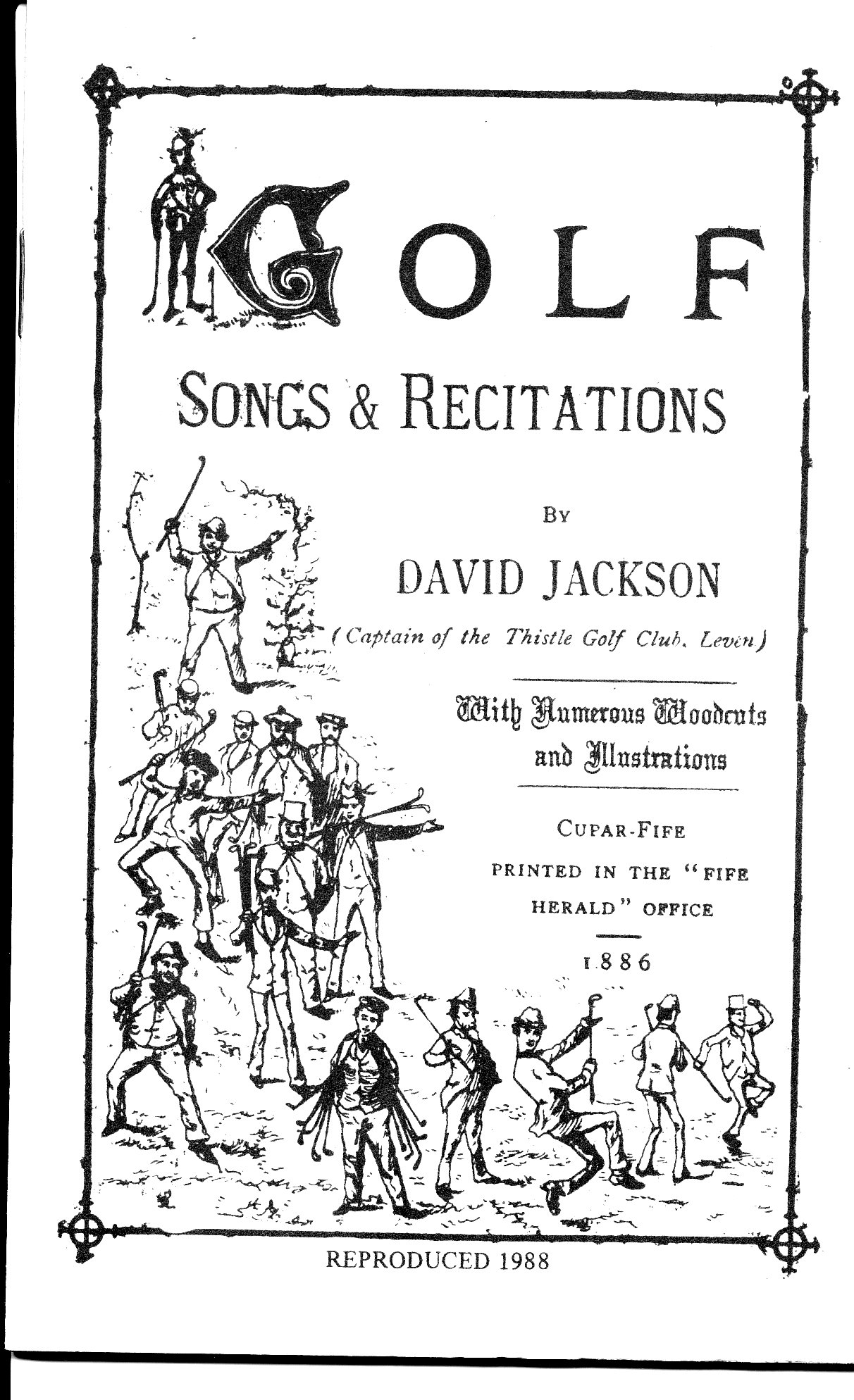
Last November I wrote a Post that included a poem from the Captain of the Thistle Golf Club, David Jackson. The poem came from a 32 page book called Golf Songs & Recitations published in 1886. In my November Post I said that the book was not available in any library. I have since learned that one copy exists in the library of the University of British Columbia. I managed to find a 1988 reproduction of the book.

I picked up Jackson’s book again recently and found a relatively short epic poem called “The Breaking O’ the Clubs.” The poem describes the tensions that golf created between a man and his wife in the 1880’s when golf was becoming more popular among the rank and file. In writing the poem, Jackson used some Scottish dialect which I have tried to translate using Internet sources. The poem is interesting both for its lively content and its “happy” ending.

THE BREAKING O’ THE CLUBS

Ae nicht (One night) I had a round at Gouff wi’ my cronies, Bob and Tam,
When we were through, to weet our mou’, some ane (one) proposed a dram;
Sae down we sat, and had a chat about our Drives and Putting—
Wi’ (with) joke and sang, it wisna lang till it was time for shutting.
Then hame I goes on my tiptoes, but ah! the wife was waken.
“The morn,” she cries, “afore ye rise, I’ll ha’e yer Clubs a’ (all) broken;
Ye gang tae (go to) Gouff, it’s a’ your houff, and then ye maun (must) be drinking,
Some morning when ye canna rise, ye’ll get the sack, I’m thinking;
Whaur wull you be, the bairns (children) and me—oh, man, ye should think shame,
If I should rise and break yer Clubs, I woudna be to blame.”
To bed I sprung, and held my tongue, thinks I before the morrie,
For a’ this lung and words high-strung she surely will be sorry.

When morning dawned, I wakened, yawned, was pulling on a stockin’,
When horrors, a’! what was I saw – my Clubs and Cleeks a’ broken.
As guid (good) a Club as e’er was swung, I won at last Spring Meetin’,
My driving Cleek, my lofting Iron, a’ tools that ne’er were beaten,
How aft I’ve praised their style o’ mak’, and rubbed wi’ oil their handle,
It’s quite enough to drive me mad, and raise a perfit scandal.
I fumed and swore, and loud did roar, and kicked up such a shindy
The neebors gathered round the door, and some glowered through the window.

“Shall I give up the Gouff for this, and frae (from) my Clubmates sever,
I tell ye plainly to yer face ye needna think it—never;
Fareweel to a’, for I’m awa, my peace wi’ you is ended,
Unless ye gang (go) this very day, and get thae Clubs a’ mended.”
I left the house in awful scorn, their cries to come back spurning,
My heart wi’ grief and anger torn, my brain wi’ rage near turning.
That was a dull and dreary day, to breathe seemed quite a labour,
I coudna sing a lilt, or say a word to my next neebor.
When I came hame frae wark that night, my heart a’ wives reviling
Wha’s (Whose) was the first that met my sicht—my ain (own) and she was smiling.
“Oh, come awa, I’m awfu’ glad that this long day is ended,
For I ha’e been at Patrick’s, lad, and got yer Clubs a’ mended;
And there’s a Club I bought for you – he said ’twas special made, man,
The wale (choice) o’ wud, a powerfu’ shaft, and bonnie driving head, man.
Forgi’e me noo.” “I will, my doo.” And bright her face did shine;
And ever since ye coudna ha’e a better wife than mine.

Though somewhat over the top, this story is probably representative of male golfers’ attitudes in the 1880’s.

post

“Just step up and give it a swat”

Golf tips have become ubiquitous. Pick up a golf magazine, turn on the golf Channel, or check your favorite golf Internet sites and you are likely to be offered lots of concisely packaged ideas to improve your game. This observation led me to Tweet the following two liner a few months ago:

Golf Tip Twine

A thousand tips from Jan to December,
But when you need one, will you remember?

I do not deny that tips are seductive. But they are also often conflicting or incomplete. Sometimes they solve one problem only to create another. They are most similar to whispered betting advice, leading possibly to a few winners, but not many.

When I began playing golf, I benefited from hours of golf instruction given by PGA professionals. From there I went on to study, practice and swear. And now, many years later as a senior golfer, I just try to remember a few fundamentals as I play. At least for me, golf has become more of a game to be enjoyed and less of an application of lessons learned and tips remembered.  In short, the pressure is off.

An anonymous poet, whose poem “The Reason” in included in Lyrics of the Links (1921) by Henry Litchfield West, seems to agree with me.

The Reason

“You are old, Father William,” the young man said,
“And your swing has become very flat,
And yet you incessantly lay the ball dead.
Pray what is the reason for that?”

“In my youth,” Father William replied, “it is that
I studied and practised and swore;
But now I just step up and give it a swat—
What reason for anything more?”

post

The Poet Laureate of St Andrews

George Fullerton Carnegie was born near St. Andrews, Scotland in 1800.  In 1833 he privately published a small book of poetry called Golfiana. The first edition included three poems, the first, “Address to St. Andrews” and third, “The First Hole at St. Andrews on a Crowded Day.”

Carnegie, who could be described as the poet laureate of St. Andrews in his time, had a passion for golf which continued to his death in 1851. In his later years he was a friend of Tom Morris. This is how Carnegie, a short man, described himself:

That little man that’s seated on the ground
In red, must be Carnegie. I’ll be bound.
A most conceited dog, not slow to go it
At golf, or anything a sort of poet.

In 1842, a third edition of Golfiana was published that included another poem about St. Andrews called “Another Peep at the Links.” The last stanza of this poem might be described as Carnegie’s final tribute to the course he loved.

And now farewell! I am the worse for wear—
Grey is my jacket, growing grey my hair!
And, though my play is pretty much the same,
Mine is, at best, a despicable game.
But still I like it—still delight to sing
Club, players, caddies, balls, everything.
But all that’s bright must fade! and we who play,
Like those before us, soon must pass away;
Yet it requires no prophet’s skill to trace
The royal game thro’ each succeeding race;
While on the tide of generations flows,
It still shall bloom, a never-fading rose:
And still St. Andrews Links, with flags unfurl’d,
Shall peerless reign, and challenge all the world!

Though written long ago, this is the St. Andrew Links that will yet again soon host another Open Championship.

post

‘Now, mind, keep your e’e on the ba’

The following appears in a description of the book A DUFFER’S HANDBOOK OF GOLF by Grantland Rice and Clare Briggs, on the Classics of Golf website.

There is no doubt “duffer” is a pejorative term. While the word’s origin is unknown, it appears in the 1800s as slang for an incompetent, ineffectual, or clumsy person. What better word to describe a neophyte attempting golf? The first “wave” of new golfers occurred when the gutta percha ball became available in the 1850s. Its lower cost and superior durability enticed many citizens to gather a few clubs and try their hand at the sport, some woefully ignorant of the rudiments of the game. “Duffer” first appears in the golf lexicon in 1875 in Clark’s Golf: A Royal and Ancient Game, in a poem by “Two Long Spoons.”

The poem was titled “Duffers Yet,” and was written by Lord Stormonth Darling (1844-1912), a judge, a Scottish Member of Parliament for Edinburgh and St Andrews Universities from 1888 to 1890, and also a golfer. Lord Darling wrote other golf related songs and verses including one called “Keep Your E’e on the Ba’.” It is subtitled, “Ballad of the Beginner,” and tells the story of when on Musselboro’s “famous old green,” Lord Darling, then no doubt a duffer, first “sought for the key to the game.”

The caddie that fell to my lot
Was old, hard of hearing, and wise;
His face had a hue that was not
Entirely the work of the skies:
He knew how the young player tries
To remember each tip all at once,
And, forgetting the vital one, sighs,
And despairs of himself as a dunce.

So, deep in his mind he had set
A rule that pervades all the rest;
‘Tis the maxim you ne’er can forget,
If you w’sh in you game to be blest:
‘Tis the greatest, the first, and the best,
The beginning and end of golf-law;
And ‘twas thus by my caddie expressed ─
‘Now, mind, keep your e’e on the ba’.’

Darling, not satisfied that he had a complete answer, asked other questions. Was he standing properly? What about his grip? Should he worry about the bunker ahead?

To each query the answer I got
Was that rigid, inflexible saw
(Of deafness and wisdom begot),
‘Now, mind, keep your e’e on the ba’.’

Lord Darling concludes,

Whate’er be the mark to be hit,
This truth from the caddie I draw ─
In life, as in golf, you’ll be fit
If you aye keep your e’e on the ba’

Although written more than a hundred years ago, Lord Darling’s words of advice are hard to improve upon!

post

The Language of Golf

The Foreword to Peter Davies’ impressive book The Historical Dictionary of Golfing Terms  − From 1500 to the Present begins:

No game has a richer array of terms than golf. Five hundred years of golfing have built up an extraordinary vocabulary.

Mr. Davies goes on to say,

…before 1850 when the Scots had the game to themselves: bunker, caddie, divot, links, putt, stance, stymie and tee [were] purely Scottish words…

Robert K. Risk, a Scottish writer, poet and golfer in his book Songs of the Links, first published in 1919, identifies a presumably non-Scottish writer who,

…in a magazine alleges that the terminology of golf is peculiarly repulsive, and instances “top,” “foozle,” “tee,” “stymie,” “divot,” and “bunker,” as the cacophonous offspring of a degraded invention.

Risk responded with “A Protest,”

A PROTEST

Imprimis, I would here protest
That any who mislikes our phrases,
Our stymies, foozles, and the rest
May, go, for all I care, to blazes,
Or any more select location
Where golf terms cannot cause vexation;

Secundo, when he sets his hand
Upon so sweet a bloom as stymie,
I’d have him clearly understand
Few words so keenly gratify me;
Stymie—it pleases me to say it
Almost as much as when I lay it.

Stymie—dear word most musical:
And what man will deny that putter,
Pronounced without a “t” at all,
Is smoother far than melted butter;
And when its “t’s” are forced to duty
Putter has still a poignant beauty.

And as for foozle—what could be
More deftly onomatopoeic?
Hearing the word, assuredly
Even one who knew not Golf, would see quick
Anger, futility, despair
As of a man who beats the air.

And divot—any duffer knows—
Is the by-product of a foozle:
When to a sounder game he grows,
And pitching-clubs cease to bamboozle,
Divot, when it is cut or said
Means a half-iron shot laid dead.

And what about those minor games—
Billiards and tennis, football, cricket—
Could one invent much uglier names
Than pot and screw and lob and wicket,
Off-side and deuce and maul and sett?
More loathly words I’ve never met.

Therefore, when in a magazine,
A writer airs such views as these,
I diagnose a touch of spleen
Or failure absolute to please
The Goddess who demands our duty—
Great are Golfina’s works and ways,
And passing sweet her every phrase,
And all her words are words of beauty.


post

Golf History, Golf Poetry and the Making of the Featherie

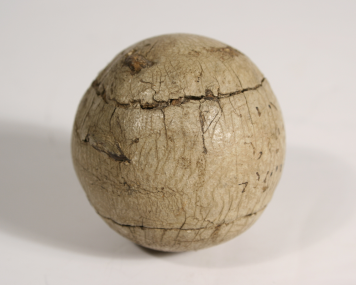
A Featherie Ball

aFor many American golfers, the history of golf begins with the 1913 U.S. Open won in a playoff by Francis Ouimet over Harry Vardon and Ted Ray. The author Mark Frost marks this event as “the birth of Modern Golf” in his bookThe Greatest Game Ever Played. But what about the birth of the game? To get a better idea as to the origins of golf and its early history I would suggest a book called A Swing Through Time — Golf in Scotland 1457-1744 by Olive M Geddes (revised edition published in 2007).  Quoting from the book’s introduction,

This book takes a close look at the earliest written records of golf in Scotland, from the 1457 Act of Parliament banning the game to the first ‘Rules’ of golf — the ‘Articles and Law’ of 1744 drawn up by the Company of Gentlemen Golfers for the competition for the Silver Cup played over Leith Links.

Interestingly, some of these “written records” were recorded in verse. For example, Ms. Geddes devotes a chapter to a discussion of the first book entirely devoted to golf, called The Goff, first published in 1743. It was a mock-heroic epic poem, 358 lines long, written by an Edinburgh lawyer (who later became a Minister) named Thomas Mathison.  A second edition was published in 1763 and a third 30 years later. In 1981 the United States Golf Association published facsimiles of all three editions under one cover in a limited edition of 1400 copies. One of few surviving third edition copes was sold for $80,500 in 1998.

The Goff tells the story of a golf match on the Leith Links played between Castalio and Pygmalion, the heroic combatants of the tale. But the poem also makes reference to some golf related activities of the time. In one interesting section of eight lines, Mathison describes in some detail how featherie golf balls were made:

The work of Bobson; who with matchless art
Shapes the firm hide, connecting ev’ry part,”
Then in a socket sets the well-stitch’d void,
And thro’ the eyelet drives the downy tide;
Crowds urging crowds the forceful brogue impels,
The feathers harden and the Leather swells;
He crams and sweats, yet crams and urges more,
Till scarce the turgid globe contains its store.

Ms. Geddes remarks that “Bobson” probably referred to a St. Andrews ball-maker named Robertson (likely an ancestor of Davie and Allen Robertson). The implication is that although balls were made in Leith at the time, the best balls came from St. Andrews. (Featherie balls dated back to 1618 and were only replaced by Gutta-Percha balls in 1848!) I hope that those of you who might be interested in golf’s early history will have the opportunity to consult A Swing Through Time.

post

A Springtime Exchange Between a Golf Poet and his Editor

Robert K. Risk's book, Songs of the Links (1919), includes the following timely exchange between Risk, the golf poet, and and Garden G. Smith (1860-1913) the editor of Golf Illustrated, the British weekly, for many years and an important contributor to the literature of the game. (Risk's poem has been slightly shortened.)

TO THE EDITOR

Bid me write and I will write
Of club and ball and tee,
Trusting the matter I indite
Will be approved by thee.

Bid me to stay my pen and I
Will muzzle it with grace,
Regarding not impatiently
Regretted "lack of space."

But when you hint that I should do
Some verse concerning Spring,
That, I must frankly caution you,
Is quite another thing.

Although not disinclined to sing,
No poet can ignore
That all that can be sung of Spring
Has been well sung before.

Therefore, should I to platitude
And outworn phrase incline,
The brickbats thrown by readers rude
Are yours, dear sir, not mine.

In Spring we walk the daisied links
Where lively lambkins leap—
Too few of them, one sadly thinks,
Will ever grow to sheep.

In Spring a brighter glitter shines
On the well-burnished cleek,
But still we do 5-holes in 9's
Though playing thrice a week.

In Spring the chronic topper dreams
Of getting down to scratch,
Of being picked in all Club teams,
And winning every match.

In Spring we cease to argufy
About the "best-length hole,"
Which simply means the one that I
Enjoy—and you can't hole.

......

'Tis Spring that whets our appetite
For Three weeks' solid golf,
Though ere the third week is in sight
We shall be direly "off."

In Spring the poet is supposed
Keenly his lyre to tune;
But here these verses are foreclosed,
For I am off to Troon.

And here is the editor Garden G. Smith's response:

THE EDITOR

WITH APOLOGIES TO HIS READERS

'Tis bitter sad the poets should
There work neglect for sport,
Wile Mr. Risk plays golf at Troon,
I am two verses short.

May bunkers trap his longest shots,
May rabbit holes annoy him;
And if this here occurs again
I'm blowed if I'll employ him.