post

Verses for Bubba, The Master’s Champion

A lot has been written about the new Master’s champion, Bubba Watson, since he put on his first green jacket. But unlike, a hundred years ago, it’s all prose and no poetry. So I’ve turned back the clock with a few verses to celebrate his well deserved and colorful victory.

Bubba’s Way 

Bubba doesn’t mind confessin’
He’s got this far without a lesson
But what’s the lesson in the tale
To the top, more than one trail.

Bubba’s Swing

Bubba’s swing is nice an’ breezy
Makes his monster shots look easy
But with that driver you’re tempted to think
They’ve got to go longer because it’s pink.

Bubba’s Shot 

About BW let’s be candid
Fortunate that he’s left handed
If he had hit a slice instead
“Our usual shot,” all we’d have said.

Bubba’s Game

Hit it and find it, that’s his game
To walk that far you’d have to train
And with his flat stick he might sink
Every putt…were it too pink!

Leon S White (golfpoet)

post

Golf Twines from Earlier Times (1898)

I began writing golf twines (two line golf poems for Twitter) in November of 2009. Two line poems are formally called “couplets” and, of course, they have a long history in poetry.

For example, Shakespeare wrote :  “Double, double, toil and trouble;/ Fire burn and caldron bubble” which in read by the three witches in his play, Macbeth.  (This is actually a golf twine now where Shakespeare is referring to Tiger’s scores on the 11th and 12th holes during the second round of the 2011 PGA Championship!)

I was hoping that my golf twines would catch on, and other Twitterers would write them as well. So far no such luck. But then I found William G. Van Tassel Sutphen, a Victorian-era fiction writer, editor of the original “Golf” magazine and author of The Golfer’s Alphabet, originally published in 1898. In The Golfer’s Alphabet, Van Tassel Sutphen wrote 27 golf twines, but he was just a little early for Twitter.

Sutphen, wrote a twine for each letter of the alphabet and added one more for the symbol “&”. His twines were illustrated by A. B. Frost. Frost (1851-1928), was considered one of the great illustrators in the “Golden Age of American Illustration”.

Below is an example:

The caption reads:

.                                                     I is for Iron that we play to perfection,
.                                                     So long as no bunker is in that direction.

And who says golf has changed!

Here are a few others from the book:

C is for Card, that began with a three,
And was torn into bits at the seventeenth tee.

H is for Hole that was easy in four,
And also for Hazard that made it six more.

N is the Niblick, retriever of blunders,
And now and again it accomplishes wonders.

And,

W in a Whisper: “Between you and me,
I have just done the round in a pat 83.”

Sutphen’s book was reprinted in 1967 and is widely available on the net.

post

A Golf Controversy Regarding the Swing

The question, “How do you swing a golf club?” , has no simple answer today or in the past. Almost 70 years ago, J. A. Hammerton wrote this verse that appeared in The Rubaiyat of a Golfer:

Myself when young would hopefully frequent
Where Pros and Plus Men had great argument
On Grips that overlapped, on Swing and Stance
But came away less hopeful than I went.

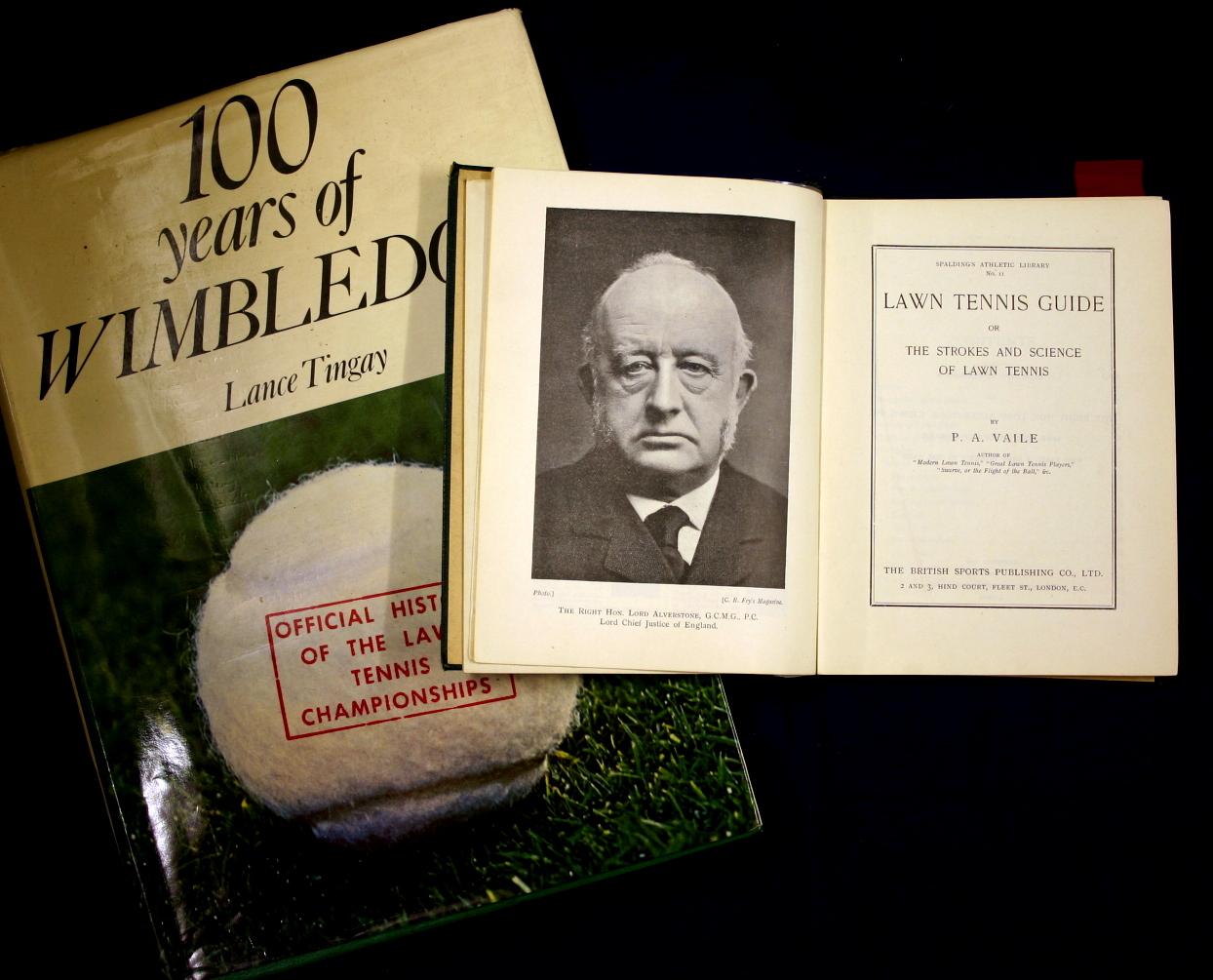
As golf became popular in the United Kingdom and then in the U.S. and other countries around the turn of the 20th Century, golf books became the primary source of swing instruction. Books were written by the major golf professionals of the time and by other self-proclaimed experts as well. One of the most prolific writers on golf and golf instruction in the early 1900’s was a New Zealander named Pembroke Adolphus (sometime Arnold) “Percy” Vaile.  Joseph Murdoch’s book, The Library of Golf, lists eight books by P.A. Vaile. (worldcat.org includes 130 entries for Vaile including a number on Tennis about which he also claimed expertise! See illustration above.)

In one of Vaile’s golf books, The New Golf, published by E.P. Dutton & Co. in 1916, Vaile almost lashes out against the idea that the left hand is dominant in the golf swing:

“The hoariest old tradition that ever fastened on to golf was the power of the left. It was more than a tradition. It was a fetich. Authors and journalists worshiped at its shrine.”

Vaile goes on to attack Vardon, Taylor and Braid (“The Great Triumvirate”) as well as Horace Hutchinson, the great amateur and leading golf writer of the day for their “moldy old idea[s].” Vaile first put forth his ideas in a newspaper article maybe eight years earlier. At that time he was attacked. In his words,

” I was in the thick of it. Anybody who bursts up any useless old tradition, or even gives it a bump, in London, is a fool, a faddist, a theorist, or a revolutionist. If he does not recognize this before he disturbs any of the dust of centuries, and if he is not prepared to accept the position kindly and patiently-and temporarily-he deserves all that is coming to him-and that is much.”

And in those days, attacks were not limited to prose:

THE LEFT HAND’S LAMENT
(Picked up on the links at
St. Andrews)

Since first by Heaven’s august decree
The Royal Ancient Game was planned,
I always was allowed to be
The Master Hand.

To Me did text-books all allot
The part of propulsative strength.
The raking drive, the brassie shot–
I gave them length.

The Right Hand was –poor thing!–designed
To guide the club, and that was all;
Mine was the power that lay behind
The far-hit ball.

Now come there one upon the scene,
Whose heresy fair turns me pale–
The Arius of the golfing green–
A wretch name Vaile.

He says our Vardons, Braids, and Whites
Don’t golf’s dynamics understand;
Their view of Me’s all wrong; the Right’s
The Master Hand.

If Fate would let me but devise
Some torture for this villain bold,
Who thus would revolutionize
Golf’s credos old–

Oh! then to ball of rubber core
I’d change him for a tidy spell,
And drop him in “The Swilcan” or
“The Burn” or “Hell”;

I’d lose him in the rock-strewn sand
Whence few topped spheres ejected come,
Of Musselburgh’s notorious Pand-
Emonium.

Clearly, todays controversies  – one plane vs. two; stack and tilt; Tee It  Forward – are mild in comparison.

post

Indoor Golf in Chicago Now and Then

From the current issue of “GolfTime Magazine,” a biannual guide to golf in the Chicago area:

Experience Chicago’s Most Accurate and Realistic Indoor Golf Facility!

Experience a new paradigm in year-round indoor golf facilities at Play 18 in downtown Chicago’s Loop.  Located at 17 N. Wabash, just a few blocks from Millennium Park, Play 18 aims to offer golf enthusiasts full game play and practice facilities with sophisticated golf technologies, amenities, membership packages and more – all 12 months of the year, rain or shine!

We all know that golf has a long history. But the folks at Play 18 may not know that indoor golf was played in Chicago and nearby more than 100 years ago.  According to Robert Pruter, a major golf instructional school, O’Neil & Fovargue Indoor Golf School (185 Wabash Ave), opened in 1910.  (Whether 185 was North or South Wabash, if the Indoor Golf School existed today it would be a very short walk from there to Play 18!)

But a student of golf poetry would have found reference to the Indoor Golf School, not in Mr. Pruter’s article, but in a poem called “Winter Golf” by Bert Leston Taylor (1866-1921), the great Chicago Tribune columnist.

WINTER GOLF

“All the benefits of outdoors winter golf
in the tropics, at the Indoor Golf School” – AD

Within the grimy Loop’s environs,
The rubber pill may be addressed,
A man may swing his golfing irons,
And let his fancy do the rest.

The murmur in the street below,
The elevated’s boom and roar,
Will sound–if fancy have it so–
Like surf upon a tropic shore.

The air within the driving stall
Does not suggest a Stilton cheese,
To one whose mind is on the ball
‘Tis fragrant as a tropic breeze.

We, upon whom the spell is laid,
For tropic things care not a whoop,
Imagination’s artful aid
Will bring the tropics to the Loop.

The sun, the breeze, the fields, the rest–
Of them let railway folders sing.
We know, who are by golf obsessed,
The Pill’s the thing! the Pill’s the thing.

With its continued relevance, Taylor’s poem may deserve a spot on the wall at Play 18.

post

Two Up on Grantland Rice

Grantland Rice, in his book, the duffer’s handbook of golf, includes a page of  humorous “sayings” under the title, “Short Approaches.” I took two of them, “If at first you don’t succeed, try looking at the ball,” and “He who swings and lifts his head, will say things better left unsaid,” and made four line verses out of them.

GOLF OR BOWLING

If at first you don’t succeed,
Try looking at the ball.
But if that doesn’t work for you
Try bowling or the crawl.

NOT FOR ATTRIBUTION

He who swings and lifts his head
Will say things better left unsaid.
He whose putting’s for the birds
Will likely echo the former’s words.

If you would like to try your hand at extending a Twine (a two line poem), try the following:

To be in the hole and not in a rut
With a short one left, don’t rush your putt.

Add a comment with your finishing two lines and thanks.

post

“Just step up and give it a swat”

Golf tips have become ubiquitous. Pick up a golf magazine, turn on the golf Channel, or check your favorite golf Internet sites and you are likely to be offered lots of concisely packaged ideas to improve your game. This observation led me to Tweet the following two liner a few months ago:

Golf Tip Twine

A thousand tips from Jan to December,
But when you need one, will you remember?

I do not deny that tips are seductive. But they are also often conflicting or incomplete. Sometimes they solve one problem only to create another. They are most similar to whispered betting advice, leading possibly to a few winners, but not many.

When I began playing golf, I benefited from hours of golf instruction given by PGA professionals. From there I went on to study, practice and swear. And now, many years later as a senior golfer, I just try to remember a few fundamentals as I play. At least for me, golf has become more of a game to be enjoyed and less of an application of lessons learned and tips remembered.  In short, the pressure is off.

An anonymous poet, whose poem “The Reason” in included in Lyrics of the Links (1921) by Henry Litchfield West, seems to agree with me.

The Reason

“You are old, Father William,” the young man said,
“And your swing has become very flat,
And yet you incessantly lay the ball dead.
Pray what is the reason for that?”

“In my youth,” Father William replied, “it is that
I studied and practised and swore;
But now I just step up and give it a swat—
What reason for anything more?”

post

After a Foozle, Remember…

There are lots of things to remember when playing a round of golf. Maybe the most important is that golf is a game in which you must only pretend seriousness. It is not an easy lesson to learn. And yet we all want to play as well as we can. So we are forever trying to bring to mind the right tip or the right thought at the right time.

I wrote a Twine (a two line golf poem for Twitter) a while ago that dealt with some of this,

Ubiquitous Golf Instruction Twine: A thousand tips from Jan to December/ But when you need one, will you remember?

As my golf has improved over the years, I try to think less, relying more on ingrained basics. Yet there are a few maxims that I do keep in mind. One is embodied in the following four lines:

Remember

When a golf shot turns out wrong,
The foozle leaves you feeling low.
That’s the time to recall the line:
Don’t hit two bad shots in a row.

LSW

post

‘Now, mind, keep your e’e on the ba’

The following appears in a description of the book A DUFFER’S HANDBOOK OF GOLF by Grantland Rice and Clare Briggs, on the Classics of Golf website.

There is no doubt “duffer” is a pejorative term. While the word’s origin is unknown, it appears in the 1800s as slang for an incompetent, ineffectual, or clumsy person. What better word to describe a neophyte attempting golf? The first “wave” of new golfers occurred when the gutta percha ball became available in the 1850s. Its lower cost and superior durability enticed many citizens to gather a few clubs and try their hand at the sport, some woefully ignorant of the rudiments of the game. “Duffer” first appears in the golf lexicon in 1875 in Clark’s Golf: A Royal and Ancient Game, in a poem by “Two Long Spoons.”

The poem was titled “Duffers Yet,” and was written by Lord Stormonth Darling (1844-1912), a judge, a Scottish Member of Parliament for Edinburgh and St Andrews Universities from 1888 to 1890, and also a golfer. Lord Darling wrote other golf related songs and verses including one called “Keep Your E’e on the Ba’.” It is subtitled, “Ballad of the Beginner,” and tells the story of when on Musselboro’s “famous old green,” Lord Darling, then no doubt a duffer, first “sought for the key to the game.”

The caddie that fell to my lot
Was old, hard of hearing, and wise;
His face had a hue that was not
Entirely the work of the skies:
He knew how the young player tries
To remember each tip all at once,
And, forgetting the vital one, sighs,
And despairs of himself as a dunce.

So, deep in his mind he had set
A rule that pervades all the rest;
‘Tis the maxim you ne’er can forget,
If you w’sh in you game to be blest:
‘Tis the greatest, the first, and the best,
The beginning and end of golf-law;
And ‘twas thus by my caddie expressed ─
‘Now, mind, keep your e’e on the ba’.’

Darling, not satisfied that he had a complete answer, asked other questions. Was he standing properly? What about his grip? Should he worry about the bunker ahead?

To each query the answer I got
Was that rigid, inflexible saw
(Of deafness and wisdom begot),
‘Now, mind, keep your e’e on the ba’.’

Lord Darling concludes,

Whate’er be the mark to be hit,
This truth from the caddie I draw ─
In life, as in golf, you’ll be fit
If you aye keep your e’e on the ba’

Although written more than a hundred years ago, Lord Darling’s words of advice are hard to improve upon!

post

The Prime Minister (to be) is on the First Tee

Arthur J. Balfour (1848 – 1930) was a lifetime professional politician and a long time avid amateur golfer, which left him little time for anything else. He was Captain of the North Berwick club, 1891-92 and Captain of the Royal and Ancient Club of St. Andrews a few years later. He was called by some “the father of English golf,” most likely for his strenuous efforts to promote the game. The high point of his 50 year political career was his time as Prime Minister of the U.K. from 1902 – 1905. Earlier as the cartoon indicates, he was Irish Secretary. He was first known as a renowned philosopher, publishing A Defence of Philosophic DoubtThe Foundations of Belief , and Theism and Humanism .

Balfour the golfer (and philosopher) once wrote:

A tolerable day, a tolerable green, a tolerable opponent, supply, or ought to supply, all that any reasonably constituted human being should require in the way of entertainment. With a fine sea-view, and a clear course in front of him, the golfer should find no difficulty in dismissing all worries from his mind, and regarding golf, even , it may be, very indifferent golf, as the true and adequate end of man’s existence.

In 1894 when Captain of the R & A and following its traditions, Balfour drove off the opening ball at the Autumn Golf Meeting with his friend Tom Morris nearby. Balfour commemorated this event with a poem that will appeal to all golfers who harbor first tee trepidations.

A REAL POLITICAL CRISIS

The crisis came, at that wave-beaten place
Men called Saint Andrews in the golfing years;
Tom Morris watched me with an anxious face,
I, full of nervous fears.

Addressed the ball: the crowd had swelled in size:
Behind the ropes I saw; though scarce alive,
The stern tweed-coated men, with golfish eyes,
Waiting to see me drive.

The feat is far less easy than it seems,
Despite the rival politician’s scoff;
Indeed I marvelled what ambitious dreams
Had tempted me to golf.

For I remembered tee-shots toed and topped,
Sad moments, when the driver firmly clutched
Had done its utmost, yet the ball had stopped
Upon the tee, untouched.

This, after all, is merit’s actual test,
I thought, and other laurels matter not,
For no distinguished man can look his best
After a foozled shot.

Still, let me strike, I said, and gathered heart;
Then, with my eye fixed firmly on the ball—
That earliest canon of the Royal Art—
Drove off—and that was all.

post

Ted Ray’s Golf Swing


The question “What’s wrong with his/her golf swing?”  is often answered today by looking at slow motion video. But the question goes back long before video analysis. It was raised with regard to Ted Ray’s swing shortly after he had participated in the famous 1913 U.S. Open won by Francis Ouimet.

The November 1913 issue of The American Golfer included the following short item titled “Ray’s ‘Sway'”:

Ray comes to us with the reputation of swaying on his up-stroke. Ray does not sway—and we have observed him very closely. What he does is this: Just after the backswing starts the weight is transferred to the right leg; then, about half way up the swing the left shoulder is dropped more or less—a movement in contradistinction to, and offsetting, the first, but to the uninitiated eye, giving every appearance of a sway. The first puts the body weight where it properly belongs—back of the ball—the second enables the arms to complete the upswing. The bending of the knees, more especially the right one, outwardly, creates the false impression of a body sway. It is a sort of leaning in to the ball. Not “according to Hoyle” perhaps, but mighty effective—in Ray’s case.

If you didn’t know, you would have thought that Johnny Miller wrote this! But this was a note in a 1913 golf magazine. And so, not unexpectedly, a short poem was also included:

OH! SAY

Oh! tell us Teddy—Teddy Ray,
Tell us truly, we do pray—
If as some are wont to say,
You do really, really sway.

We ourselves incline that way;
But that is not the proper way,
Our friends inform us day by day
When at the 19th hole we pay.

HIP-HIP-HOO-RAY

Does Ray sway?
Ray does not sway.
He leans; which means
Ray does not sway.

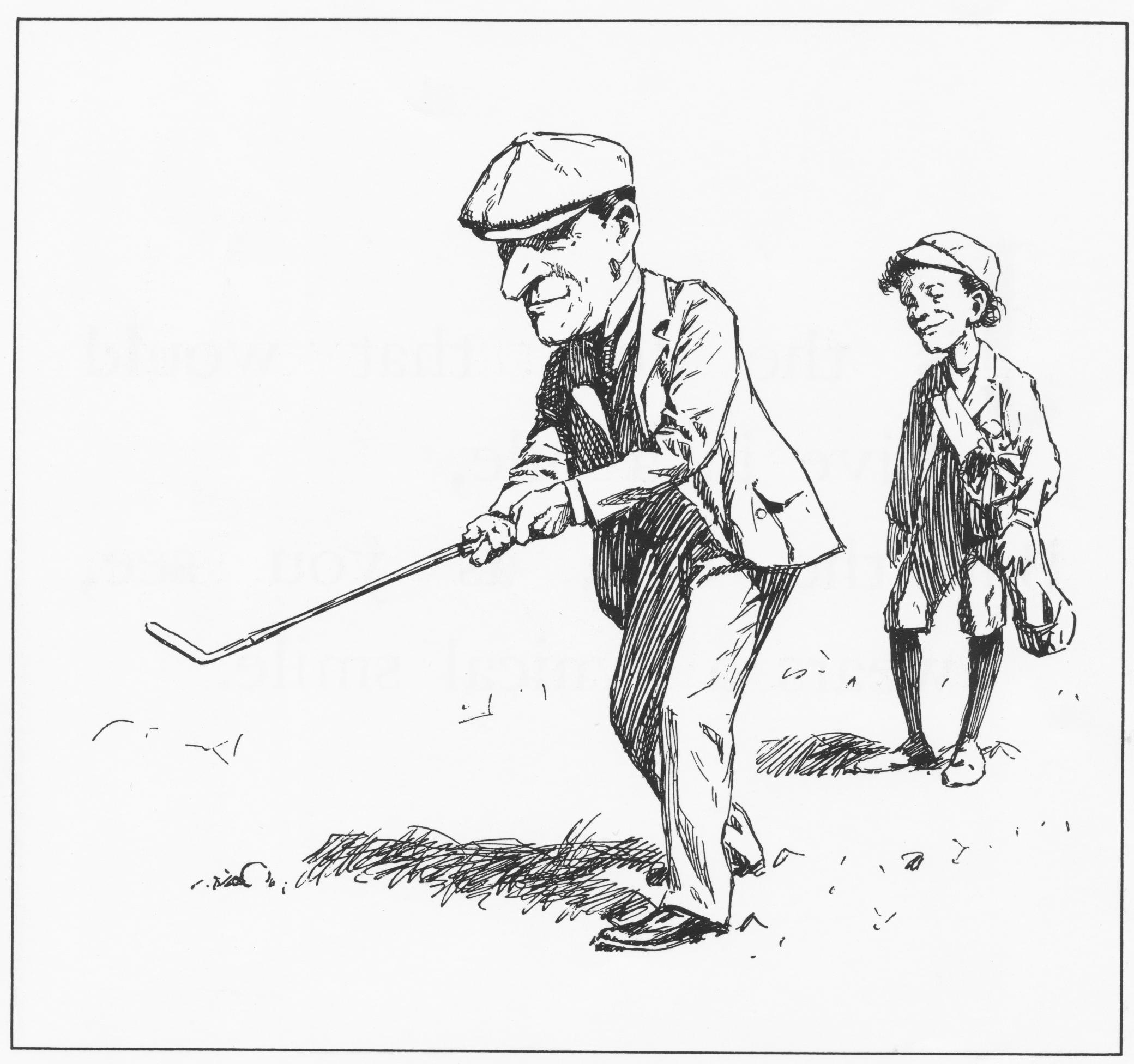
Ray was known for his portly build and prodigious length off the tee, though his ball often landed in awful lies. His recovery powers were said to be phenomenal and cartoonists usually caricatured him with a niblick in hand, festooned with clumps of heather and saplings, with an inseparable pipe clamped between his teeth. During his career he won the 1912 British Open and the 1920 U.S. Open.