post

“The Apple-faced Sage” and Two Enduring Swing Principles

In an earlier post, I included several stanzas from a poem by  Lord Darling called “Keep Your E’e on the Ba’.” While Darling limited his advice to a few lines of verse, Horace Hutchinson (1859-1932), 15 years Darling’s junior, published the first popular book of golf instruction, Hints on Golf in 1886. The book is described on the Classics of Golf website as “The first mass-produced instruction book in the history of golf, the 14 editions of this book are credited with popularizing the written word as a viable means of teaching.” In the Classic of Golf edition, Hutchinson is described as “undoubtedly the first Englishman to become an important figure in the game of golf,” by Herbert Warren Wind, American’s greatest golf writer.Besides being first, Hints on Golf may be the only instruction book ever to employ verse to emphasize important swing principles. Hutchinson writes,
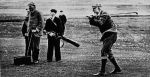
HH 1903

Horace Hutchinson 1903

“The head must necessarily be steady, for it is most important that you should keep your eye fixedly on the ball from the moment that the club -head is lifted from the ground until the ball is actually struck. [Then following Darling} ‘Keep your eye on the ball,’ should be your companion text to ‘Slow Back.’ A golfing poet writes of

The apple-faced sage, with his nostrum for all,
‘Dinna hurry the swing! keep your e’e on the ball!'”

Next time you step up to the tee you might startle the members of your group by reciting the words of “The apple-faced sage”as part of your pre-shot routine!

But two questions remain: Who was this Scottish mentor? And who was the “golfing poet” who immortalized his versified advice? With the help of Google I can report the following: [Read more…]

post

The Language of Match Play in 1504

The poem below, from a book called Lyrics of the Links compiled by Henry Litchfield West and published in 1921, ends with a clever play on words. However, to appreciate the poet’s skill requires an understanding of the language of match play scoring. By way of reference, according to Robert Browning, a noted golf historian, stroke play began in 1759. The first match play of record was between King James IV and the “Erle” of Bothuile on Feburary 3, 1504, about 605 years ago! [Read more…]

post

The Importance of Golf – A Sentimental View from the Past

A hundred years ago, golf was a game to embrace for its personal challenges, competitive qualities and unique history. It was not yet a big time professional sport. Nor was it a huge business dependent on tour sponsors, equipment sales and resort travel. It was just golf played for enjoyment, “for [its] vigor without violence, for life-long joy of youth.” The relationship of the average golfer to golf was straight forward. He was a duffer trying to improve without much help from his golf clubs or the few sources of instruction then available. Golf poetry at that time provided an interesting window into the minds of ardent golfers. [Read more…]

post

Doug Sanders’ British Open Miss for the Ages

Doug Sanders misses 30 inch putt

Doug Sanders misses 30 inch putt

My previous post celebrates one of Tiger Woods’ greatest moments when he chipped in on the 16th hole at Augusta during the 2005 Masters Tournament which he won.

Unfortunately, not so great moments have their place in golf history as well. In 1970, Doug Sanders, described by Golf Hall of Famer Johnny Miller as “a crowd-pleasing showman who dressed loud, lived fast and made golf the glamour game it was in the 1960s and ’70s,” missed a critical putt on the eighteenth green at the British Open. I wrote the following poem to memorialize this famous run-by that cost Sanders the tournament. [Read more…]

post

Tiger Woods’ Masters Chip for the Ages

The PGA.com headline read “The Chip Heard ‘Round the World.’” The shot, of course, was Tiger Woods’ chip from behind the sixteenth green on the final day of the 2005 Masters. Art Spander, an Oakland Tribune’s golf writer, started his article: [Read more…]

post

Ageless Advice from Lord Darling

The following appears in a description of the book A DUFFER’S HANDBOOK OF GOLF by Grantland Rice and Clare Briggs, on the Classics of Golf website.

There is no doubt “duffer” is a pejorative term. While the word’s origin is unknown, it appears in the 1800s as slang for an incompetent, ineffectual, or clumsy person. What better word to describe a neophyte attempting golf? The first “wave” of new golfers occurred when the gutta percha ball became available in the 1850s. Its lower cost and superior durability enticed many citizens to gather a few clubs and try their hand at the sport, some woefully ignorant of the rudiments of the game. “Duffer” first appears in the golf lexicon in 1875 in Clark’s Golf: A Royal and Ancient Game, in a poem by “Two Long Spoons.” [Read more…]

post

Welcome to Golf Course of Rhymes

Golf’s long and colorful history is well documented. It origins, however have always been uncertain. Sir Walter Simpson, an early golf historian, writes in The Art of Golf, published in 1887, that golf at St. Andrews probably began when a shepherd idly hit a stone into a hole with his crook. An anonymous nineteenth century poet gives us a charming poetic version of this apocryphal story. [Read more…]