post

Does Golf Improve Health? – A Turn of the Century (20th) View

PlayGolfForHealth

Before I begin, please note that this Post is not an argument for adding Golf to the President’s Health Care Reform Bill!

According to Murray G Phillips, an Australian sports historian writing in the May 1989 issue of the Journal of the Australian Society for Sports History, around the beginning of the 20th Century,

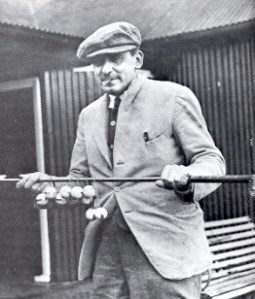
“Golf’s major justification rested on the belief that sporting participation improved one’s health. The game was lauded for its ability to aid in health-related matters. Consider the testimony of the English champion of 1902 [Sandy Herd] who was successful at 53 years of age. To him it was ‘golf and golf alone that kept him of the youthful side’.”

Philips goes on the quote a review article on golf in Australia written around 1900 in which the writer claims that,

“There is no other form of sport which is so recommended by the medical faculty.”

Interestingly, some of the golf poetry of the time echoed this theme. For example, from a 1906 issue of Golf Illustrated,

There is an old person of Bickley
Who for sixty long years had been sickly;
.       Since taking up golf
.       His ailments are off,
He’s renewing his youth very quickly.

Here are a quick four lines from an 1893 issue of Golf,

To drive the Golf ball on the ground,
To spoon it o’er the hill,
Will keep both mind and body sound,
And save the doctor’s bill.

And in another issue of Golf, later the same year, a poem “A Song of Golf” included the following healthful and colorful stanza:

When doctors fail to cure you, and you go from bad to worse,
Your head just like a toy shop, and existence but a curse,
You need not knuckle under, be it fever, chill, or cough,
Just take your clubs and caddie, and then whack away at Golf.
.                Then whack away at Golf,
.                Then smack away at Golf,
You can banish pills and potions if you whack away at Golf.

(These verses all come from an unpublished collection of poems put together by the late Joseph S. F. Murdoch, the renowned golf book collector and bibliographer. I was extremely fortunate to receive a copy of this collection from one of his close friends.)

It is interesting to note that today, at least in the U.S., the health benefits of golf are often lost to golf carts, unwalkable golf courses and cigars. Meanwhile, many professional golfer prepare to play golf by adhering to rigorous exercise routines designed by expert trainers. Golf isn’t the source of their improved fitness, it’s the driver.

post

Golf and the Need for Self-deception

Bernard Darwin

Bernard Darwin

Herbert Warren Wind, himself an outstanding golf writer, described Bernard Darwin as “the greatest writer on golf the world has ever known.” Darwin (1876 – 1961), was a grandson of Charles Darwin. He was trained in law at Cambridge where he also played golf.  He disliked the practice of law but loved golf. So despite having no formal training, he began what would become an illustrious career writing about golf. He covered the sport for The Times of London from 1907 to 1953 and for Country Life from 1907 to 1961, the first writer ever to cover golf on a daily basis, instead of an occasional feature.

Darwin wrote more than 20 books on golf. In one, simply called Golf, he wrote,

“Is there any other game in which the player is so constantly wondering what is the matter with him and so regularly finding a cure which he believes will heal him for ever, only to suffer a dreadful relapse next day? I can hardly think there is since so few other games give the same opportunity for solitary practice, and it is the solitude above everything else that promotes this pleasant  form of self-deception.”

Robert Risk, a Scottish writer and poet, published a book of 36 poems in 1919 called Songs of the Links that included a poem “The Golfer’s Discontent” that expands on Darwin’s observation. The last stanza is acutely perceptive.

The evils of the Golfer’s state
Are shadows, not substantial things—
That envious bunkers lie in wait
For all our cleanest, longest swings;
The pitch that should have won the round
Is caught and killed in heavy ground.

And even if at last we do
That 80, coveted so long,
A melancholy strain breaks through
The cadence of our even-song—
A 7 (which was “an easy 4”)
Has “spoilt our 77 score.”

And thus, with self-deception bland,
We mourn the fours that should have been,
Forgetting, on the other hand,
The luck that helped us through the green;
Calmly accepting as our due
The four-hole which we fluked [luckily stroked] in two.

The drive that barely cleared the sand,
The brassy-shot which skimmed the wall
The useful “kick,” the lucky “land” —
We never mention these at all;
The only luck that we admit
Is when misfortune comes of it.

And therefore, in a future state,
When we shall all putt out in two,
When drives are all hole-high and straight,
And every yarn we tell is true,
Golf will be wearisome and flat,
When there is naught to grumble at.

post

Advice on Putting in Prose and Poetry

Fig-40-PUTTING-OFF-THE-LEFT-LEG-MR-l-AIDI-AY-ADDRESSI

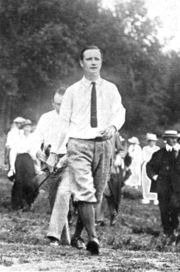
In last week’s Post I included a poem, “Dedicated to the Duffer” from a book, The Winning Shot, by Jerome Travers and Grantland Rice published in 1915. But what is “the winning shot?”  According to Travers, who won the U.S. Amateur Championship four times and the U.S. Open once,

“Undoubtedly “the winning shot” in golf is the putt. There can be no question about it.”

Travers later on in the chapter continues,

“We all know that there is less of the physical and more of the psychological in putting than in any other part of golf. To be putting well the golfer must have absolute control of his nerves…”

Travers ends the chapter with “a few condensed suggestions” to improve your putting:

  1. Stand well over the ball and keep your head still.
  2. Keep your eye on that ball and don’t move your body.
  3. Cut out the jab or the stab, learn the pendulum swing, and get a follow through with the club.
  4. Cultivate, in practice as well as play, the knack of being a trifle beyond the hole if you miss. Make a steady practice of giving the ball a chance.
  5. Cultivate the habit of concentration.
  6. Cultivate the habit of confidence and determination, for mental faults can be improved as well as physical ones.
  7. And then practise putting wherever and whenever you get the chance.

Remember these words were written almost 100 years ago. They hold up well when reading the modern gurus Pelz, Utley, Rotella and Valiante.

And yet, as the following poem suggests, when you compare all the words of wisdom regarding putting, the result is more often confusion than improvement.  [Read more…]

post

U.S. Open Champ and Ace Sportswriter Produced Golf Book of Prose and Poetry

Jerome Travers 1915 Open

Jerome Travers 1915 Open

Grantland Rice

Grantland Rice


The November 1917 issue of The American Golfer includes a column by a writer who used the pen-name  “Sam Solomon” in which he considers the relationship between golf and poetry:

“A certain affection appears to exist between the spirits of this game and the muse of verse. There is an old affinity between golf and poetry. It is natural, surely, that is should be so, when we consider that golf is a thing of Nature and freedom and the open world, and makes a riot of the emotions, and that, again, it is a thing of history and traditions, and colourful romance all the way from the beginning until now. Great pictures have been painted of golfers at their game; statues of golfers have been raised; art and the sport have had much to do with one another, and agreeably so.”

He continues,

“Here in America there has for long been the tendency in the game to versify. Our own pages within the golden covers from time to time bear witness of it. Perhaps Grantland Rice has come nearest of all Americans to the true sentiment coupled with graceful phrasing, and he has maintained the most indispensable quality of dignity. He has known that the truth can often be told in verse better than any other way. In his [poem] “Dedicated to the Duffer” at the beginning of The Winning Shot, and elsewhere in that book, there are some pretty pearls:”

This is the substance of our Plot—
For those who play the Perfect Shot,
There are ten thousand who do not.

For each who comes to growl and whine
Because one putt broke out of line
And left him but a Sixty-Nine.

At least ten thousand on the slate
Rise up and cheer their blessed fate
Because they got a Ninety-Eight.

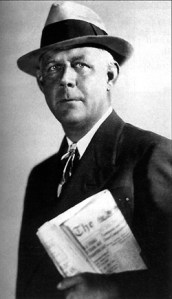
The Winning Shot (published by Doubleday, Page & Co. in 1915) was actually written by Jerome Travers, a great amateur golfer of the early 20th century who won the U.S. Amateur Championship four times and won the U.S. Open as an amateur in 1915 at Baltusrol. Travers wrote the prose and Grantland Rice, arguably the greatest sportswriter of the first half of the 20th century, wrote the poetry. Rice, of course, is best known for his lines,

For when the One Great Scorer comes
To write against your name,
He marks – not that you won or lost –
But how you played the Game. [Read more…]

post

The Origin of The Royal and Ancient Game of Golf

image0-4

With the site of the British Open at Turnberry in Scotland next month, it’s an appropriate time to review what is known about golf’s beginnings.

We know that the earliest written reference to golf in Scotland was in the famous Act of Parliament of 1457. We know as well, as Robert Browning writes in his book A History of Golf (1955), that

“from the Peace of Glasgow in 1502 to the Revolution of 1688, every reigning monarch of the Stuart line — two kings and one queen of Scotland, four kings of the United Kingdom — was a golfer.”

It’s not called “The Royal and Ancient Game of Golf” for nothing!

But what of golf’s actual origin, its “big bang?” Sir Walter G. Simpson in his book The Art of Golf, published in 1887, suggests the following “two shepherds theory:”

“A shepherd tending his sheep would often chance upon a round pebble, and having his crook in his hand, he would strike it away…On pastures green this led to nothing : but one on a time (probably) a shepherd, feeding his sheep on a links—perhaps those of St. Andrews—rolled one of these stones into a rabbit scrape. “

The shepherd then hailed another who attempts to duplicate the feat, but fails. They then deepen the rabbit scrape and begin practicing. Simpson continues, [Read more…]

post

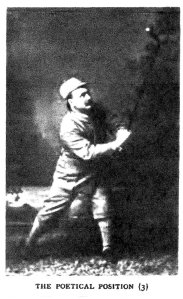
Golf Instruction With Illustrated Poetical Positions!

image0-1image0

image0-2

FORE

Fore, lads! Keep out o’ the line o’ fire,
And I’ll teach ye to drive a ba’,
That’ll flee to the clud, and fa’ wi’ a thud,
Twa hundred yards awa’.

Ye maunna (must not) be stridin’ your legs ower wide,
Like a puddock (frog), across the green,
Nor be haudin’ your elbows pinned to your side,
And lettin’ your nails be seen.

And dinna be bendin’ your chin to your knees,
At an angle o’ forty-five,
Nor wrigglin’, as if ye were treadin’ on peas:
Keep your energy a’ for your drive.

Fix your e’e on the gutta, stride fair, feet square,
Elbows free, gie (give) your back a bit thraw (a small turn)
Heel up; swing your club round the nape o’ your neck,
Whish, click, and the ba’s awa’!

The above, in a slightly different format, appears on page 503 of the Rev. John Kerr’s The Golf-Book of East Lothian published in Edinburgh in 1896. This is clearly an early example of illustrated golf instruction so common in today’s golf magazines and instruction books. But it is surely unique in its description of the three “poetical” positions. The poet was A. P. Aitken, D. Sc., lecturer on Agricultural Chemistry at the U. of Edinburgh and member of the Gullane Golfers, an East Lothian golf club formed in 1868.

Kerr’s book was the first to be written about a golfing area or club. Decent first edition copies are rare, often selling for well over $1000 when available. Joseph Murdoch points out in his book, The Library of Golf 1743-1966, that the first action pictures (not posed) appeared in How to Play Golf by H. J. Whigham published in Chicago in 1897.

post

Be a Happy Golfer; Just Play and Have Fun

The-Happy-Golfer

Here is a list of golf books that you might consider to help you improve your game:

The Happy Golfer by H. Leach
Advanced Golf by J. Braid
How to Play Golf by H. Vardon
Golf Faults Illustrated by J. H. Taylor
Golf for the Late Beginner by Henry Hughes
The Golfer’s Pocket Tip Book by G. D. Fox
Modern Golf by P. A. Vaile
Success at Golf by H. Vardon, F. Ouimet, and others.

Though their titles look current, these books were included in an advertisement in the September 1914 issue of the magazine Golf/USGA Bulletin. The first golf instruction book published in the U.S., Golf in America: A Practical Manual, by James Lee, appeared in 1895.

 Of course, if instruction books don’t help enough, you can always take lessons from a Professional. And neither lessons or books will help much if you don’t practice. But then Malcolm Gladwell in Outliers tells us that 10,000 hours or more or practice are needed to excel. What to do? [Read more…]

post

An Old Golf Magazine and a Poem for Old Golfers

waltertravis

Walter J. Travis

The first issue of the magazine The American Golfer hit the newsstands in November 1908, a little over 100 years ago. It would fold in 1936 during the Depression.

 In the beginning, much of the news provided by the magazine’s correspondents related to amateur golf matches sponsored by local golf clubs in various regions of the country and in Great
Britain. These reports were written under such headings as: “Eastern Department”, “Western Department,” “From the South” and “Foreign Notes.”

 Within a year, the local news reports became more local with “Around Philadelphia” and “Pittsburgh Notes” added to chronicle the activities of the golf tycoons Wanamaker, Havemeyer, Carnegie and Frick. As time went on and golf became more popular, more areas, New York State, Ohio, the Pacific Slope, separately reported in as well. This primary focus on amateur golf was gradually replaced with articles on professional golf and golfers and instruction articles by writers and golfers such as O. B. Keeler, Bobby Jones, Bernard Darwin, Tommy Armour and others.

 Early issues of The American Golfer also included reports on U.S.G.A. sponsored championships, decisions of the Rules of Golf Committee, descriptions of new golf courses and articles on golf history, and golf course maintenance. And from the beginning, the magazine offered its readers golf poems in every issue.

 The first editor of The American Golfer was a transplanted Australian named Walter J. Travis. Grantland Rice, the only other editor of the magazine, wrote of Travis, “In many respects [he] will stand as the most remarkable golfer that ever lived.” Travis began playing golf in late 1896 at the age of 35. He won the first tournament he ever entered about a month later. In 1900 he won his first U.S. Amateur Championship and over the next four years would add two more plus a British Amateur Championship as well. He ended his tournament career by winning the Metropolitan Championship at age 54 in 1915. In this, his last tournament, he beat Jerry Travers, the U.S. Open Champion of the same year. [Read more…]

post

Footnote: Gray’s “Elegy” Inspired a Second Golf Parody

Could there be more than one golf parody of Gray’s “Elegy?” Surprisingly, the answer is yes, and, therefore, a “footnote” to this week’s Post. (And being a footnote, it is not required reading.) [Read more…]

post

If [Thomas] Gray Had Been a Golfer

Gray's Churchyard

A Country Churchyard

This post introduces an unusual but historically interesting golf poem called “If Gray had been a Golfer” by Samuel E. Kiser (1862-1942), a newspaperman, poet and humorist. Kiser’s poem of nine stanzas is a parody of a much longer poem “Elegy Written in a Country Churchyard” written by the English poet Thomas Gray (1716-1771) and first published in 1751.  

Gray’s poem has been described as “one of the greatest poems in the English language,” and as such was often a candidate to be parodied. Also, two lines from the poem have inspired movie titles: “The paths of glory lead but to the grave” and “Far from the madding crowd’s ignoble strife.”

One of the themes of the poem, as embodied in the stanza below, is that poverty or other barriers prevent many talented people from fully exercising their capabilities.

Full many a gem of purest ray serene,
The dark unfathom’d caves of ocean bear:
Full many a flow’r is born to blush unseen,
And waste its sweetness on the desert air. 

Kiser adopted this theme for his poem memorializing the “golfless” poor.   [Read more…]