post

A Pitch for Golf Poetry

I’ve been writing golf poems for this blog for more than 15 years. (Most are included in my book, If Golf Balls Could Talk, available on Amazon.) But, I’ve never written a poem that promotes golf poetry, that is until now. Let me know what you think.

A Pitch for Golf Poetry

Why not learn golf
A different way?
Read a golf poem
At least one a day.

I’m betting the poems
Will lower your score;
If that’s not the case
Then search for more.

Some titles to start with
Hope they attract;
I know it’s poetry
But don’t hold back.

The first one is called
“Far and Sure;”
If your drives are unnerving
It may be the cure.

How about this one,
“The Futility of Thinking;”
It’s a definite winner
If your putts aren’t sinking.

“Dedicated to a Duffer”
May be for you
If you’re just starting out
And haven’t a clue.

By now it should
Be clear as a bell;
Choose poetry not Pros
And your game might gel.

Leon S White, PhD

("Far and Sure" is both a song, by a Canadian, Edward Atherton and a poem by "the late Sheriff Logan." Don't know anything more about the sheriff. "The Futility of Thinking" is one of mine. And "Dedicated to a Duffer" was written by the great sports poet and writer Grantland Rice.)
post

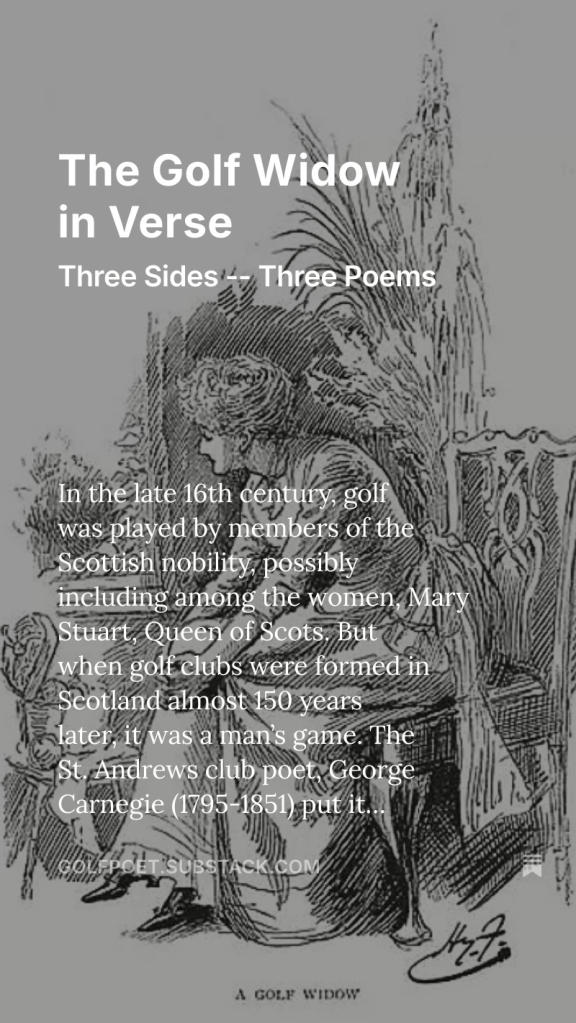
A New Substack Post – The Golf Widow in Verse

I’m using my Substack site to publish longer pieces about the poetry of golf. “The Golf Widow in Verse” is my second post. My poetry and shorter golf poetry pieces will continue to appear on this blog. Also note that the blog already contains more than 260 entries. If you have time, I hope you will find some interesting poetry among them.

Here is the link: https://golfpoet.substack.com/p/the-golf-widow-in-verse?r=zljx

post

Substack Site

I’ve decided to create a Substack Site for longer articles. I just published my first one which you can read at https://golfpoet.substack.com/p/links-between-golf-and-poetry-from. Here is a summary of of what I wrote:

“Links Between Golf and Poetry from the Earliest Days” delves into the rich history of golf and its poetic connections, providing many examples. It begins with a charming anecdote from 1894, where Arthur Conan Doyle, the creator of Sherlock Holmes, gave golf lessons to Rudyard Kipling. Doyle, a lifelong golfer, expressed his love for the game in a poem titled “A Lay of the Links.”

The earliest known golf poem dates back to 1687, written by Thomas Kincaid, an Edinburgh medical student. The first book of golf poetry, The Goff, was published in 1743. The rise of golf clubs in Scotland in the 18th century led to a flourishing of golf poetry, with many early golf writings being in verse form. George Fullerton Carnegie, known as “The Golfer’s Poet,” published Golfiana in 1833, a significant collection of golf poems.

David Jackson, another notable golf poet, published Golf – Songs and Recitations in 1886, expressing his love for the game through poetry. The article also mentions the role of golf magazines in promoting golf poetry, with publications like Golf Illustrated and The American Golfer featuring poems extensively.

The article contains poems from the humorous to serious, with poems addressing topic including the frustrations of the game, the notion of the “golf widow,” and even political and social issues. Notably, Sarah N. Cleghorn used golf imagery to protest child labor in her poem “Through the Needle’s Eye.”

Overall, the article illustrates how golf and poetry have been intertwined for centuries, with writers using aspects of the game as the starting points for their poems. This historical connection identifies a unique and enriching dimension to the literature of golf.