post

Golfing Truths

A golfing truth:

Golf is changing always changing
When you’re talking balls and clubs;
But if you’re talking golfing talent
Dubs today are still just dubs.

To validate this “golfing truth” one need only consult the golf poetry of close to 100 years ago. For example, Grantland Rice, the best American sports writer of the time and also the best sports poet, wrote the following lines which are found in his book Songs of the Stalwart (New York: D. Appleton and Company, 1917), and to which we can still relate.

THE LAND OF PAR

There are days when my drives wing far,
When my iron shots clear the rut;
But then when I get on the green in two
I putt and I putt and I putt.

There are days when my chip shots roll
Like a Vardon’s to the pin,
But I’ve missed my drive and I’ve taken six
At last when the putt drops in.

There are days when my putts run true
And straight to the waiting hole;
But these are the days when my mashie shots
Have shattered my aching soul.

Oh, gods of the golfer’s realm,
Over the bunkered heather,
When is the day to come when I
Hook three fine shots together?

But fortunately,

From time to time we make those shots
Instead of just imploding;
Then brief delight is our lot  
And we make like Vesuvius exploding.

post

Na Yeon Choi – U.S. Women’s Open Champion

no preview

Less than two weeks ago, Na Yeon Choi won the U.S. Women’s Open by four shots over Amy Yang. Choi began the day with a six shot lead. And at the turn, she still led Yang by five. Then it got interesting.

 The newspapers and magazines have told the story of the last nine holes in straight forward prose. I thought it would be fun to re-cast this minor epic in a more traditional form.

Na Yeon Choi – U.S. Women’s Open Champion

She was cruising along with a five shot lead
And just nine more to play
But the ever present golf gods
Had not yet had their say!

As she turned for home with a  big Open lead
Fans saw her name on the cup
Especially now with it down to a match
And she was the on five up.

But the golf gods knew the score as well
And on ten they went into action
Soon enough Na Yeon Choi
Was losing more than just traction.

Her drive went out and couldn’t be found
She was back on the tee for her third
When her putt finally sank she was up only two
But surprisingly undeterred.

A resolute Choi bounced right back
With a birdy on eleven
The golf gods were clearly hard at work
In the depths, then close to heaven.

The down and up would continue
From the next tee into high weeds
But a brilliant wedge put her ball on the green
And she holed with a perfect read.

On thirteen the gods gave one final scare
Her ball hit two rocks, au revoir
But dry it remained miraculously
Choi then made an up and down par.

In the end the golf gods seemed to remember
A dream from way way back
When Na Yeon first said “I just want to be there”
While watching Se Ri Pak.

Accepting the cheers as she walked up the last,
Her win beyond a doubt
Standing where her hero had stood
She finally putted out.

“I’m here right now and I made it” she said
After winning ─ though I would wager
The thought that was foremost in her mind —
Like Se Ri, I’ve won this Major.

Leon S White
July 12, 2012

post

Golf Poem to Commemorate George Wright – A Baseball Hall-of-Famer

The Baseball All-Star game will be played this week. I can’t think of a better time to recall a baseball player who had a profound early impact on golf in America. No, it’s not A. G. Spalding although he would qualify. Rather, the player I’m thinking of is George Wright. “Who?”, you say. Here is an excerpt from my book, Golf Course of Rhymes – Links between Golf and Poetry Through the Ages, that will give you the answer.

“… on December 10, 1890, with almost no one watching, George Wright, later a baseball Hall-of-Famer, and three friends played the first round of golf ever in Boston. Wright, baseball player turned golfer, created the first great moment for New England golf. Earlier, in 1871, with his baseball career over, Wright, along with Henry Ditson, formed the sporting goods company, Wright and Ditson. Their company was bought out by A. G. Spalding & Co. in the early 1890’s. Up to the buyout, Wright and Ditson had imported all of its golf merchandise from Scotland. Later, Spalding & Co. began producing its own clubs under both the Spalding and the Wright and Ditson names. George Wright’s accomplishments moved me to write a poem commemorating him:

George Wright (1847–1937)

He never had an equal as a fielder
He ran the bases better than the rest
As a hitter he was feared and fearless
In his time George Wright was unsurpassed.

In ’69 he played for Cincinnati
Standing out at bat and on the field
He revolutionized the play at shortstop
And hit .633 which was unreal.

From Cincinnati he moved on to Boston
The Stockings first, the Red Caps later on
He led the mighty Sox to four straight pennants
Then with the Caps another two he won.

His ball field feats were cheered by all who saw him
He was an early hero of the game
Still it took the voters until thirty-seven
To elect him to the Baseball Hall of Fame.

Wright the player is today all but forgotten
But with regard to fame another claim
Retired from the ball field but still active
He brought to town the great old Scottish game.

A permit from the Boston Parks Commission
Let Wright lay out some holes at Franklin Park
Then on a cold fall day in eighteen ninety
He took along three pals to play ’til dark.

So add the name George Wright to your sports heroes
A pioneer in not one sport but two
The father of the golf game in New England
A double Hall-of-Famer through and through.”

post

A Golf Poem by Herbert Warren Wind!

Herbert Warren Wind, golf writer

After the U.S. Open Championship ends as it did so dramatically last Sunday, you might look forward to what the pundits on the Golf Channel or in the newspapers, golf magazines and blogs have to say.  Years ago, if you followed golf faithfully, you waited patiently for Herbert Warren Wind’s New Yorker article. And you were never disappointed. Wind, who graduated from Yale University, and earned a Master’s degree in English Literature from the University of Cambridge, began writing for the New Yorker in 1941. He covered the major golf tournaments for the magazine from 1960 to 1990 when he retired, a period when television coverage was for the most part still limited.

Wind often wrote in the first person and his reports always described the scenes he witnessed most vividly. For example, writing about the 1956 Open at the Olympic Club, at a point soon after television coverage had ended by proclaiming Hogan champion,

            “In the clubhouse—how sharp the picture remains!—Hogan sat slumped before his locker, patiently answering the questions of the press but sidestepping all congratulations with the reminder that his victory was not yet official, since some players were still out on the course.”

Later in the same paragraph,

“The news that filtered in was not hard and exact, but [Jack] Fleck was reported to have parred the thirteenth and bogeyed the fourteenth. Now, to tie he would have to birdie two of the last four holes. It was at about that time that I decided to get out on the course again.”

Catching up with Fleck on the par-3 fifteenth hole, Wind continued,

“As I was trying to find elbowroom in the crowd, a galvanic shout went up. Fleck, a frenzied man informed me, had holed from 9 feet for a 2. Now all he had to do was birdie one of the last three holes—not that this would be easy.”

With Wind’s retirement golf writing took a hit from which it may never recover.

As far as I knew, Wind confined himself to prose, so I was surprised to learn (from Bill Scheft, a Wind nephew) that Wind’s first contribution to the New Yorker was a poem. With Scheft’s help I found the poem on the last page of Herbert Warren Wind’s Golf Book. I offer it more as an historical artifact than great poetry. Wind’s prose will more than suffice.

Upbringing

The elevator man’s son counts:
1,2,3,4,5,6,7,8,9,10,11,12,14 and so on.
And sometimes mezzanine.

The porter’s son counts by fives:
5,10,15, and carry one, 15,20,25, and carry two. Or
By tens should speed require.

The agent’s son counts by fractions:
1-1/10, 2-1/10, 3-1/10, and so on.
He does it in his bean.

The golfer’s son counts:
1,2,3,fore,5,6,7. And balks
At counting any higher.

post

Golf Poetry – Who Wrote it; Who Reads It (Part 2)

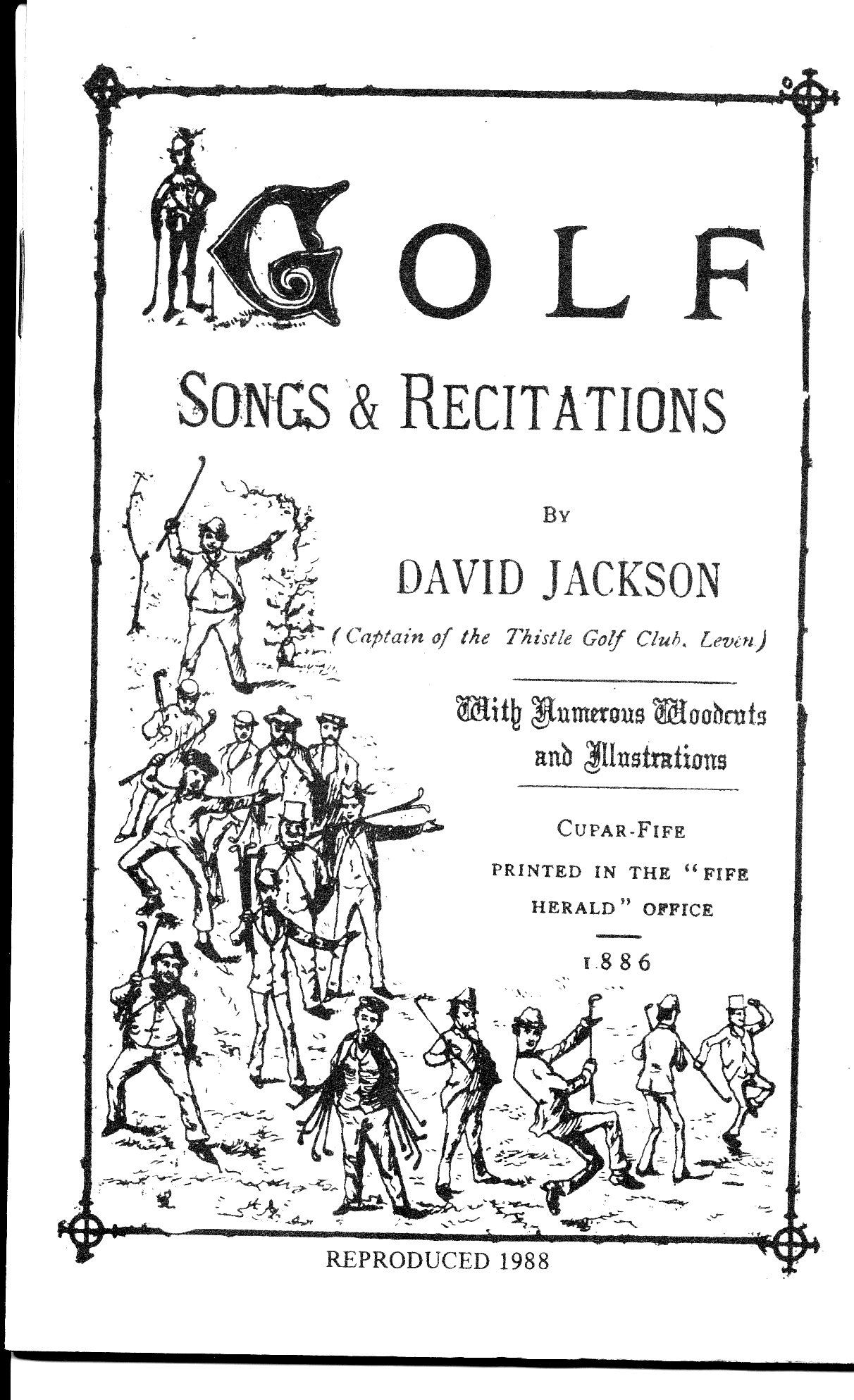
In 1886 David Jackson, the Captain of the Thistle Golf Club in Scotland, published a 32 page tract of poems and songs at the “repeated request of many members of my own and other Clubs.” Earlier in 1833, George Fullerton Carnegie privately published a long poem called “The Golfiad” which he dedicated the “Members of all Golfing Clubs, and to those of St. Andrews and North Berwick in particular.” They were his readers.

In the first 30 years or so of the 20th century, the audience for golf poetry expanded. The poetry appeared in golf magazines in both the United Kingdom and the United States and in a few newspapers as well.  A number of (real) books of golf poetry were also published But after about 1930, golf poetry lost its place as a part of the literature of golf and all but disappeared. As Grantland Rice saw it, “…good poets suddenly disappeared and readers for some reason lost the old poetic zest.” It may also be that movies, radio and other sources of entertainment began to attract audiences away from poetry in general.

Today poets struggles to attract an audience and golf poetry has few serious adherents. But we can, with the help of the internet, libraries and the digital reprinting of out-of-print books, rediscover the golf poetry of the past, which is what I have attempted to do with this Blog and my book Golf Course of Rhymes – Links between Golf and Poetry Through the Ages. And happily a number of readers have responded.

With the help of WordPress.com, my Blog host, I can tell you that golf poetry today enjoys a wider audience than ever before. Poetry on this Blog has been read (and hopefully enjoyed) by readers in more than 70 countries. Leading the list are the countries most associated with golf’s history, the United States (54% of the page views), the United Kingdom (21%), Canada (6%) and Australia (3.3%). But all of the continents have contributed viewers and the Blog has even had four page views from Iceland and two from Belarus! Page views in total for the three plus years of this Blog have passed 67,000.

Reading and even more so, reciting golf poetry is a new experience for most of today’s golfers. So, if it’s new for you, why not begin by reciting the last four lines from one of David Jackson’s poems, “Gouff Dings A’” loosely translated as “Golf Surpasses All,”

Then, let us swell the mighty throng of Princes, Lords, and Kings
Who have enjoyed the game of Golf above all other things
And wish success to every one, let him be great or sma’,
Who loves the jolly game o’ Gouff–for Gouff dings a’. 

 And sometimes poetry dings prose.

post

The Mental Game in Prose and Poetry

Product Details

I’ve been reading Dr. Bob Rotella’s new book, The Unstoppable Golfer, (written with Bob Cullen)His basic thesis is that to play your best golf you need to develop repeatable sensible pre-shot routines, establish targets for all your shots and then go as “unconscious” as you can while hitting the shot or putting. While this approach is important for all shots, Rotella believes it is especially important for the short game. Rotella assumes that the reader can play, but is being stopped from improvement by a weak mental game that shows up more frequently from 100 yards in. By following Rotella’s mental prescriptions readers will become “unstoppable”  on the golf course. The book is easy to read and his mental game approach is well accepted among professionals. If you are looking for help with your short game and know the basics of chipping, pitching and putting, this book will help.

In the book Rotella rightly points out that sports psychology is a relatively new profession. However, he may not have come across what is likely the first reference to the mental game which appeared in a poem written by an Edinburgh medical student in 1687! The 12 line poem appears in Thomas Kincaid’s diary and is the first poem entirely about golf.

Gripe fast stand with your left leg first not farr
Incline your back and shoulders but beware
You raise them not when back the club you bring
Make all the motion with your bodies swinge
And shoulders, holding still the muscles bent                   (5)
Play slowly first till you the way have learnt
At such lenth hold the club as fitts your strength
The lighter head requires the longer lenth
That circle wherein moves your club and hands
At forty five degrees from Th[e] horizon stands             (10)
What at on[e] stroak to effectuat you dispaire
Seek only ’gainst the nixt it to prepare.

The mental game reference is in lines 11 and 12. These last two lines suggest that if you hit a bad shot, put it out of your mind when preparing to hit the next. Still good advice.

In my book, Golf Course of Rhymes – Links between Golf and Poetry Through the Ages I include a poem that I wrote which sums up the challenge of following the prescriptions in Dr. Rotella’s tome.

The Futility of Thinking

With golf and sleeping
The more that you think
The odds of succeeding
Are likely to shrink.

Be it sheep in a line
Or the ball at address
Your thoughts only lead to
An increase in stress.

But,

To swing without thinking
Requires that you
Fill your mind up with blanks
It’s darn hard to do!

But in spite of the challenge, Dr. Rotella’s book may help. Check it out on Amazon. Oh, and you can check out mine as well. Thanks.

post

Verses for Bubba, The Master’s Champion

A lot has been written about the new Master’s champion, Bubba Watson, since he put on his first green jacket. But unlike, a hundred years ago, it’s all prose and no poetry. So I’ve turned back the clock with a few verses to celebrate his well deserved and colorful victory.

Bubba’s Way 

Bubba doesn’t mind confessin’
He’s got this far without a lesson
But what’s the lesson in the tale
To the top, more than one trail.

Bubba’s Swing

Bubba’s swing is nice an’ breezy
Makes his monster shots look easy
But with that driver you’re tempted to think
They’ve got to go longer because it’s pink.

Bubba’s Shot 

About BW let’s be candid
Fortunate that he’s left handed
If he had hit a slice instead
“Our usual shot,” all we’d have said.

Bubba’s Game

Hit it and find it, that’s his game
To walk that far you’d have to train
And with his flat stick he might sink
Every putt…were it too pink!

Leon S White (golfpoet)

post

Golf Poetry – Who Wrote it; Who Reads It (Part 1)

April is Poetry Month, so why not a Post focusing of some of what I’ve learned about golf poetry.

In doing research for my book, Golf Course of Rhymes – Links between Golf and Poetry Through the Ages, I found that the earliest poem known to include a reference to golf was called “The Muses Threnodie” by Henry Adamson, published in Edinburgh in 1638. Some have argued that Shakespeare preceded Adamson. For example, here is King Lear on pressing: “Striving to better, oft we mar what’s well.” But, I think we’ll stick with Adamson.

Possibly the first poem devoted entirely to golf was found in a 1687 diary entry of an Edinburgh medical student, Thomas Kincaid. In 12 lines, Kincaid establishes himself as golf’s first swing instructor. The poem begins,

Grip fast stand with your left leg first not farr
Incline your back and shoulders but beware
You raise them not when back the club you bring

The complete poem is included in my book. I found it in a wonderful reference book on early golf history called A Swing Through Time by Olive M. Geddes, a Senior Curator in the National Library of Scotland. The “triumvirate” of early golf poems is completed with The Goff,” a 358-line mock-heroic poem written by an Thomas Mathison and published in book form first in Edinburgh in 1743. The Goff is thought to be the first book entirely devoted to golf.

As golf developed in Scotland and then in England, golf poetry developed as well. One of great golf poets of the first half of the 19th century was George Fullerton Carnegie, a member of St. Andrews. His poetry is included in a book edited by Robert Clark called Golf: A Royal & Ancient Game. One of Carnegie’s poems, “Address to St. Andrews” begins,

St. Andrews! They say that thy glories are gone,
That thy streets are deserted, thy castles o’erthrown;
 If they glories be gone, they are only, methinks,
As it were, by enchantment, transferr’d to thy Links.

In 1886, David Jackson, Captain of the Thistle Golf Club, Scotland, published a 32 page pamphlet/book called Golf – Songs & Recitations. You can search this Blog for three Posts that include poems that Jackson wrote. A few years earlier in 1873, Thomas Marsh, described as the poet-laureate of the Royal Blackheath Golf Club in London, privately published a small book called Blackheath Golfing Lays. A rare 1st edition copy recently sold for $8400.

In my opinion, one of the best golf poets of the 19th-early 20th century, was the Scottish writer, poet and drama critic, Robert K. Risk. In 1919 he published a book of 36 golf poems called Songs of the Links with illustrations by H.M. Bateman, a famous British cartoonist. I was fortunate to win a copy of Risk’s book at auction three years ago. Risk was a golfer, as were virtually all of the golf poets of this time  Only a golfer, Risk in this case, could write lines such as these,

Here, with an open course from Tee To Tee,
 A Partner not too dexterous – like Thee—
Beside me swiping o’er Elysian Fields,
And Life is wholly good enough for Me.

Other British golfer-poets of Risk’s time included Sir Arthur Conan Doyle, Rudyard Kipling (born in India), Andrew Lang, better known for his children’s fairy tale books, Robert H. K. Browning (not that Browning) and John Thomson who wrote a wonderful short book called A Golfing Idyll under the pseudonym “Violet Flint.” The book, subtitled The Skipper’s Round with the Deil (Devil) On the Links of St. Andrews, was first published privately in 1892.

In my research I discovered one golf poet of the time, Harry Vardon, who may have borrowed the verse he offered to an auction during World War One. This story can be found in an earlier Post and also in my book.

Golf poetry was also being written in the United State and Canada during the late 19th and early 20th centuries. One of the best American golf poets was Grantland Rice, the first dean of American sports writing. Rice wrote hundreds of poems about many sports, wrote prose and poetry for a number of New York City papers and was editor an early golf magazine, American Golfer, in the 1920’s. Among the many golf poems Rice wrote, here is one of his shortest:

The bloke who lifts his well known dome
Will let it hang when he starts home.
And he who finds missed puts are rife
Is no companion for a wife.

Other American golfer-poets, contemporaries of Rice, include Charles “Chick” Evans, Jr., the great amateur player, Tom Bendelow, an important early American golf architect, who wrote a parody of “Casey at the Bat” called “Hoo Andra Foozled Oot,” Ring Lardner, one of American’s best short story writers, the Chicago Tribune columnist Bert Leston Taylor, and a New York lawyer, Norman Levy.

I also discovered three Canadian poets: Edward Atherton, who wrote a song called “Far and Sure” in 1901; W. Hastings Webling; and a Montreal judge, writer and poet, Robert Stanley Weir, who was most famous for writing in 1908 the first English lyrics to O Canada, Canada’s national anthem.

Outside of Scotland, England, the United States and Canada, I have found only one golf poet. His name was Barton “Banjo” Paterson from Australia. The poem he wrote is called “The Wreak of the Golfer” but he was much more famous for writing “Waltzing Matilda.”

If you know of any golf poetry by poets from other countries, for example, Ireland, India or France, please leave a comment with the reference or poem. And to read poems by most of the poets mentioned above, please consult my book.

Note: Part 2, focuses on the question: who reads golf poetry?

post

A Poem for Michelle Wie Upon her Graduation from Stanford

Last Summer, at the time of the U.S. Women’s Open, an Internet headline read “It’s Open Season on Michelle Wie . . .”  The story included the statement that, “school [Stanford] was too much of a distraction for Wie . . . “ In fact, Ms. Wie has had her critics almost from the time she began playing competitive golf more than eleven years ago. Her detractors would have liked her to satisfy their plans. She had her own ideas and has carried them out exceedingly well.

Now that Ms. Wie is graduating from Stanford this month (fairness requires me to admit that long ago I earned two degrees from the university), I thought she deserved poetic recognition for her achievements and best wishes for a great post-graduate career in golf and otherwise.

  FOR MICHELLE WIE

Michelle Wie, Michelle Wie,
Will your critics ever see,
That a Stanford ed has done for you,
What winning on the tour could  never do.

If you’re a star, the critics said —
Play the game — get ahead,
Full time’s required, if not more;
A degree from Stanford won’t help your score.

But a different scorecard you have kept,
Not just at golf are  you  adept,
Your student days deserves acclaim;
Golf, scholarship and fun have been your game.

But now Degreed, you can roll,
Through tourney gates in your Kia Soul.
Ready to play; give it your all —
Dispatching your critics with an educated ball.

Leon S White, PhD
Stanford, ’58, ‘59

post

Golfpoet.com’s Top Ten

First, I would like to thank all of you for supporting golf poetry by visiting golfpoet.com. We have passed the three year mark and you have registered more than 60,000 page visits. Together we have made golf poetry, mostly poems written before 1920, a little more visible to the golfers of today.

Response to the Blog also encouraged me to complete my book, Golf Course of Rhymes — Links between Golf and Poetry Through the Ages with a Foreword by Robert Trent Jones, Jr.

The Blog now has more than 120 Posts. Of that number, I though it might be interesting to list the Top Ten at this point. They are as follows:

1.  Golf Ball Poetry

2.  A Golf Poem You Can Relate To

3.  Doug Sanders’ British Open Miss for the Ages

4.  An Old Golf Magazine and a Poem for Old Golfers

5.  Lying in Golf Poetry

6.  Golf Ball Poetry Continued

7.  If Johnny Cash Had Been a Golfer

8.  Attitudes Toward Women Golfers in the Early Days (Part 1)

9.  The Importance of Golf – A Sentimental View from the Past

10. Twines — Two Line Golf Poems from Twitter

If any of these titles look interesting, please take a look and enjoy.

Finally, I would encourage you to send links from this Post/ Blog to any of your golfing friends who might enjoy the experience a reciting golf poetry. Thanks.