post

The Ball (Again)

I began this blog in December 2008 to introduce golfers to a golf history they were not likely to have encountered – poetry about golf. I also wanted to share golf poetry that I was writing. Now, after more than 15 years, the blog has grown to maybe 250 or so entries and lately interest seems to be increasing. Understanding that blog readers have limited time to spend on the internet, and recognizing that many entries have been read rarely, I have decided to re-introduce some of the poetry that you might have missed and would enjoy. I’ll begin with a poem I wrote in 2013 called “The Ball.”

The poem was inspired by one written by Raymond Carver (1938-1988), a famous American short story writer and also a poet. His poem was called “The Car.” It begins,

The car with a cracked windshield.
The car that threw a rod.
The car without brakes.
The car with a faulty U-joint.

And continues in a similar fashion for 44 additional lines!

Using Mr. Carver’s poem as a model, I wrote a more modest poem of 20 lines:

 THE BALL

The ball with a smile.
The ball with dimples.
The ball with two colors.
The ball with a liquid center.
The ball with mud on it.

The hard wooden round ball.
Old Tom’s featherie ball.
The  Woodley Flyer ball.
The balata ball.
The three piece ball.

The ball that missed the tree.
The ball that hit the spectator.
The ball that hung on the edge.
The ball that sits on the tee.
The ball that lands in a trap.

The ball lofted in the air.
The ball lost in the gorse.
The ball left on the range.
The ball belted with a driver.
The ball signed by Tiger.

Leon S White, PhD

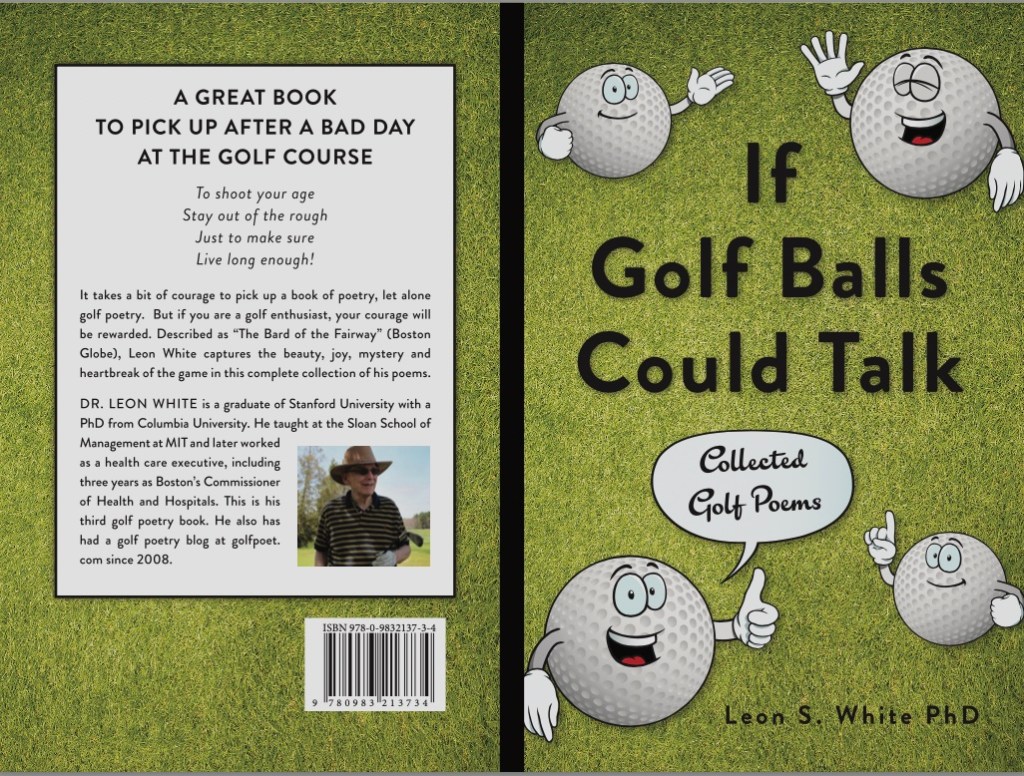
(“The Ball” is included in my book, “If Golf Balls Could Talk,” available on Amazon for $6.95.)
post

Swing It

My older son has been trying to improve his golf swing and add distance to his shots, a common goal among golfers. He has been focusing on using the count, one and two, to control the rhythm of his swing and it’s working. I, on the other hand, gave up my clubs and picked up the guitar several years ago with the goal of playing jazz standards. Most jazz standards are written with four beats to the measure. So, as I have often done, I put these swing thoughts into a poem.

Swing It

Swing’s the thing in jazz and golf,
With rhythm is how you do it.
In jazz the count is 1,2, 3, 4;
In golf you 1 and 2 it.

Leon S White, PhD

A book of my poetry, If Golf Balls Could Talk, is still available on Amazon. But it may disappear if it continues to go unsold!!! Please consider giving it as a gift to a literate golfer. Thanks.

post

Have You Met Him

Thanks for visiting again or for the first time. As you may know (from reading this Blog) I’ve recently published a book called If Golf Balls Could Talk – Collected Golf Poems (available on Amazon). Here is a poem from the book that tells a familiar story:

 HE TALKS A GOOD GAME

He talks a good game

You know the guy


He judges each swing


With a critical eye. 

He talks a good game
Awash with advice


He’s off to the races


When he sees you slice. 

He talks a good game

He studies the pros


He is eager to tell you


All that he knows. 

He talks a good game

Can he turn a phrase


He talks a good game


But it’s not how he plays. 

He talks and he talks
With eyeballs that glisten
But even the duffers
No longer listen. 

If you’ve met this guy, you are welcome to share the experience in the comments section.

post

New Book on Amazon: If Golf Balls Could Talk

Recently I decided it would be a good time to collect my poetry together in a single volume. If Golf Balls Could Talk is the result. I recognize that it takes a bit of courage to buy a book of poetry, let alone golf poetry. But your presence on this Blog is a good start. And, by being here, you must be a golf enthusiast, and so I think your courage will be rewarded.

post

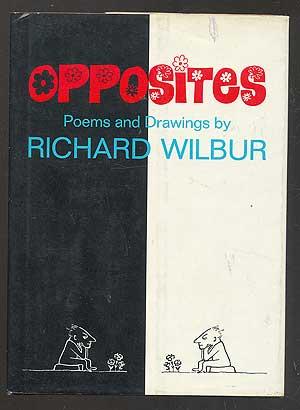
With Thanks to Richard Wilber

md1180450788

Last year I published a book called Opposites in Golf. The 32 poems in the book were all based on the idea of taking a word (in my book the word was related to golf) and then going on a poetic search for its opposite. The idea was originated by the great American poet, Richard Wilber. Wilber passed away a few days ago at age 96. 

One of Wilber’s shortest opposites poem may also be one of his best,

What is the opposite of two?
A lonely me, a lonely you.

 In my book, I also included a two line poem,

What’s the opposite of flub?
To hit it flush with any club.

When I first began to write opposites poems, I sent a few to Mr. Wilber. He wrote back, “Tennis has always been my game …but I see enough golf … to understand you very well, and to know that a number of words like putt and tee are waiting to claim your attention.” And they did and here’s one of them,

What is the opposite of tea?
It’s coffee we would all agree.
But avid golfers might start yelling,
Insisting on a different spelling.

For them,

A tee is wooden; its top is round
To place a golf ball above ground.
Remove the tee and then alas,
A tee’s opposite must be grass.

May Mr. Wilber’s memory be an abiding blessing.

post

Cost of Putters

Golf_Improve_Swing_Joke (1)

Periodically, you hear the story about a pro who sours on his/her putter. Before the tournament begins, the pro goes to the pro-shop, picks a putter out of a barrel of used putters, and then goes on to win the event. It does happen.

But most pros and the rest of us add to our collection of putters, from time to time, by buying a new one … that feels just right. New putters today seem to be getting more expensive. Hence my observation:

The Cost of Putters

Have you noticed the price of putters?
Many $200 and more;
They could be considered a bargain
If only they lowered your score.

Leon S White, Phd

post

Par The Last

Hole in One

Shakespeare wrote “All’s Well that Ends Well.” In psychology there is a precept called the “peak-end rule” which states that the way an experience ends determines the happiness we ascribe to it. In golf, the effect of the rule might be described as,

Par The Last

Bogey after bogey,
You’re failing the test,
Par the last hole . . .
And you forget the rest!

Leon S White, PhD


Please come back next week for another poetic observation on golf.

post

Trapped

the-old-course-experience

How many times have you heard or read “It’s easy to get out of a trap” or “Bunker shots are easy.” Here is my view,

Trapped

If you’ve found that your ball
Came to rest in the sand;
Were the rules more obliging
You’d remove it by hand.

Leon S White, PhD


Hope you will come back next week for another break from the prose of golf.

post

Roughly Speaking


Pic for Roughly Speaking

Last week I mentioned my book, Opposites in Golf.  It consists of a series of 32 poems. Each takes a golfing term or expression and then embarks on a poetic adventure seeking its opposite. Here is an example.

ROUGHLY SPEAKING

What is the opposite of rough?
Smooth an answer, not too tough.
But golfers might say, “Wait a minute,
Rough, we’d rather not be in it.
The fairway that is our suggestion.
The opposite of rough, no question.”

Leon S White, PhD


Please come back next week for another golf poem to remember when you are in the rough!


post

A Golfing Sin

Cartoon 1h210

Another Monday, another Post. I think all golfers can relate to these four short lines.

 A Golfing Sin

A putt left short —
A golfing sin;
An inner voice reminds —
Never up, never in.

Leon S White, PhD

Come back next Monday for another four line golf poem to start your week.


And, if you are new to this Blog, please know that I have a recent book, Opposites in Golf, for sale on Amazon for $4.50. It’s a great gift to slip into someone’s golf bag. If you have time, check it out at https://golfpoet.com/category/opposites-in-golf/.