post

Golf Twines from Earlier Times (1898)

I began writing golf twines (two line golf poems for Twitter) in November of 2009. Two line poems are formally called “couplets” and, of course, they have a long history in poetry.

For example, Shakespeare wrote :  “Double, double, toil and trouble;/ Fire burn and caldron bubble” which in read by the three witches in his play, Macbeth.  (This is actually a golf twine now where Shakespeare is referring to Tiger’s scores on the 11th and 12th holes during the second round of the 2011 PGA Championship!)

I was hoping that my golf twines would catch on, and other Twitterers would write them as well. So far no such luck. But then I found William G. Van Tassel Sutphen, a Victorian-era fiction writer, editor of the original “Golf” magazine and author of The Golfer’s Alphabet, originally published in 1898. In The Golfer’s Alphabet, Van Tassel Sutphen wrote 27 golf twines, but he was just a little early for Twitter.

Sutphen, wrote a twine for each letter of the alphabet and added one more for the symbol “&”. His twines were illustrated by A. B. Frost. Frost (1851-1928), was considered one of the great illustrators in the “Golden Age of American Illustration”.

Below is an example:
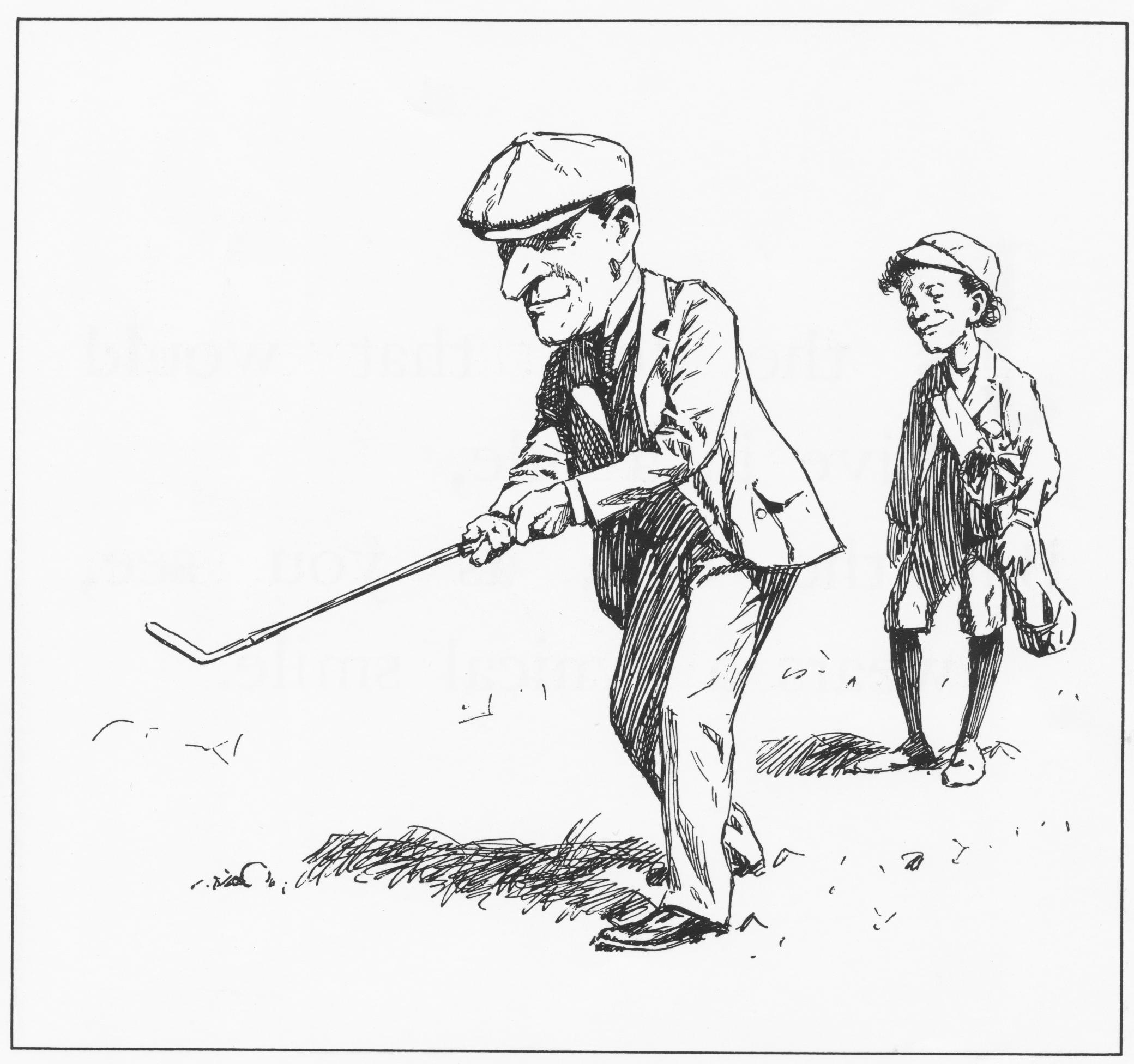
The caption reads:

.                                                     I is for Iron that we play to perfection,
.                                                     So long as no bunker is in that direction.

And who says golf has changed!

Here are a few others from the book:

C is for Card, that began with a three,
And was torn into bits at the seventeenth tee.

H is for Hole that was easy in four,
And also for Hazard that made it six more.

N is the Niblick, retriever of blunders,
And now and again it accomplishes wonders.

And,

W in a Whisper: “Between you and me,
I have just done the round in a pat 83.”

Sutphen’s book was reprinted in 1967 and is widely available on the net.

post

Golf and Skiing in Vermont: A Footnote to Keegan Bradley’s PGA Championship Victory

Rudyard Kipling

Bill Pennington, in today’s New York Times, notes that Keegan Bradley, a Vermont native, played golf in the summer and skied in the winter while growing up there. Rudyard Kipling, the famous English author and poet, is credited by a number of internet sources with also golfing and skiing in Vermont in the 1890’s. What appears to be certain is that in 1894 Arthur Conan Doyle, the creator of Sherlock Homes, visited Kipling at his temporary home outside Brattleboro at Thanksgiving time, and gave Kipling some help with his golf game. From Doyle’s diary, “I had brought my clubs and gave him lessons in a field while the New England rustics watched us from afar, wondering what we were at, for golf was unknown in America at the time.” [Actually the first permanent golf club, The St. Andrews Golf Club in Yonkers, N.Y., was formed in 1888. But golf may not yet have reached Vermont by 1894.]

Doyle is also said to have brought with him or sent Kipling skis. One internet source goes so far as to say that “according to legend, skiing was introduced to Vermont by Rudyard Kipling.”

The extent of Kipling’s interest in golf is not clear. Doyle, however, was an avid golfer. He was for many years a member of the Crowborough Beacon Golf Club in Sussex, England and was the club’s captain in 1910. He even wrote a golf poem, “A Lay of the Links,” that is included in my book, Golf Course of Rhymes – Links between Golf and Poetry Through the Ages.

Kipling’s poetry also includes references to golf. One of his poems called “Verses on Games” includes the stanza:

Why Golf is art and art is Golf
We have not far to seek–
So much depends upon the lie,
So much upon the cleek.

Clearly, Kipling understood golf.

post

Attitudes Toward Women Golfers in the Early Days (Part 3)

Gillian Kirkwood (Kirkwoodgolf.com.uk), an expert on the history of women’s golf, wrote the following about the pioneering British women golfers in the late 19th Century:
These early ladies were really the suffragettes of their time, they forged the way for us to follow.   They fought tooth and nail for womens’ golf to be recognised  and taken seriously.   I think they might be disappointed that some attitudes to women golfers have not changed much in the intervening 100 years.
In two previous Posts (in May 2009), I focused on poems displaying condescending attitudes towards women golfers around the beginning of the 20th century. Now I think I have found the poem that would head this list. Its title is “Love and Golf” and its was written by A. D. Godley. It appeared in his book Verses to Order published in London in 1892. Godley was a classical scholar at Oxford University.

            LOVE AND GOLF

Hear me swearing, fairest Phyllis!
–Golfers all know how to swear–
Though, of course, your presence still is
Most attractive  everywhere,
Links were ne’er designed for lovers:
Do not, Phyllis, deem me rude,
When I hint that man discovers
Charms at times in solitude.

Lips like yours should never utter
Ugly words that golfers speak–
“Dormy,” “stimy,” “mashy,”  “putter,”
Driver,” “brassy,” “bunker,” “cleek”!
Sooner read–though Cultured Woman
Is a thing I hate and shun–
Horace, that distinguished Roman,
Than Horatius Hutchinson.

Though, in hours of deep dejection,
When the disappointing ball
Takes, if hit, the wrong direction,
Sometimes can’t be hit at all,–
Though whate’er the golfer says is
Justified by reason due,
Still I hold his Saxon phrases
Most unsuitable for you.

Tennis be your sole endeavous
If you must aspire to fame!
But at golf–believe me, never
Can you hope to play the game.
There, your “swing” but courts the scoffer,
Boor and clowns your “driving” mock;
Fate, who made the clown a golfer,
Meant you, Phyllis! for a “crock.”

Meet me then by lawn or river,
Meet me then at routs or rinks,
Meet me where the moonbeams quiver,
Anywhere–but on the links!
Thus of you I’ll fondly ponder
O’er the green where’er I roam,
(Absence makes the heart grow fonder),
Only, Phyllis, stay at home.

This definitely needs a response from Phyllis, even at this late date!
post

Magnets of the Fairway

I play golf on a town-owned 9-hole course called Pine Meadows in Lexington, MA. Over the past 27 years I’ve gotten to know the course well. The layout includes  several attractions or should I say “attractors,” that generally reek havoc with players’ drives: the tree on the 8th fairway, the pond that cuts across the 5th and 9th holes and the sand trap in the middle of the first fairway (until it was removed).

The other day on the 8th tee, I watched golfers hit their balls where they always seem to hit them —  towards the imposing tree.  And on the 9th, the pond was collecting balls as usual. As we all know, this doesn’t just happen at my course.  So I concluded that such a ubiquitous phenomenon is worthy of poetic reflection. My effort is called “Magnets of the Fairway.

 MAGNETS OF THE FAIRWAY

Magnet are mostly made of steel
In golf: sand, water or wood.
When looking at these fairway lures,
The pre-shoot does no good.

On tees with trees control is lost
No matter how you bat it.
The only way to miss a tree
May be to aim right at it.

Sand traps also play a role
Attracting errant shots.
The magnet-makers in this case—
The golf-inventing Scots.

I wish I had a dollar bill
For every tree branch hit.
I’d use the sum to bribe the Keep
To grass each sandy pit.

A third attraction, stream or pond,
On fairways, far from rare.
The only way to circumvent—
Stay totally unaware.

For a holiday trip, sand and trees,
Even a water-fall.
But when you find them on a course,
They’re just magnets to draw your ball.

Leon S White
July 7, 2011


post

A Golf Controversy Regarding the Swing

The question, “How do you swing a golf club?” , has no simple answer today or in the past. Almost 70 years ago, J. A. Hammerton wrote this verse that appeared in The Rubaiyat of a Golfer:

Myself when young would hopefully frequent
Where Pros and Plus Men had great argument
On Grips that overlapped, on Swing and Stance
But came away less hopeful than I went.

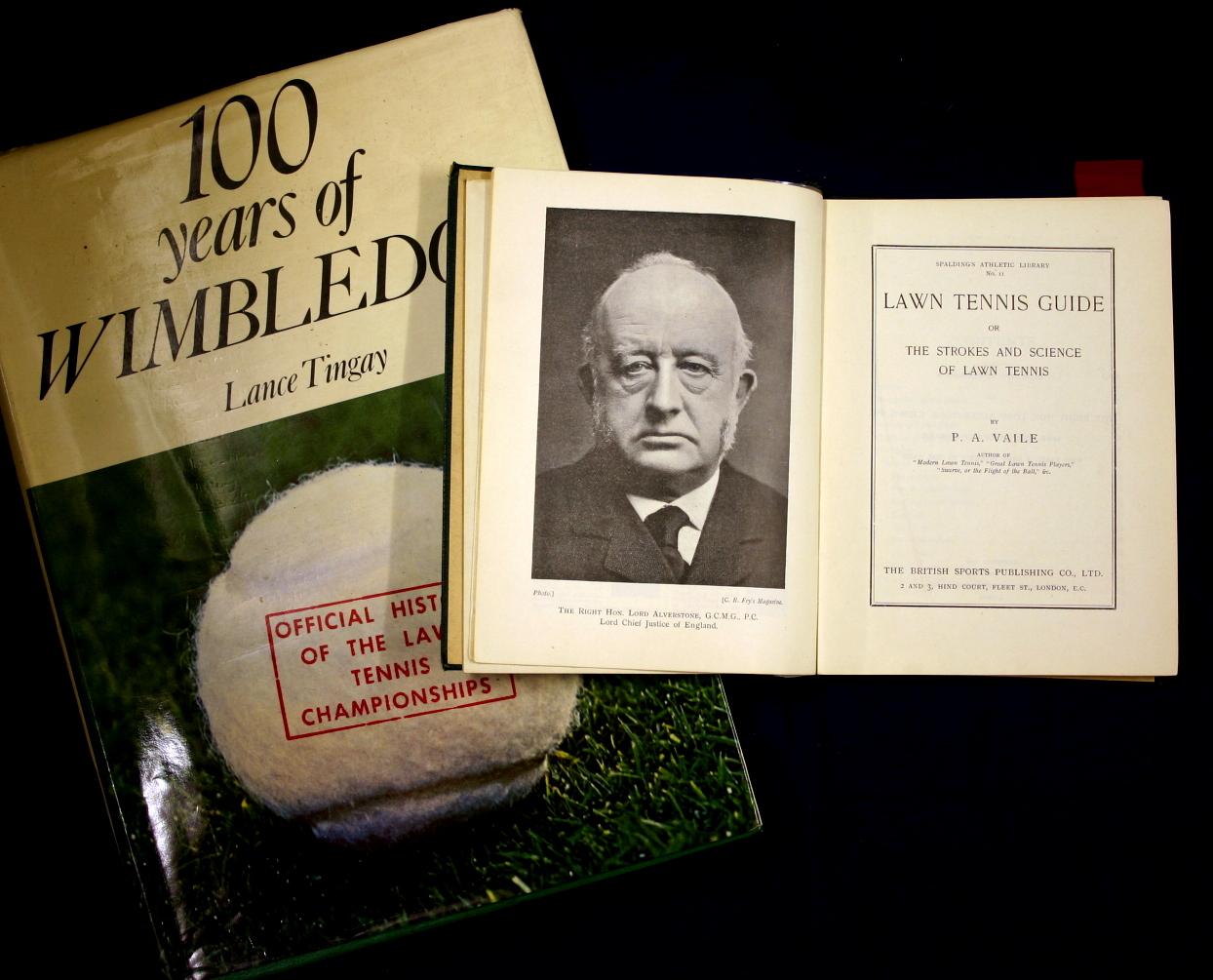
As golf became popular in the United Kingdom and then in the U.S. and other countries around the turn of the 20th Century, golf books became the primary source of swing instruction. Books were written by the major golf professionals of the time and by other self-proclaimed experts as well. One of the most prolific writers on golf and golf instruction in the early 1900’s was a New Zealander named Pembroke Adolphus (sometime Arnold) “Percy” Vaile.  Joseph Murdoch’s book, The Library of Golf, lists eight books by P.A. Vaile. (worldcat.org includes 130 entries for Vaile including a number on Tennis about which he also claimed expertise! See illustration above.)

In one of Vaile’s golf books, The New Golf, published by E.P. Dutton & Co. in 1916, Vaile almost lashes out against the idea that the left hand is dominant in the golf swing:

“The hoariest old tradition that ever fastened on to golf was the power of the left. It was more than a tradition. It was a fetich. Authors and journalists worshiped at its shrine.”

Vaile goes on to attack Vardon, Taylor and Braid (“The Great Triumvirate”) as well as Horace Hutchinson, the great amateur and leading golf writer of the day for their “moldy old idea[s].” Vaile first put forth his ideas in a newspaper article maybe eight years earlier. At that time he was attacked. In his words,

” I was in the thick of it. Anybody who bursts up any useless old tradition, or even gives it a bump, in London, is a fool, a faddist, a theorist, or a revolutionist. If he does not recognize this before he disturbs any of the dust of centuries, and if he is not prepared to accept the position kindly and patiently-and temporarily-he deserves all that is coming to him-and that is much.”

And in those days, attacks were not limited to prose:

THE LEFT HAND’S LAMENT
(Picked up on the links at
St. Andrews)

Since first by Heaven’s august decree
The Royal Ancient Game was planned,
I always was allowed to be
The Master Hand.

To Me did text-books all allot
The part of propulsative strength.
The raking drive, the brassie shot–
I gave them length.

The Right Hand was –poor thing!–designed
To guide the club, and that was all;
Mine was the power that lay behind
The far-hit ball.

Now come there one upon the scene,
Whose heresy fair turns me pale–
The Arius of the golfing green–
A wretch name Vaile.

He says our Vardons, Braids, and Whites
Don’t golf’s dynamics understand;
Their view of Me’s all wrong; the Right’s
The Master Hand.

If Fate would let me but devise
Some torture for this villain bold,
Who thus would revolutionize
Golf’s credos old–

Oh! then to ball of rubber core
I’d change him for a tidy spell,
And drop him in “The Swilcan” or
“The Burn” or “Hell”;

I’d lose him in the rock-strewn sand
Whence few topped spheres ejected come,
Of Musselburgh’s notorious Pand-
Emonium.

Clearly, todays controversies  – one plane vs. two; stack and tilt; Tee It  Forward – are mild in comparison.

post

Indoor Golf in Chicago Now and Then

From the current issue of “GolfTime Magazine,” a biannual guide to golf in the Chicago area:

Experience Chicago’s Most Accurate and Realistic Indoor Golf Facility!

Experience a new paradigm in year-round indoor golf facilities at Play 18 in downtown Chicago’s Loop.  Located at 17 N. Wabash, just a few blocks from Millennium Park, Play 18 aims to offer golf enthusiasts full game play and practice facilities with sophisticated golf technologies, amenities, membership packages and more – all 12 months of the year, rain or shine!

We all know that golf has a long history. But the folks at Play 18 may not know that indoor golf was played in Chicago and nearby more than 100 years ago.  According to Robert Pruter, a major golf instructional school, O’Neil & Fovargue Indoor Golf School (185 Wabash Ave), opened in 1910.  (Whether 185 was North or South Wabash, if the Indoor Golf School existed today it would be a very short walk from there to Play 18!)

But a student of golf poetry would have found reference to the Indoor Golf School, not in Mr. Pruter’s article, but in a poem called “Winter Golf” by Bert Leston Taylor (1866-1921), the great Chicago Tribune columnist.

WINTER GOLF

“All the benefits of outdoors winter golf
in the tropics, at the Indoor Golf School” – AD

Within the grimy Loop’s environs,
The rubber pill may be addressed,
A man may swing his golfing irons,
And let his fancy do the rest.

The murmur in the street below,
The elevated’s boom and roar,
Will sound–if fancy have it so–
Like surf upon a tropic shore.

The air within the driving stall
Does not suggest a Stilton cheese,
To one whose mind is on the ball
‘Tis fragrant as a tropic breeze.

We, upon whom the spell is laid,
For tropic things care not a whoop,
Imagination’s artful aid
Will bring the tropics to the Loop.

The sun, the breeze, the fields, the rest–
Of them let railway folders sing.
We know, who are by golf obsessed,
The Pill’s the thing! the Pill’s the thing.

With its continued relevance, Taylor’s poem may deserve a spot on the wall at Play 18.

post

Short Golf Poems – Less Than a Foot

Two line golf poems, such as the Twines I occasionally write for Twitter, are short. But what about really short golf poems?

The widely acknowledged shortest general poem is:

FLEAS

Adam
Had ’em.

I would offer as a possible shortest golf poem:

BACKSWING

Low
Slow.

A three word entry might be:

DUFFER’S GOLF

A profane
Game!

And in the four word category, a familiar refrain uttered by many after a series of bad shots:

A GOLFER’S LAMENT

Can’t hit
For sh–.

If you would like to share your two, three or four word golf poems, please leave a reply. It shouldn’t take long.

[And if you are looking for a unique gift, please consider my book, Golf Course of Rhymes – Links between Golf and Poetry.” Robert Trent Jones, Jr. wrote the foreword.  Thanks.]

post

Was Omar Khayyam a Golfer?

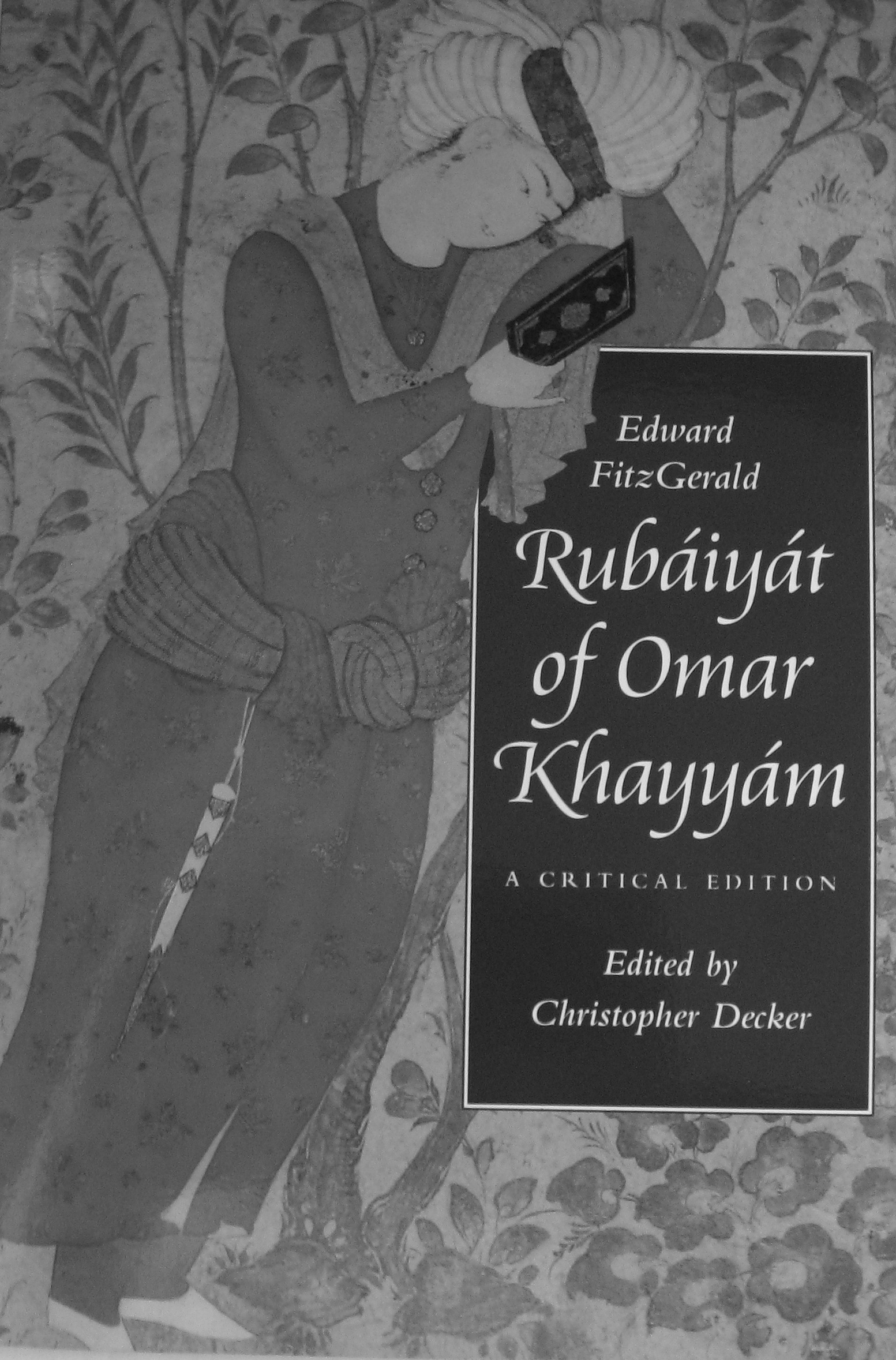
In 1965, when I was a young professor at the M.I.T. Sloan School, I wrote a paper with the title, “Markovian Decision Models for the Evaluation of a Large Class of Continuous Sampling Inspection Plans.” In June of 2009, I published a paper with the title, “Was Omar Khayyam a Golfer” in “Through the Green,” a publication of the British Golf Collectors Society. I leave it to you to characterize the arc of my writing career. Right now I’m more concerned with the arc of my drives! The golf parodies of Khayyam’s famous poem, “The Rubaiyat” are  explored more fully in the 7th Chapter of my new book, “Golf Course of Rhymes.”


post

The Essence of Golf in an Old Poem

Today (3/30) I drove by the local driving range and it was open! Always a good sign. And the afternoon temperature was above 50 degrees — another good sign. But the weather report warns of wet snow tomorrow night and Friday. And there you have it – early spring for the golfers of New England.

In the past at this time of year, I have offered spring celebration golf poetry, see “Another Golf Season Begins” and “A Springtime Exchange . . .” To start this golf season I would like you to read (out-loud and slowly if possible and more than once if you have the time) a poem “Ode to Golf” that gets at the essence of the game. The poem was written by Andrew Lang (1844 -1912), a prolific Scots poet, novelist, literary critic and appeared in a book titled, Ban and Arriere — A Rally of Fugitive Rhymes, published in 1894. [The poem makes several references to St. Andrews.]

Ode to Golf

‘Delusive Nymph, farewell!’
How oft we’ve said or sung,
When balls evasive fell,
Or in the jaws of ‘Hell,’
Or salt sea-weeds among,
‘Mid shingle and sea-shell!

How oft beside the Burn (stream),
We play the sad ‘two more’;
How often at the turn,
The heather must we spurn;
How oft we’ve ‘topped and swore,’
In bent and whin and fern!

Yes, when the broken head
Bounds further than the ball,
The heart has inly bled.
Ah! and the lips have said
Words we would fain recall –
Wild words, of passion bred!

In bunkers all unknown,
Far beyond ‘Walkinshaw,
Where never ball had flown –
Reached by ourselves alone –
Caddies have heard with awe
The music of our moan!

Yet, Nymph, if once alone,
The ball hath featly fled –
Not smitten from the bone –
That drive doth still atone;
And one long shot laid dead
Our grief to the winds hath blown!

So, still beside the tee,
We meet in storm or calm,
Lady, and worship thee;
While the loud lark sings free,
Piping his matin psalm
Above the grey sad sea

The old golf poetry, well represented in this Blog, time and again makes clear how timeless the game is. One drive “featly fled” will bring us back for another round, yesterday, today or tomorrow.

post

A Golf Poem with a Boston Accent

Grantland Rice

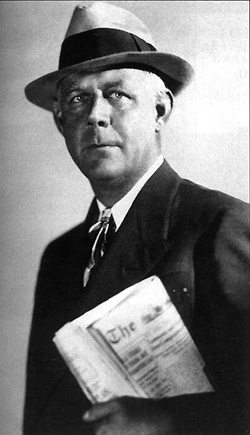
Grantland Rice wasn’t from Boston, he was born in Murfreesboro, TN in1880. And I don’t think he spent much time there. Nevertheless, in the following poem “Beating ‘Em To It” he somehow picked up at least a slight Boston accent. The poem appeared in The Winning Shot, a book written by Jerome Travers which I have mentioned in previous Posts. Rice’s poetry is sprinkled through out the book’s pages.

BEATING ‘EM TO IT

Yes Pal, I know just how it was–you should have won a mile;
You had him trimmed ten ways on form and twenty ways on style;
You had him stewed into a trance–you had him strung until
You went and blew a ten-inch putt where something tipped the pill;
A putt you wouldn’t miss again the whole blank summer long–
A pop-eyed pipe to anchor– am I right or am I wrong?

I get you pal–don’t say a word–he wasn’t in your class;
You had no less than twelve bad kicks that plunked you in the grass;
While you were straight upon the pin, he foozled every shot,
But somehow skidded on the green and gathered in the pot;
No not a word; I know, old top–your case is nothing new–
I know, because each time I lose they beat me that way, too.

Now that golf season has begun,keep the poem in mind when you have one of those matches or one of those days.