post

U.S. Open Champ and Ace Sportswriter Produced Golf Book of Prose and Poetry

Jerome Travers 1915 Open
Jerome Travers 1915 Open

Grantland Rice

Grantland Rice


The November 1917 issue of The American Golfer includes a column by a writer who used the pen-name  “Sam Solomon” in which he considers the relationship between golf and poetry:

“A certain affection appears to exist between the spirits of this game and the muse of verse. There is an old affinity between golf and poetry. It is natural, surely, that is should be so, when we consider that golf is a thing of Nature and freedom and the open world, and makes a riot of the emotions, and that, again, it is a thing of history and traditions, and colourful romance all the way from the beginning until now. Great pictures have been painted of golfers at their game; statues of golfers have been raised; art and the sport have had much to do with one another, and agreeably so.”

He continues,

“Here in America there has for long been the tendency in the game to versify. Our own pages within the golden covers from time to time bear witness of it. Perhaps Grantland Rice has come nearest of all Americans to the true sentiment coupled with graceful phrasing, and he has maintained the most indispensable quality of dignity. He has known that the truth can often be told in verse better than any other way. In his [poem] “Dedicated to the Duffer” at the beginning of The Winning Shot, and elsewhere in that book, there are some pretty pearls:”

This is the substance of our Plot—
For those who play the Perfect Shot,
There are ten thousand who do not.

For each who comes to growl and whine
Because one putt broke out of line
And left him but a Sixty-Nine.

At least ten thousand on the slate
Rise up and cheer their blessed fate
Because they got a Ninety-Eight.

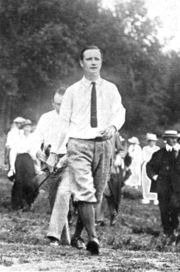
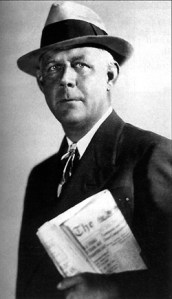
The Winning Shot (published by Doubleday, Page & Co. in 1915) was actually written by Jerome Travers, a great amateur golfer of the early 20th century who won the U.S. Amateur Championship four times and won the U.S. Open as an amateur in 1915 at Baltusrol. Travers wrote the prose and Grantland Rice, arguably the greatest sportswriter of the first half of the 20th century, wrote the poetry. Rice, of course, is best known for his lines,

For when the One Great Scorer comes
To write against your name,
He marks – not that you won or lost –
But how you played the Game. [Read more…]

post

Golf Instruction With Illustrated Poetical Positions!

image0-1image0

image0-2

FORE

Fore, lads! Keep out o’ the line o’ fire,
And I’ll teach ye to drive a ba’,
That’ll flee to the clud, and fa’ wi’ a thud,
Twa hundred yards awa’.

Ye maunna (must not) be stridin’ your legs ower wide,
Like a puddock (frog), across the green,
Nor be haudin’ your elbows pinned to your side,
And lettin’ your nails be seen.

And dinna be bendin’ your chin to your knees,
At an angle o’ forty-five,
Nor wrigglin’, as if ye were treadin’ on peas:
Keep your energy a’ for your drive.

Fix your e’e on the gutta, stride fair, feet square,
Elbows free, gie (give) your back a bit thraw (a small turn)
Heel up; swing your club round the nape o’ your neck,
Whish, click, and the ba’s awa’!

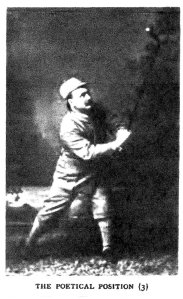
The above, in a slightly different format, appears on page 503 of the Rev. John Kerr’s The Golf-Book of East Lothian published in Edinburgh in 1896. This is clearly an early example of illustrated golf instruction so common in today’s golf magazines and instruction books. But it is surely unique in its description of the three “poetical” positions. The poet was A. P. Aitken, D. Sc., lecturer on Agricultural Chemistry at the U. of Edinburgh and member of the Gullane Golfers, an East Lothian golf club formed in 1868.

Kerr’s book was the first to be written about a golfing area or club. Decent first edition copies are rare, often selling for well over $1000 when available. Joseph Murdoch points out in his book, The Library of Golf 1743-1966, that the first action pictures (not posed) appeared in How to Play Golf by H. J. Whigham published in Chicago in 1897.

post

Be a Happy Golfer; Just Play and Have Fun

The-Happy-Golfer

Here is a list of golf books that you might consider to help you improve your game:

The Happy Golfer by H. Leach
Advanced Golf by J. Braid
How to Play Golf by H. Vardon
Golf Faults Illustrated by J. H. Taylor
Golf for the Late Beginner by Henry Hughes
The Golfer’s Pocket Tip Book by G. D. Fox
Modern Golf by P. A. Vaile
Success at Golf by H. Vardon, F. Ouimet, and others.

Though their titles look current, these books were included in an advertisement in the September 1914 issue of the magazine Golf/USGA Bulletin. The first golf instruction book published in the U.S., Golf in America: A Practical Manual, by James Lee, appeared in 1895.

 Of course, if instruction books don’t help enough, you can always take lessons from a Professional. And neither lessons or books will help much if you don’t practice. But then Malcolm Gladwell in Outliers tells us that 10,000 hours or more or practice are needed to excel. What to do? [Read more…]

post

An Old Golf Magazine and a Poem for Old Golfers

waltertravis

Walter J. Travis

The first issue of the magazine The American Golfer hit the newsstands in November 1908, a little over 100 years ago. It would fold in 1936 during the Depression.

 In the beginning, much of the news provided by the magazine’s correspondents related to amateur golf matches sponsored by local golf clubs in various regions of the country and in Great
Britain. These reports were written under such headings as: “Eastern Department”, “Western Department,” “From the South” and “Foreign Notes.”

 Within a year, the local news reports became more local with “Around Philadelphia” and “Pittsburgh Notes” added to chronicle the activities of the golf tycoons Wanamaker, Havemeyer, Carnegie and Frick. As time went on and golf became more popular, more areas, New York State, Ohio, the Pacific Slope, separately reported in as well. This primary focus on amateur golf was gradually replaced with articles on professional golf and golfers and instruction articles by writers and golfers such as O. B. Keeler, Bobby Jones, Bernard Darwin, Tommy Armour and others.

 Early issues of The American Golfer also included reports on U.S.G.A. sponsored championships, decisions of the Rules of Golf Committee, descriptions of new golf courses and articles on golf history, and golf course maintenance. And from the beginning, the magazine offered its readers golf poems in every issue.

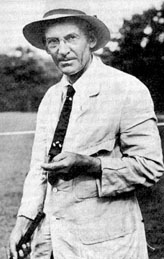
 The first editor of The American Golfer was a transplanted Australian named Walter J. Travis. Grantland Rice, the only other editor of the magazine, wrote of Travis, “In many respects [he] will stand as the most remarkable golfer that ever lived.” Travis began playing golf in late 1896 at the age of 35. He won the first tournament he ever entered about a month later. In 1900 he won his first U.S. Amateur Championship and over the next four years would add two more plus a British Amateur Championship as well. He ended his tournament career by winning the Metropolitan Championship at age 54 in 1915. In this, his last tournament, he beat Jerry Travers, the U.S. Open Champion of the same year. [Read more…]

post

Footnote: Gray’s “Elegy” Inspired a Second Golf Parody

Could there be more than one golf parody of Gray’s “Elegy?” Surprisingly, the answer is yes, and, therefore, a “footnote” to this week’s Post. (And being a footnote, it is not required reading.) [Read more…]

post

If [Thomas] Gray Had Been a Golfer

Gray's Churchyard

A Country Churchyard

This post introduces an unusual but historically interesting golf poem called “If Gray had been a Golfer” by Samuel E. Kiser (1862-1942), a newspaperman, poet and humorist. Kiser’s poem of nine stanzas is a parody of a much longer poem “Elegy Written in a Country Churchyard” written by the English poet Thomas Gray (1716-1771) and first published in 1751.  

Gray’s poem has been described as “one of the greatest poems in the English language,” and as such was often a candidate to be parodied. Also, two lines from the poem have inspired movie titles: “The paths of glory lead but to the grave” and “Far from the madding crowd’s ignoble strife.”

One of the themes of the poem, as embodied in the stanza below, is that poverty or other barriers prevent many talented people from fully exercising their capabilities.

Full many a gem of purest ray serene,
The dark unfathom’d caves of ocean bear:
Full many a flow’r is born to blush unseen,
And waste its sweetness on the desert air. 

Kiser adopted this theme for his poem memorializing the “golfless” poor.   [Read more…]

post

Early Golfers: “The Best People” and the Poor

IH169022

Charles “Chick” Evans, Jr. (1890-1979), the great amateur golfer, writing about the beginnings of golf in American in the June 1922 issue of Vanity Fair, said,

“Across the water [golf] came and our best people took it up. They had discovered it in their travels abroad. It is true that poor people played it in Britain, but it seemed very sure that they would not do so in America. … To say that you played golf, however badly, and Heaven knows most of the early golfers played very badly, was in a manner of declaring yourself a member of the best American society. The right sort of people were playing golf…”

The American woman poet, Sarah N. Cleghorn (1876-1959), a peaceful but committed activist in reform movements ranging from anti-lynching to opposition to child labor, looked at the new game from a different perspective. A stanza from a work called “Through the Needle’s Eye”  has become famous as a statement against child labor:

            The Golf Links

The links lie so near the mill
That almost every day
The laboring children can look out
And see the men at play.

These lines were first printed in The New York Tribune on January 1, 1915.

post

Attitudes Toward Women Golfers in the Early Days (Part 2)

Women golfers, circa 1900

Women golfers, circa 1900

As I noted in the last Post, women began playing golf in larger numbers in England, the U.S. and other countries such as Australia, around the turn of the 20th century. However, as Murray G. Phillips points out in an article in the May 1989 issue of Sporting Traditions – Journal of the Australian Society for Sports History,

“Golf was considered a suitable ‘ladies’ sport because it complemented the cultural image of women that was essentially passive, non-aggressive and non-competitive.”

Phillips goes on to say that

“[the] acceptance of golf as a suitable sport for women was also made possible because it did not pose a serious threat to male golfers. To many male players, female golf was nothing more than ‘a gentle counterpoint to tea and gossip’.”

And yet organized women’s golf began, major amateur tournaments were organized and held, and over the years things have improved. And as seen in last week’s Post, some poets did take the women’s side. Below I offer two more examples. [Read more…]

post

Attitudes Toward Women Golfers in the Early Days (Part 1)


From old Life Magazine, 1900 (Life Publishing Co.)

From old Life Magazine, 1900 (Life Publishing Co.)


The period of about 1880 to 1900 marked the first major expansion of golf interest and play among Englishmen. This golf boom was sparked in part by the publication of The Badminton Library: Golf written and edited by Horace G. Hutchinson. Most of the new players were men. However, women’s golf received a boost during this period when the first British Ladies Championship was held at Lytham St. Anne’s in 1893.

Nevertheless, Lord Wellwood may have expressed the prevailing attitude of his fellows when he wrote in Hutchinson’s book,  “If [women] choose to play at times when the male golfers are feeding or resting, no one can object…at other times…they are in the way.” Hutchinson, himself, was even more direct, when he was quoted as saying, “Constitutionally and physically women are unfit for golf.”

In the U.S., the first women’s amateur championship was held in 1895 at the Meadow Brook Club in Hempstead, N.Y. But when golf began in America, the general attitude toward women golfers was anything but supportive. Consider a 1900 cartoon (above) showing a caddie on a knees ostensibly looking for a lost ball but actually looking at a shapely woman golfer nearby. The caption says “ADVICE TO CADDIES – You will save time by keeping your eye on the ball, not on the player.”

Golf poetry, when the subject was a woman golfer, also often focused on the girl and not the golf. Here is an example from Lyrics of the Links, an anthology of golf poems collected by Henry Litchfield West and published in 1921.

[Read more…]

post

What Puts You off Your Game Most? Answers From a 1923 Golf Magazine

From the USGA Digital Library

From the USGA Digital Library

In 1923, The American Golfer, the golf magazine of its day, asked its readers to submit entries to answer the question “What Puts Me off My Game Most?” The April 7th issue included the responses of the three prize winners. The winner of the second prize wrote, in part,

“…I can play with the hare type and with the human tortoise…Sun nor wind nor clouds affect me, I enjoy them all. Nor does a bad hole depress me, for there are many such in my life and I should worry.

But delivery me, oh, delivery me from the fiend who coaches my each and every shot! He usually has about a twenty-four handicap. He has made every hole on the course in par, but never by any chance has he gotten two of them in the same round.

As I step up to drive it starts. My stance is wrong. I should waggle more; my backswing is too short. If I take my midiron for one hundred and twenty-five yards, I am patiently told that I should pitch up with a mashie….”

The second prize winner goes on a while longer, but you get the point.

The first prize winner complains about a similar critic that he calls “NEVER-WILLIE.” In his entry he includes these quotes:

[Read more…]