post

‘Now, mind, keep your e’e on the ba’

The following appears in a description of the book A DUFFER’S HANDBOOK OF GOLF by Grantland Rice and Clare Briggs, on the Classics of Golf website.

There is no doubt “duffer” is a pejorative term. While the word’s origin is unknown, it appears in the 1800s as slang for an incompetent, ineffectual, or clumsy person. What better word to describe a neophyte attempting golf? The first “wave” of new golfers occurred when the gutta percha ball became available in the 1850s. Its lower cost and superior durability enticed many citizens to gather a few clubs and try their hand at the sport, some woefully ignorant of the rudiments of the game. “Duffer” first appears in the golf lexicon in 1875 in Clark’s Golf: A Royal and Ancient Game, in a poem by “Two Long Spoons.”

The poem was titled “Duffers Yet,” and was written by Lord Stormonth Darling (1844-1912), a judge, a Scottish Member of Parliament for Edinburgh and St Andrews Universities from 1888 to 1890, and also a golfer. Lord Darling wrote other golf related songs and verses including one called “Keep Your E’e on the Ba’.” It is subtitled, “Ballad of the Beginner,” and tells the story of when on Musselboro’s “famous old green,” Lord Darling, then no doubt a duffer, first “sought for the key to the game.”

The caddie that fell to my lot
Was old, hard of hearing, and wise;
His face had a hue that was not
Entirely the work of the skies:
He knew how the young player tries
To remember each tip all at once,
And, forgetting the vital one, sighs,
And despairs of himself as a dunce.

So, deep in his mind he had set
A rule that pervades all the rest;
‘Tis the maxim you ne’er can forget,
If you w’sh in you game to be blest:
‘Tis the greatest, the first, and the best,
The beginning and end of golf-law;
And ‘twas thus by my caddie expressed ─
‘Now, mind, keep your e’e on the ba’.’

Darling, not satisfied that he had a complete answer, asked other questions. Was he standing properly? What about his grip? Should he worry about the bunker ahead?

To each query the answer I got
Was that rigid, inflexible saw
(Of deafness and wisdom begot),
‘Now, mind, keep your e’e on the ba’.’

Lord Darling concludes,

Whate’er be the mark to be hit,
This truth from the caddie I draw ─
In life, as in golf, you’ll be fit
If you aye keep your e’e on the ba’

Although written more than a hundred years ago, Lord Darling’s words of advice are hard to improve upon!

post

The Language of Golf

The Foreword to Peter Davies’ impressive book The Historical Dictionary of Golfing Terms  − From 1500 to the Present begins:

No game has a richer array of terms than golf. Five hundred years of golfing have built up an extraordinary vocabulary.

Mr. Davies goes on to say,

…before 1850 when the Scots had the game to themselves: bunker, caddie, divot, links, putt, stance, stymie and tee [were] purely Scottish words…

Robert K. Risk, a Scottish writer, poet and golfer in his book Songs of the Links, first published in 1919, identifies a presumably non-Scottish writer who,

…in a magazine alleges that the terminology of golf is peculiarly repulsive, and instances “top,” “foozle,” “tee,” “stymie,” “divot,” and “bunker,” as the cacophonous offspring of a degraded invention.

Risk responded with “A Protest,”

A PROTEST

Imprimis, I would here protest
That any who mislikes our phrases,
Our stymies, foozles, and the rest
May, go, for all I care, to blazes,
Or any more select location
Where golf terms cannot cause vexation;

Secundo, when he sets his hand
Upon so sweet a bloom as stymie,
I’d have him clearly understand
Few words so keenly gratify me;
Stymie—it pleases me to say it
Almost as much as when I lay it.

Stymie—dear word most musical:
And what man will deny that putter,
Pronounced without a “t” at all,
Is smoother far than melted butter;
And when its “t’s” are forced to duty
Putter has still a poignant beauty.

And as for foozle—what could be
More deftly onomatopoeic?
Hearing the word, assuredly
Even one who knew not Golf, would see quick
Anger, futility, despair
As of a man who beats the air.

And divot—any duffer knows—
Is the by-product of a foozle:
When to a sounder game he grows,
And pitching-clubs cease to bamboozle,
Divot, when it is cut or said
Means a half-iron shot laid dead.

And what about those minor games—
Billiards and tennis, football, cricket—
Could one invent much uglier names
Than pot and screw and lob and wicket,
Off-side and deuce and maul and sett?
More loathly words I’ve never met.

Therefore, when in a magazine,
A writer airs such views as these,
I diagnose a touch of spleen
Or failure absolute to please
The Goddess who demands our duty—
Great are Golfina’s works and ways,
And passing sweet her every phrase,
And all her words are words of beauty.


post

Golf History, Golf Poetry and the Making of the Featherie

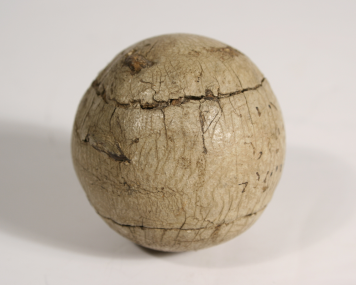
A Featherie Ball

aFor many American golfers, the history of golf begins with the 1913 U.S. Open won in a playoff by Francis Ouimet over Harry Vardon and Ted Ray. The author Mark Frost marks this event as “the birth of Modern Golf” in his bookThe Greatest Game Ever Played. But what about the birth of the game? To get a better idea as to the origins of golf and its early history I would suggest a book called A Swing Through Time — Golf in Scotland 1457-1744 by Olive M Geddes (revised edition published in 2007).  Quoting from the book’s introduction,

This book takes a close look at the earliest written records of golf in Scotland, from the 1457 Act of Parliament banning the game to the first ‘Rules’ of golf — the ‘Articles and Law’ of 1744 drawn up by the Company of Gentlemen Golfers for the competition for the Silver Cup played over Leith Links.

Interestingly, some of these “written records” were recorded in verse. For example, Ms. Geddes devotes a chapter to a discussion of the first book entirely devoted to golf, called The Goff, first published in 1743. It was a mock-heroic epic poem, 358 lines long, written by an Edinburgh lawyer (who later became a Minister) named Thomas Mathison.  A second edition was published in 1763 and a third 30 years later. In 1981 the United States Golf Association published facsimiles of all three editions under one cover in a limited edition of 1400 copies. One of few surviving third edition copes was sold for $80,500 in 1998.

The Goff tells the story of a golf match on the Leith Links played between Castalio and Pygmalion, the heroic combatants of the tale. But the poem also makes reference to some golf related activities of the time. In one interesting section of eight lines, Mathison describes in some detail how featherie golf balls were made:

The work of Bobson; who with matchless art
Shapes the firm hide, connecting ev’ry part,”
Then in a socket sets the well-stitch’d void,
And thro’ the eyelet drives the downy tide;
Crowds urging crowds the forceful brogue impels,
The feathers harden and the Leather swells;
He crams and sweats, yet crams and urges more,
Till scarce the turgid globe contains its store.

Ms. Geddes remarks that “Bobson” probably referred to a St. Andrews ball-maker named Robertson (likely an ancestor of Davie and Allen Robertson). The implication is that although balls were made in Leith at the time, the best balls came from St. Andrews. (Featherie balls dated back to 1618 and were only replaced by Gutta-Percha balls in 1848!) I hope that those of you who might be interested in golf’s early history will have the opportunity to consult A Swing Through Time.

post

A Springtime Exchange Between a Golf Poet and his Editor

Robert K. Risk's book, Songs of the Links (1919), includes the following timely exchange between Risk, the golf poet, and and Garden G. Smith (1860-1913) the editor of Golf Illustrated, the British weekly, for many years and an important contributor to the literature of the game. (Risk's poem has been slightly shortened.)

TO THE EDITOR

Bid me write and I will write
Of club and ball and tee,
Trusting the matter I indite
Will be approved by thee.

Bid me to stay my pen and I
Will muzzle it with grace,
Regarding not impatiently
Regretted "lack of space."

But when you hint that I should do
Some verse concerning Spring,
That, I must frankly caution you,
Is quite another thing.

Although not disinclined to sing,
No poet can ignore
That all that can be sung of Spring
Has been well sung before.

Therefore, should I to platitude
And outworn phrase incline,
The brickbats thrown by readers rude
Are yours, dear sir, not mine.

In Spring we walk the daisied links
Where lively lambkins leap—
Too few of them, one sadly thinks,
Will ever grow to sheep.

In Spring a brighter glitter shines
On the well-burnished cleek,
But still we do 5-holes in 9's
Though playing thrice a week.

In Spring the chronic topper dreams
Of getting down to scratch,
Of being picked in all Club teams,
And winning every match.

In Spring we cease to argufy
About the "best-length hole,"
Which simply means the one that I
Enjoy—and you can't hole.

......

'Tis Spring that whets our appetite
For Three weeks' solid golf,
Though ere the third week is in sight
We shall be direly "off."

In Spring the poet is supposed
Keenly his lyre to tune;
But here these verses are foreclosed,
For I am off to Troon.

And here is the editor Garden G. Smith's response:

THE EDITOR

WITH APOLOGIES TO HIS READERS

'Tis bitter sad the poets should
There work neglect for sport,
Wile Mr. Risk plays golf at Troon,
I am two verses short.

May bunkers trap his longest shots,
May rabbit holes annoy him;
And if this here occurs again
I'm blowed if I'll employ him.

post

Golf’s “Don’t Ask, Don’t Tell”

This week’s poem is by an English golfing poet though his name is unknown. It appeared in a book called Mr. Punch on the Links which consists of golf stories, cartoons, and poems from the British magazine “Punch.” The book was published around 1930.  “Punch,” a magazine of humour and satire, ran from 1841 until its closure in 2002.

The poem provides a gentle warning to two kinds of golfers; the first who is only too willing to tell it all after a match and the second who give the first the opportunity.

The Retort Imaginary

SIR, for the information you’ve imparted,
The prompt outspokenness of your reply,
Ranging from that fine drive with which you started
To the long putt by which you won the bye,
With details of the bunkers, whins and banks
Which you surmounted, pray accept my thanks.

I’ve no excuse now, with the facts before me,
For ignorance, no reasonable ground
For doubt as to the hole that saw you dormy,
Or where your victim finally was drowned.
‘Twas kind to give a confidence so free
To a mere casual listener like me.

You’ve told me of the pair in front that beckoned
For you to pass, then found the ball and played
(At the fourth hole) which made you miss your second;
You’ve told me of the stymies you were laid,
And indicated just exactly where
You lifted from the ground under repair.

That chip that got a bad kick at the seventh;
The ninth (the short hole), where you hit the pin;
That run-up shot that won you the eleventh;
The thirteenth where the ball just trickled in—
You’ve made it all quite clear, and it was nice
To know you’ve cured that tendency to slice.

I’m quite convinced you’ve done the best you can, Sir;
Ungrudgingly you’ve given me, I know,
A comprehensive categoric answer
To my brief question of an hour ago;
But it was mere politeness, all the same,
That made me say, “Well, Jones, how goes the game?”

post

The “Rubaiyat’s” Contribution to Golf Poetry

To write a parody of a poem, you would take the basic characteristics of the verse (for example, its rhyming scheme and basic idea) and then rework them for comic or ironic effect.

Now suppose that you are a young golfer and poet around the turn of the 20th century. Being literate, you are aware that Omar Khayyam’s poem, Rubaiyat, is being parodied left and right. So one day, after being around the golf course until early evening, you pick up a copy of the poem (it was easy to do then). Reading through the verses, you are struck by the stanza 27,

Myself when young did eagerly frequent
Doctor and Saint, and heard great Argument
.     About it and about;  but evermore
Came out by the same Door where in I went.

If your name was Henry Boynton, a graduate of Amherst with a Masters of Arts, then, looking at the stanza you might have thought about all the controversies regarding the fundamental of golf being discussed by golfers such as Jamie Anderson and Jamie Braid and all the other Jamies of the time. And this might have led you to write (as part of a book, The Golfer’s Rubaiyat),

Myself when young did eagerly frequent
Jamie and His, and heard great argument
.     Of Grip and Stance and Swing; but evermore
Found at the Exit but a Dollar spent.

Little did Boynton know, but he himself would be parodied by later golfing poets.

In the July 1910 issue of  The American Golfer, a poet named Jack Warbasse wrote,

Myself when young did eagerly frequent
Travis and Braid, and read great argument
.     About the Grip and Stance; but evermore
Play’d out by the same Stump where in I went.

And then in 1919, a Scottish writer, poet and drama critic Robert K. Risk published a book of collected poems, Songs of the Links, that included the poem “The Golfaiyat of Dufar Hy-Yam.” In that poem we have,

Myself when you did eagerly frequent,
Club-makers’ Shops, and heard great Argument
.     Of Grip and Stance and Swing; but evermore
Learned and Bought little I did not repent.

Finally, in 1946, J. A. Hammerton, a Scottish statesman and author, published a book, The Rubiayat of a Golfer, in which he wrote,

Myself when young would hopefully frequent
Where Pros and Plus Men had great argument
.     On Grips that overlapped, on Swing and Stance
But came away less hopeful than I went.

So what have we learned? First, that there are limits to the golfing parodies of stanza 27 of the Rubaiyat. And second, Instruction about grip, stance and swing has been confusing for a long time!

post

When Golf Poetry Matters

Jerome Travers, the great amateur golfer of the early 20th century, included a chapter called “‘First Aid’ to a golfer ‘Off his Game,'” in his book Travers’ Golf Book ( New York: The Macmillan Company, 1913). He began, “What a note of tragedy there is in those few words “the golfer is off his game.” Travers went on to write,

The golfer ‘off his game’ cannot drive, approach or putt, he doesn’t know what the matter is and he has completely lost confidence in himself.

Travers’ prose gives us a straight forward description of what it is to be off one’s game in golf. However, it takes a poet to get to the essence of the problem and its ramifications.

In a book called Humors and Emotions of Golf (1905), a poet known only by the initials (E.M.B.) tells us what it’s really like when “He’s off his game.”

He’s off his game.”

Like hollow echoes boding ill,
His heart is wild with tremors chill,
And whispers in a small voice still—
An admonition—ghostly—shrill—
.          “He’s off his game!”

His divots fly like night-bats doure;
His drives are never far and sure;
And bunkers, like Charybdis, lure
His erring ball to depths obscure;
.          “He’s off his game!”

In vain seem all the pro’s sage tips;
His little gutty always lips
Or over-runs the hole; then slips
That naughty D——I must ellipse,
.          He’s off his game!”

Thro’ distant whins and stubborn gorse
With grim expletives gaining force,
He plunges on his zig-zag course,
Until he sighs in deep remorse,
.          “I’m off my game!”

At home his brooding spirit shows
The weighty cares of hidden throes;
Too well his Golfing Widow knows
The anguish of her hubby’s woes—
.          “He’s off his game!”

Andrew Lang (1844-1912), a famous Scottish writer and poet as well as golfer, also wrote a poem of similar anguish called “Off my Game.” Could the agonies and frustrations of golf be fully described without poetry? I think not.

post

A Rare Golf Poetry Book

124510c

Those of you who have been following this blog know that most of the poetry is from old golf books and magazines. Part of the fun of writing the blog is finding new (old) books which provide me with new material.  Brian Siplo (co-author of a wonderful book about Harry Vardon’s first trip to the U. S., called The Vardon Invasion) recently told me about some old golf poetry books. With a bit of luck, I was able to buy one of them called Divots for Dubs through Abebooks. The 96 page book was written by J. Ellsworth Schrite who self-published it in 1934.

The book  explains in verse, how to play golf. The author makes this very clear in his charming introduction,

Divots for Dubs

“DIVOTS FOR DUBS” explains in verse,
How to play golf, better or worse;

The history, the course, the clubs to choose,
The stance to take, the swings to use;

What to wear, and where to look,
How to slice, and how to hook;

Things that on each course are seen,
Things you need to play “Nineteen”;

A bit of humor, a bit of sense,
Some alibis for self defence:

Get your “Divots”, take a look,
You miss a “par” if you miss the book.

If you want to read on, however, you will be challenged. According to WorldCat only four libraries in the world have it! But that’s also part of the fun I have: bringing inaccessible golf poetry back to life in this blog.