post

Golfpoet.com’s Top Ten

First, I would like to thank all of you for supporting golf poetry by visiting golfpoet.com. We have passed the three year mark and you have registered more than 60,000 page visits. Together we have made golf poetry, mostly poems written before 1920, a little more visible to the golfers of today.

Response to the Blog also encouraged me to complete my book, Golf Course of Rhymes — Links between Golf and Poetry Through the Ages with a Foreword by Robert Trent Jones, Jr.

The Blog now has more than 120 Posts. Of that number, I though it might be interesting to list the Top Ten at this point. They are as follows:

1.  Golf Ball Poetry

2.  A Golf Poem You Can Relate To

3.  Doug Sanders’ British Open Miss for the Ages

4.  An Old Golf Magazine and a Poem for Old Golfers

5.  Lying in Golf Poetry

6.  Golf Ball Poetry Continued

7.  If Johnny Cash Had Been a Golfer

8.  Attitudes Toward Women Golfers in the Early Days (Part 1)

9.  The Importance of Golf – A Sentimental View from the Past

10. Twines — Two Line Golf Poems from Twitter

If any of these titles look interesting, please take a look and enjoy.

Finally, I would encourage you to send links from this Post/ Blog to any of your golfing friends who might enjoy the experience a reciting golf poetry. Thanks.

post

Golf Gods and Goddesses and a New Year Ode

Nobel Prize Winner Daniel Kahneman, in his best selling book, Thinking, Fast and Slow, includes the following formula:  Success = Talent + Luck. In golf, the player contributes the talent, but what about luck?

These days luck, good or bad, is often attributed to “the golf gods.” These gods go nameless and as far as I can tell influence the success of all golfers regardless of talent level. In a few cases, lapses in talent are also attributed to the golf gods: for example, from Golf.com in June 2011 — “[Tiger’s] latest setback seems like the golf gods kicking a guy when he’s down.”

During earlier times, at least in Scotland, luck was the province of golf goddesses, not gods. We know this from the poetry of the time. From the first book solely about golf, The Goff, published first in 1743, the author, Thomas Mathison, pleads,

‘O thou GOLFINIA, Goddess of these plains,
Great Patroness of GOFF, indulge my strains;

A second goddess, Golfina, appears in John Kerr’s book, The Golf-Book of East Lothian (1896),

“Then, clad in white, and wearing a gutta-percha crown, tipped with golden balls, her sceptre a long spoon, entered the fair Golfina, Goddess of the Royal and Ancient Game, . . .”

The goddess Golfina is also the subject of a poem by Robert K. Risk that appeared in his book, Songs of the Links published in 1919.

       TO GOLFINA

A New Year Ode
Above the clubhouse portal
Crowned with green turf she stands,
Who gathers all men mortal
In sacrificial bands;
.        Her iron face is sweeter
.        Than Love’s, who fears to meet her,
.        To men who daily greet her
With supplicating hands.

She waits for each and other,
She waits for all men born,
Who straight forget their mother,
Their sins, their wives forlorn;
.        Their food they swiftly swallow,
.        Take wing for her and follow
.        O’er hedge, and hill, and hollow,
Till eve from early morn.

Forgetting loves that wither,
Desks, Pulpits, Stocks, and Rings,
Forgetting bores who blither,
And all disastrous things;
.        We may have done some task illk
.        Been cheated by a rascal,
.        But let us tee a Haskell,
And debts and duns take wings.

Golfina may send sorrow—
Six down and five to play—
But we will win to-morrow,
Which is another day;
.        Though we have lost a fiver,
.        Or broken our pet driver
.        Golfina bates no stiver
The homage we must pay.

From enervated putting,
From topping on the tee,
Perpetual tut-tutting
At things which should not be,
.        Miscalculated pitches
.        That land us deep in ditches,
.        New golf-books that bewitch us,
Golfina, set us free!

I have not been able to determine the relationship between Golfinia and Golfina. Any ideas?

post

Joys of Golf

Dear Blog reader: I hope that you won’t mind if, from time to time, I post a short excerpt from my book, Golf Course of Rhymes – Links between Golf and Poetry Through the Ages. The book provides a lyrical view of golf and its history through the words of golfing poets from publications dated 1638 to the present. It will make a great present for any golfer who loves the game. The book is available on Amazon.com.

The book is organized like a golf course – it has an Introduction, the Practice Tee, and then 18 Holes (chapters); it ends on the 19th Hole. The 3rd Hole, titled “Joys of Golf” included the following poem which I wrote.

On Course

Golf is a singular way
to take temporary leave
following a zigzag path
in search of a small white ball;

to abandon reality,
but stay the course,
hole after hole;

to create a new story,
always different
to be told to someone
before it’s forgotten.

An extraordinary chance
to pretend for a brief time
no matter how unskilled
that each stroke will be flawless;

to endure the pain of failure
without really failing,
and even if only once a round,

to truly enjoy
the pure pleasure
of hitting the ball rock-solid
or sinking a long tricky putt.

Among the other poems in the chapter, one was written by Arthur Conan Doyle, the creator of Sherlock Homes and another by Sir John Betjman, a British poet laureate. Both Doyle and Betjman were avid golfers. I’m among good company!

post

Marketing Golf Poetry

Marketing golf poetry—talk about a tough assignment. That’s what I have been doing with this Blog for almost three years. And now with my book as well. I have had some success with about 54,000 Blog page views and a spot on some of the top 50 golf blog lists.

But just recently, I zeroed in on what I’m “selling.” Let me explain it this way. Products and services are now thought of by marketers as means to an end. And the end has to be a great, memorable, unique, (you put in the adjective) experience. For example, a golf course wants to create an unforgettable experience for its customers. A club maker isn’t selling you clubs; he’s selling you the experience of playing your best golf with them.

So old readers and new, I am not selling golf poetry on this Blog or in my book. I am selling a unique and exhilarating golf experience —the experience of reciting golf poems. And you know what? You won’t get that golf experience any other way on the course or off. For some, reading poetry out-loud will take as much courage as playing a fairway wood over water. For others it may come easier. But whatever your predisposition, this much I know. Unlike golfers of an earlier generation, you have had little or no opportunity to enjoy this aspect of the game. Here is your chance.

You might begin with the opening stanza from a poem called “The Lay for the Troubled Golfer” by Edgar A. Guest (born in England in 1881), a writer for the Detroit Free Press for more than sixty years. This is a poem you just have to read out loud.

 His eye was wild and his face was taut with anger and hate and rage,
And the things he muttered were much too strong for the ink of the printed page.
I found him there when the dusk came down, in his golf clothes still was he,
And his clubs were strewn around his feet as he told his grief to me:
“I’d an easy five for a seventy-nine—in sight of the golden goal—
An easy five and I took an eight—an eight on the eighteenth hole!

Not all golf poems, or poems in general, are that dramatic, so reading experiences will be different. But just as with hitting different golf shots, each experience can be rewarding.

Let’s try one more, this one the first two stanzas from a poem in an earlier Post called “St. Andrew’s Law by Robert Browning.” Robert H. K. Browning (not the famous poet) was a Scottish writer, golf magazine editor and golf historian who was active in the first half of the 20th century.

 When prehistoric swipers sliced, and blamed the sloping tee,
They got so riled, Saint Andrew smiled, and “Blasphemers,” said he,
“Henceforth the lightly made excuse shall give you no resource;
Ye may not win to act or use of falsehood on the course.

“Let Peter judge his fisher folk, whose unexamined scales
Their easy consciences provoke to all-unswallowed tales;
But ye the prickly whin shall test, the bunker shall condemn:
The gods of golfing love to jest–but do not jest with them.

If you are having fun, come back to my Blog from time to time and choose from the many poems I have posted. And if you like, look at my book, Golf Course of Rhymes – Links between Golf and Poetry Through the Ages, on Amazon. If you do you can recite the rest of Guest’s poem, “The Lay for the Troubled Golfer.”

post

Golf Twines from Earlier Times (1898)

I began writing golf twines (two line golf poems for Twitter) in November of 2009. Two line poems are formally called “couplets” and, of course, they have a long history in poetry.

For example, Shakespeare wrote :  “Double, double, toil and trouble;/ Fire burn and caldron bubble” which in read by the three witches in his play, Macbeth.  (This is actually a golf twine now where Shakespeare is referring to Tiger’s scores on the 11th and 12th holes during the second round of the 2011 PGA Championship!)

I was hoping that my golf twines would catch on, and other Twitterers would write them as well. So far no such luck. But then I found William G. Van Tassel Sutphen, a Victorian-era fiction writer, editor of the original “Golf” magazine and author of The Golfer’s Alphabet, originally published in 1898. In The Golfer’s Alphabet, Van Tassel Sutphen wrote 27 golf twines, but he was just a little early for Twitter.

Sutphen, wrote a twine for each letter of the alphabet and added one more for the symbol “&”. His twines were illustrated by A. B. Frost. Frost (1851-1928), was considered one of the great illustrators in the “Golden Age of American Illustration”.

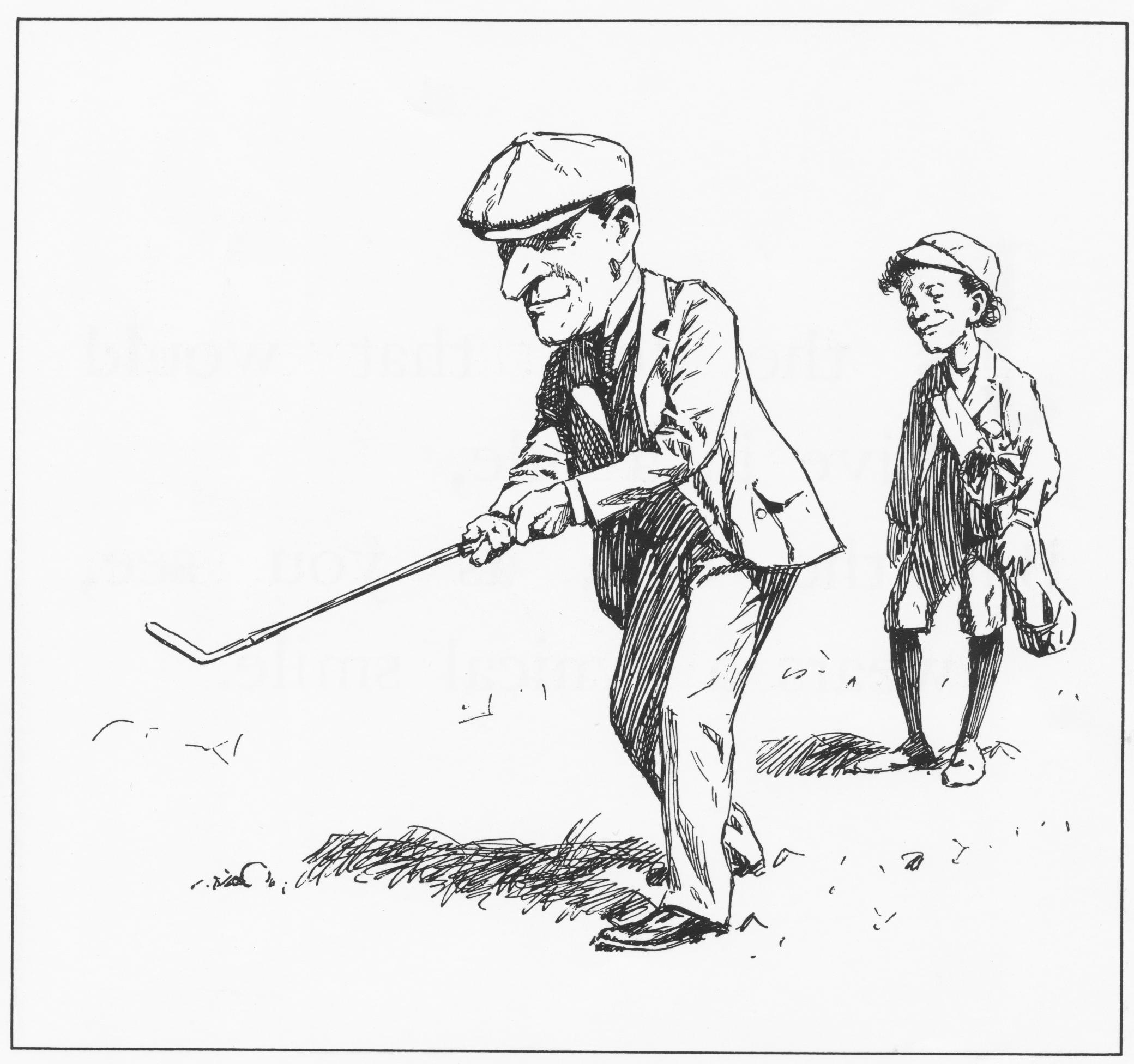
Below is an example:

The caption reads:

.                                                     I is for Iron that we play to perfection,
.                                                     So long as no bunker is in that direction.

And who says golf has changed!

Here are a few others from the book:

C is for Card, that began with a three,
And was torn into bits at the seventeenth tee.

H is for Hole that was easy in four,
And also for Hazard that made it six more.

N is the Niblick, retriever of blunders,
And now and again it accomplishes wonders.

And,

W in a Whisper: “Between you and me,
I have just done the round in a pat 83.”

Sutphen’s book was reprinted in 1967 and is widely available on the net.

post

A Golf Controversy Regarding the Swing

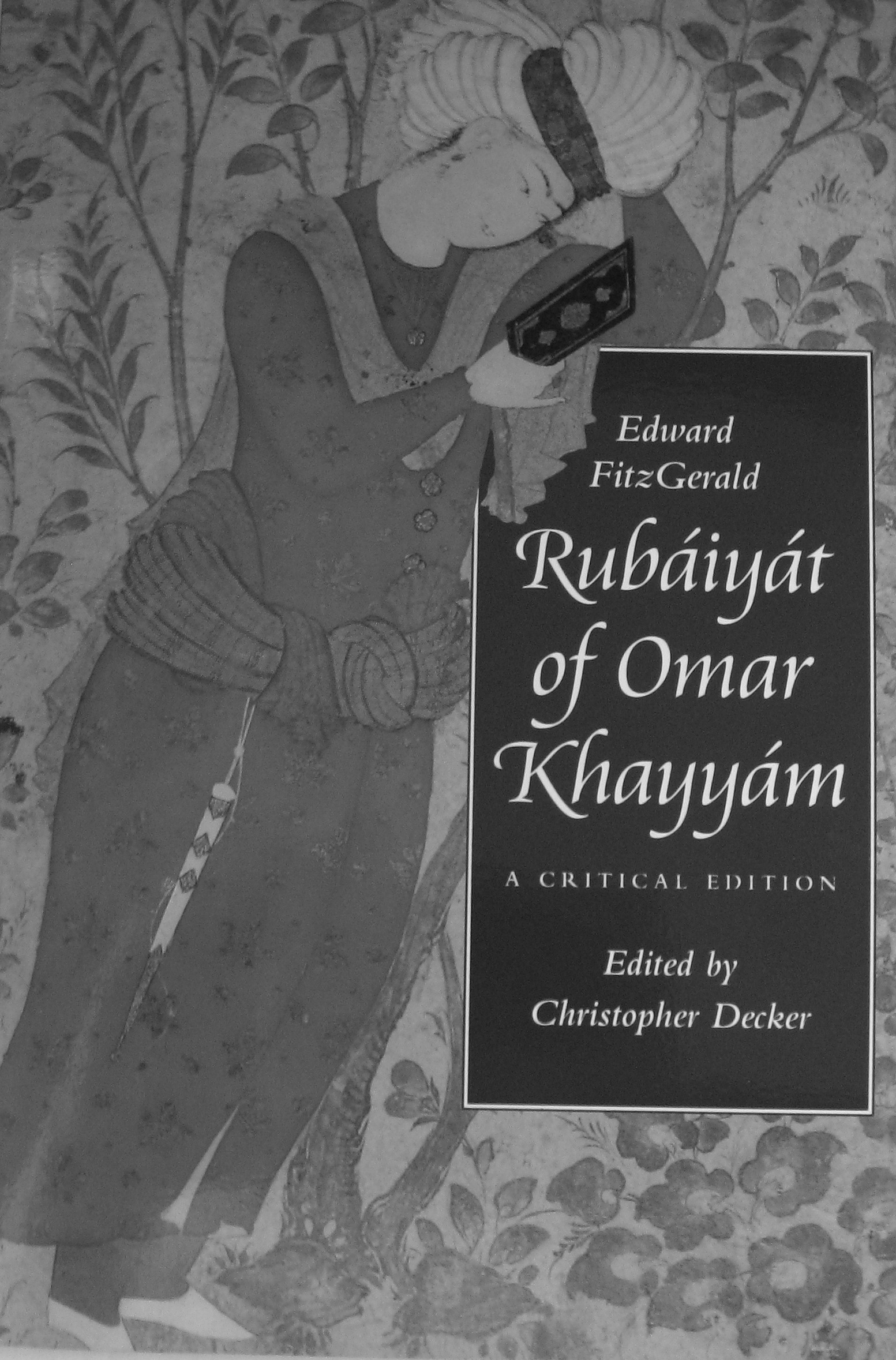
The question, “How do you swing a golf club?” , has no simple answer today or in the past. Almost 70 years ago, J. A. Hammerton wrote this verse that appeared in The Rubaiyat of a Golfer:

Myself when young would hopefully frequent
Where Pros and Plus Men had great argument
On Grips that overlapped, on Swing and Stance
But came away less hopeful than I went.

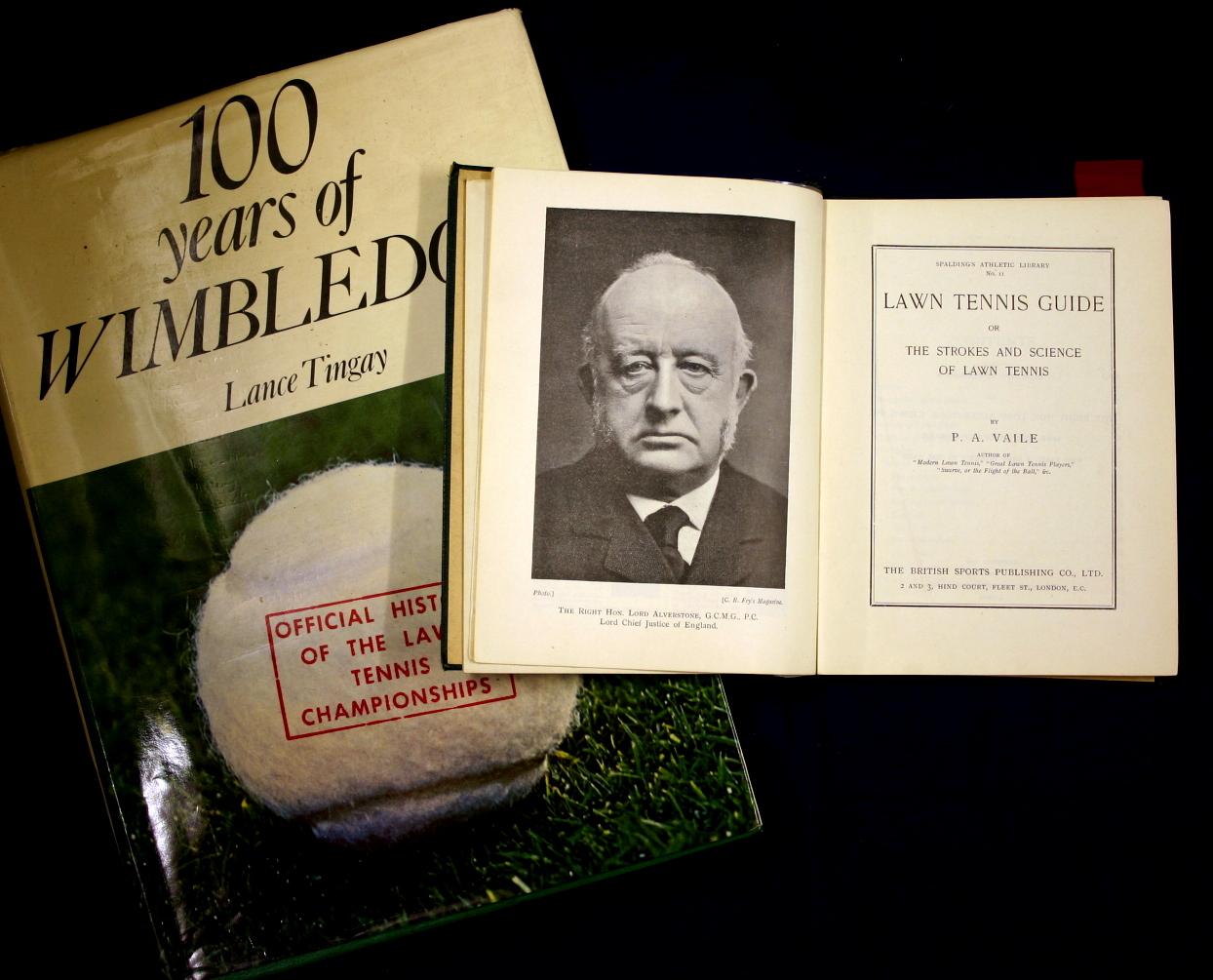
As golf became popular in the United Kingdom and then in the U.S. and other countries around the turn of the 20th Century, golf books became the primary source of swing instruction. Books were written by the major golf professionals of the time and by other self-proclaimed experts as well. One of the most prolific writers on golf and golf instruction in the early 1900’s was a New Zealander named Pembroke Adolphus (sometime Arnold) “Percy” Vaile.  Joseph Murdoch’s book, The Library of Golf, lists eight books by P.A. Vaile. (worldcat.org includes 130 entries for Vaile including a number on Tennis about which he also claimed expertise! See illustration above.)

In one of Vaile’s golf books, The New Golf, published by E.P. Dutton & Co. in 1916, Vaile almost lashes out against the idea that the left hand is dominant in the golf swing:

“The hoariest old tradition that ever fastened on to golf was the power of the left. It was more than a tradition. It was a fetich. Authors and journalists worshiped at its shrine.”

Vaile goes on to attack Vardon, Taylor and Braid (“The Great Triumvirate”) as well as Horace Hutchinson, the great amateur and leading golf writer of the day for their “moldy old idea[s].” Vaile first put forth his ideas in a newspaper article maybe eight years earlier. At that time he was attacked. In his words,

” I was in the thick of it. Anybody who bursts up any useless old tradition, or even gives it a bump, in London, is a fool, a faddist, a theorist, or a revolutionist. If he does not recognize this before he disturbs any of the dust of centuries, and if he is not prepared to accept the position kindly and patiently-and temporarily-he deserves all that is coming to him-and that is much.”

And in those days, attacks were not limited to prose:

THE LEFT HAND’S LAMENT
(Picked up on the links at
St. Andrews)

Since first by Heaven’s august decree
The Royal Ancient Game was planned,
I always was allowed to be
The Master Hand.

To Me did text-books all allot
The part of propulsative strength.
The raking drive, the brassie shot–
I gave them length.

The Right Hand was –poor thing!–designed
To guide the club, and that was all;
Mine was the power that lay behind
The far-hit ball.

Now come there one upon the scene,
Whose heresy fair turns me pale–
The Arius of the golfing green–
A wretch name Vaile.

He says our Vardons, Braids, and Whites
Don’t golf’s dynamics understand;
Their view of Me’s all wrong; the Right’s
The Master Hand.

If Fate would let me but devise
Some torture for this villain bold,
Who thus would revolutionize
Golf’s credos old–

Oh! then to ball of rubber core
I’d change him for a tidy spell,
And drop him in “The Swilcan” or
“The Burn” or “Hell”;

I’d lose him in the rock-strewn sand
Whence few topped spheres ejected come,
Of Musselburgh’s notorious Pand-
Emonium.

Clearly, todays controversies  – one plane vs. two; stack and tilt; Tee It  Forward – are mild in comparison.

post

Short Golf Poems – Less Than a Foot

Two line golf poems, such as the Twines I occasionally write for Twitter, are short. But what about really short golf poems?

The widely acknowledged shortest general poem is:

FLEAS

Adam
Had ’em.

I would offer as a possible shortest golf poem:

BACKSWING

Low
Slow.

A three word entry might be:

DUFFER’S GOLF

A profane
Game!

And in the four word category, a familiar refrain uttered by many after a series of bad shots:

A GOLFER’S LAMENT

Can’t hit
For sh–.

If you would like to share your two, three or four word golf poems, please leave a reply. It shouldn’t take long.

[And if you are looking for a unique gift, please consider my book, Golf Course of Rhymes – Links between Golf and Poetry.” Robert Trent Jones, Jr. wrote the foreword.  Thanks.]

post

Was Omar Khayyam a Golfer?

In 1965, when I was a young professor at the M.I.T. Sloan School, I wrote a paper with the title, “Markovian Decision Models for the Evaluation of a Large Class of Continuous Sampling Inspection Plans.” In June of 2009, I published a paper with the title, “Was Omar Khayyam a Golfer” in “Through the Green,” a publication of the British Golf Collectors Society. I leave it to you to characterize the arc of my writing career. Right now I’m more concerned with the arc of my drives! The golf parodies of Khayyam’s famous poem, “The Rubaiyat” are  explored more fully in the 7th Chapter of my new book, “Golf Course of Rhymes.”


post

A Golf Poem with a Boston Accent

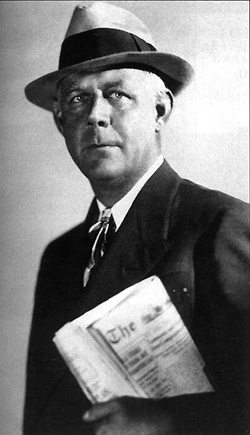
Grantland Rice

Grantland Rice wasn’t from Boston, he was born in Murfreesboro, TN in1880. And I don’t think he spent much time there. Nevertheless, in the following poem “Beating ‘Em To It” he somehow picked up at least a slight Boston accent. The poem appeared in The Winning Shot, a book written by Jerome Travers which I have mentioned in previous Posts. Rice’s poetry is sprinkled through out the book’s pages.

BEATING ‘EM TO IT

Yes Pal, I know just how it was–you should have won a mile;
You had him trimmed ten ways on form and twenty ways on style;
You had him stewed into a trance–you had him strung until
You went and blew a ten-inch putt where something tipped the pill;
A putt you wouldn’t miss again the whole blank summer long–
A pop-eyed pipe to anchor– am I right or am I wrong?

I get you pal–don’t say a word–he wasn’t in your class;
You had no less than twelve bad kicks that plunked you in the grass;
While you were straight upon the pin, he foozled every shot,
But somehow skidded on the green and gathered in the pot;
No not a word; I know, old top–your case is nothing new–
I know, because each time I lose they beat me that way, too.

Now that golf season has begun,keep the poem in mind when you have one of those matches or one of those days.

post

The Golfer’s Wife

If you search this blog, using “Wife” as the search term, you will find five Posts that one way or another characterize the golfer’s wife of about 100 years ago. In these early days when golf was becoming popular and affordable the men played and for the most part their wives did not. A popular description of such wives was (and still is) “golf widows.” Yesterday, while searching through a Google book called Humours of the Fray by Charles L. Graves (published in London in 1907) I found yet another poem with the subject as its title, “The Golfer’s Wife.”

As is often true in these poems, the golfer himself is subject to the poet’s ridicule, while the wife though suffering is clearly the “hero.”

THE  GOLFER’S WIFE

OF  perfect stamina possessed,
From centenarians descended,
Jones spends his lifetime in the quest
Of health-although his health is splendid.
Last year he throve upon a fare
Which  now he views with utter loathing,
And monthly he elects to wear
New hygienic underclothing.

His doctors order exercise,
Fresh air and healthy recreation;
And Jones assiduously tries
To combat physical stagnation.
Llandrindod welcomes him to-day,
To-morrow Droitwich  lures him brinewards;
Next week ’tis Bath, or Alum Bay,
Or  Bournemouth,  and he hurries pinewards.

At scholarship inclined to scoft,
Yet  fond of neither dogs nor horses,
Upon his diet and his golf
Jones focusses his mental forces ;
Unmoved by mountain  peaks sublime,
Or  ‘mid the most enchanting  greenery,
Because he’s musing all the time
On  his inside, and not the scenery.

To travel with this fearsome freak,
This  valetudinarian* loafer,  (*unhealthy)
I should decline, though for one week
He gave me all the gold of Ophir.
Yet  his self-sacrificing spouse,
All normal interests resigning,
Beneath her lifelong burden bows
Without  the semblance of repining.

With  him she trots from links to links,
Wearing  a smile of saintly meekness ;
With  him eternal cocoa drinks
Though  China tea’s her special weakness.
Nor  is her sympathy profound
Relaxed at luncheon or at dinner,
When  Jones reconstitutes each round,
And turns the tables on the winner.

Fine weather keeps him out of doors,
But when it rains or even drizzles
The  slightest moisture he abhors
Her fate is worse than patient Grizel’s*. (* A reference to the wife of Marc Antony)
For Jones exacts attentive  heed
To his malingering recital,
And poses as an invalid
When  Mrs. Jones deserves the title.

No chance of respite or reward
To her the future seems to offer,
Unless some random rubber-cored
Despatches this dyspeptic golfer.
Already shrunken  to a shred
By her devotion self-denying,
She perseveres, and when she’s dead
He’ll  blame her selfishness in dying.

Divines are wont  to disagree
Acutely in regard to Heaven,
Some doctors holding it to be
A single sphere, and others seven ;
But Jones’s consort entertains
No doubt about one crucial question ;
There will, upon the heav’nly plains,
Be neither golf nor indigestion.

Mr. Graves lived from 1856 to 1944. He was a prolific writer and poet. Among his books were a four volume set called Mr. Punch’s History of Modern England. Though I searched widely, I could find no other connections between Graves and golf beyond his poetry.