post

Golf Instruction With Illustrated Poetical Positions!

image0-1image0

image0-2

FORE

Fore, lads! Keep out o’ the line o’ fire,
And I’ll teach ye to drive a ba’,
That’ll flee to the clud, and fa’ wi’ a thud,
Twa hundred yards awa’.

Ye maunna (must not) be stridin’ your legs ower wide,
Like a puddock (frog), across the green,
Nor be haudin’ your elbows pinned to your side,
And lettin’ your nails be seen.

And dinna be bendin’ your chin to your knees,
At an angle o’ forty-five,
Nor wrigglin’, as if ye were treadin’ on peas:
Keep your energy a’ for your drive.

Fix your e’e on the gutta, stride fair, feet square,
Elbows free, gie (give) your back a bit thraw (a small turn)
Heel up; swing your club round the nape o’ your neck,
Whish, click, and the ba’s awa’!
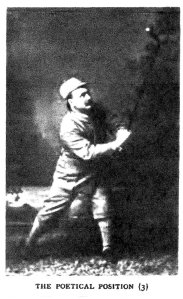
The above, in a slightly different format, appears on page 503 of the Rev. John Kerr’s The Golf-Book of East Lothian published in Edinburgh in 1896. This is clearly an early example of illustrated golf instruction so common in today’s golf magazines and instruction books. But it is surely unique in its description of the three “poetical” positions. The poet was A. P. Aitken, D. Sc., lecturer on Agricultural Chemistry at the U. of Edinburgh and member of the Gullane Golfers, an East Lothian golf club formed in 1868.

Kerr’s book was the first to be written about a golfing area or club. Decent first edition copies are rare, often selling for well over $1000 when available. Joseph Murdoch points out in his book, The Library of Golf 1743-1966, that the first action pictures (not posed) appeared in How to Play Golf by H. J. Whigham published in Chicago in 1897.

post

Be a Happy Golfer; Just Play and Have Fun

The-Happy-Golfer

Here is a list of golf books that you might consider to help you improve your game:

The Happy Golfer by H. Leach
Advanced Golf by J. Braid
How to Play Golf by H. Vardon
Golf Faults Illustrated by J. H. Taylor
Golf for the Late Beginner by Henry Hughes
The Golfer’s Pocket Tip Book by G. D. Fox
Modern Golf by P. A. Vaile
Success at Golf by H. Vardon, F. Ouimet, and others.

Though their titles look current, these books were included in an advertisement in the September 1914 issue of the magazine Golf/USGA Bulletin. The first golf instruction book published in the U.S., Golf in America: A Practical Manual, by James Lee, appeared in 1895.

 Of course, if instruction books don’t help enough, you can always take lessons from a Professional. And neither lessons or books will help much if you don’t practice. But then Malcolm Gladwell in Outliers tells us that 10,000 hours or more or practice are needed to excel. What to do? [Read more…]

post

“The Apple-faced Sage” and Two Enduring Swing Principles

In an earlier post, I included several stanzas from a poem by  Lord Darling called “Keep Your E’e on the Ba’.” While Darling limited his advice to a few lines of verse, Horace Hutchinson (1859-1932), 15 years Darling’s junior, published the first popular book of golf instruction, Hints on Golf in 1886. The book is described on the Classics of Golf website as “The first mass-produced instruction book in the history of golf, the 14 editions of this book are credited with popularizing the written word as a viable means of teaching.” In the Classic of Golf edition, Hutchinson is described as “undoubtedly the first Englishman to become an important figure in the game of golf,” by Herbert Warren Wind, American’s greatest golf writer.Besides being first, Hints on Golf may be the only instruction book ever to employ verse to emphasize important swing principles. Hutchinson writes,

HH 1903

Horace Hutchinson 1903

“The head must necessarily be steady, for it is most important that you should keep your eye fixedly on the ball from the moment that the club -head is lifted from the ground until the ball is actually struck. [Then following Darling} ‘Keep your eye on the ball,’ should be your companion text to ‘Slow Back.’ A golfing poet writes of

The apple-faced sage, with his nostrum for all,
‘Dinna hurry the swing! keep your e’e on the ball!'”

Next time you step up to the tee you might startle the members of your group by reciting the words of “The apple-faced sage”as part of your pre-shot routine!

But two questions remain: Who was this Scottish mentor? And who was the “golfing poet” who immortalized his versified advice? With the help of Google I can report the following: [Read more…]

post

Ageless Advice from Lord Darling

The following appears in a description of the book A DUFFER’S HANDBOOK OF GOLF by Grantland Rice and Clare Briggs, on the Classics of Golf website.

There is no doubt “duffer” is a pejorative term. While the word’s origin is unknown, it appears in the 1800s as slang for an incompetent, ineffectual, or clumsy person. What better word to describe a neophyte attempting golf? The first “wave” of new golfers occurred when the gutta percha ball became available in the 1850s. Its lower cost and superior durability enticed many citizens to gather a few clubs and try their hand at the sport, some woefully ignorant of the rudiments of the game. “Duffer” first appears in the golf lexicon in 1875 in Clark’s Golf: A Royal and Ancient Game, in a poem by “Two Long Spoons.” [Read more…]