post

Verses for Bubba, The Master’s Champion

A lot has been written about the new Master’s champion, Bubba Watson, since he put on his first green jacket. But unlike, a hundred years ago, it’s all prose and no poetry. So I’ve turned back the clock with a few verses to celebrate his well deserved and colorful victory.

Bubba’s Way 

Bubba doesn’t mind confessin’
He’s got this far without a lesson
But what’s the lesson in the tale
To the top, more than one trail.

Bubba’s Swing

Bubba’s swing is nice an’ breezy
Makes his monster shots look easy
But with that driver you’re tempted to think
They’ve got to go longer because it’s pink.

Bubba’s Shot 

About BW let’s be candid
Fortunate that he’s left handed
If he had hit a slice instead
“Our usual shot,” all we’d have said.

Bubba’s Game

Hit it and find it, that’s his game
To walk that far you’d have to train
And with his flat stick he might sink
Every putt…were it too pink!

Leon S White (golfpoet)

post

Golf Poetry – Who Wrote it; Who Reads It (Part 1)

April is Poetry Month, so why not a Post focusing of some of what I’ve learned about golf poetry.

In doing research for my book, Golf Course of Rhymes – Links between Golf and Poetry Through the Ages, I found that the earliest poem known to include a reference to golf was called “The Muses Threnodie” by Henry Adamson, published in Edinburgh in 1638. Some have argued that Shakespeare preceded Adamson. For example, here is King Lear on pressing: “Striving to better, oft we mar what’s well.” But, I think we’ll stick with Adamson.

Possibly the first poem devoted entirely to golf was found in a 1687 diary entry of an Edinburgh medical student, Thomas Kincaid. In 12 lines, Kincaid establishes himself as golf’s first swing instructor. The poem begins,

Grip fast stand with your left leg first not farr
Incline your back and shoulders but beware
You raise them not when back the club you bring

The complete poem is included in my book. I found it in a wonderful reference book on early golf history called A Swing Through Time by Olive M. Geddes, a Senior Curator in the National Library of Scotland. The “triumvirate” of early golf poems is completed with The Goff,” a 358-line mock-heroic poem written by an Thomas Mathison and published in book form first in Edinburgh in 1743. The Goff is thought to be the first book entirely devoted to golf.

As golf developed in Scotland and then in England, golf poetry developed as well. One of great golf poets of the first half of the 19th century was George Fullerton Carnegie, a member of St. Andrews. His poetry is included in a book edited by Robert Clark called Golf: A Royal & Ancient Game. One of Carnegie’s poems, “Address to St. Andrews” begins,

St. Andrews! They say that thy glories are gone,
That thy streets are deserted, thy castles o’erthrown;
 If they glories be gone, they are only, methinks,
As it were, by enchantment, transferr’d to thy Links.

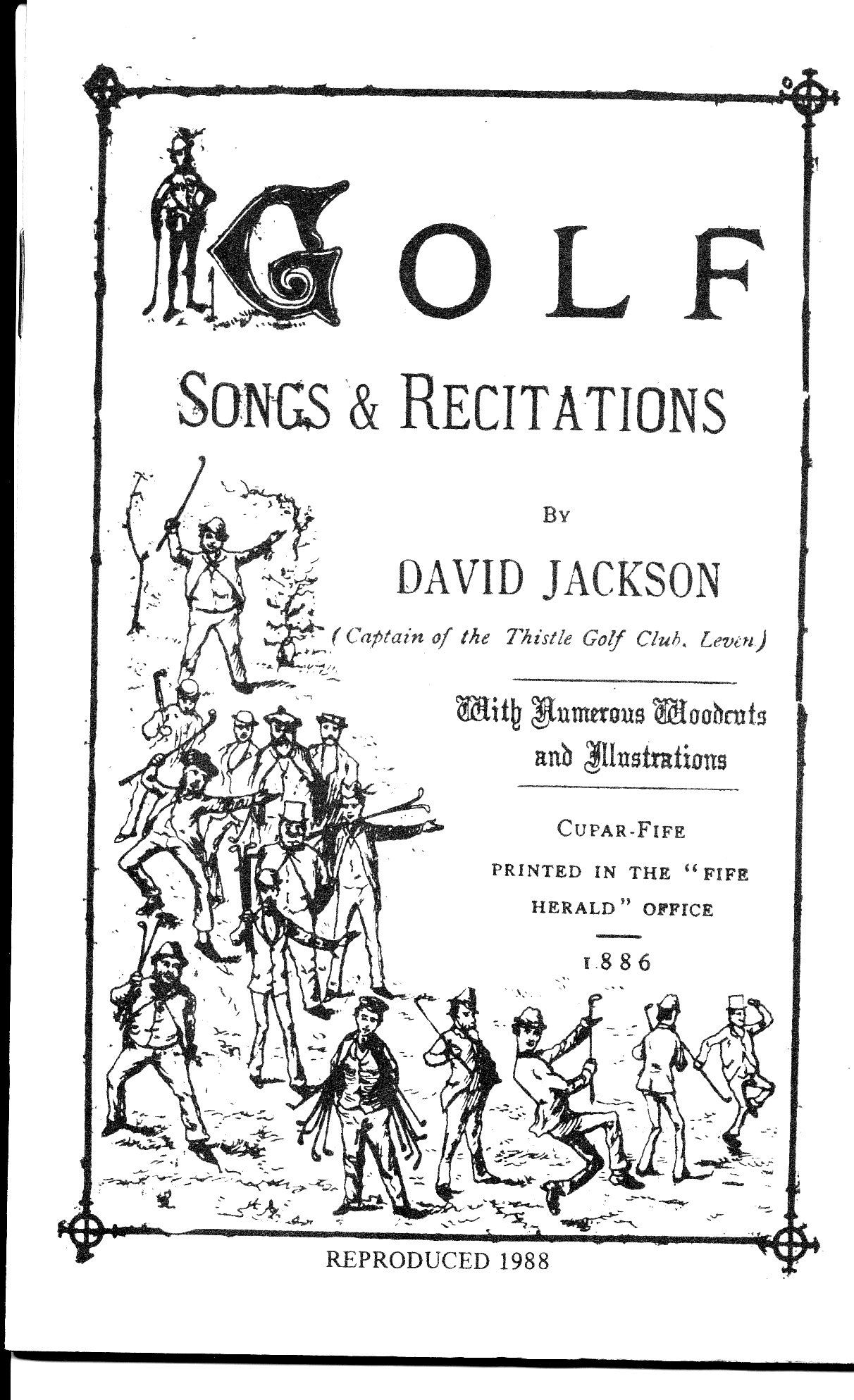
In 1886, David Jackson, Captain of the Thistle Golf Club, Scotland, published a 32 page pamphlet/book called Golf – Songs & Recitations. You can search this Blog for three Posts that include poems that Jackson wrote. A few years earlier in 1873, Thomas Marsh, described as the poet-laureate of the Royal Blackheath Golf Club in London, privately published a small book called Blackheath Golfing Lays. A rare 1st edition copy recently sold for $8400.

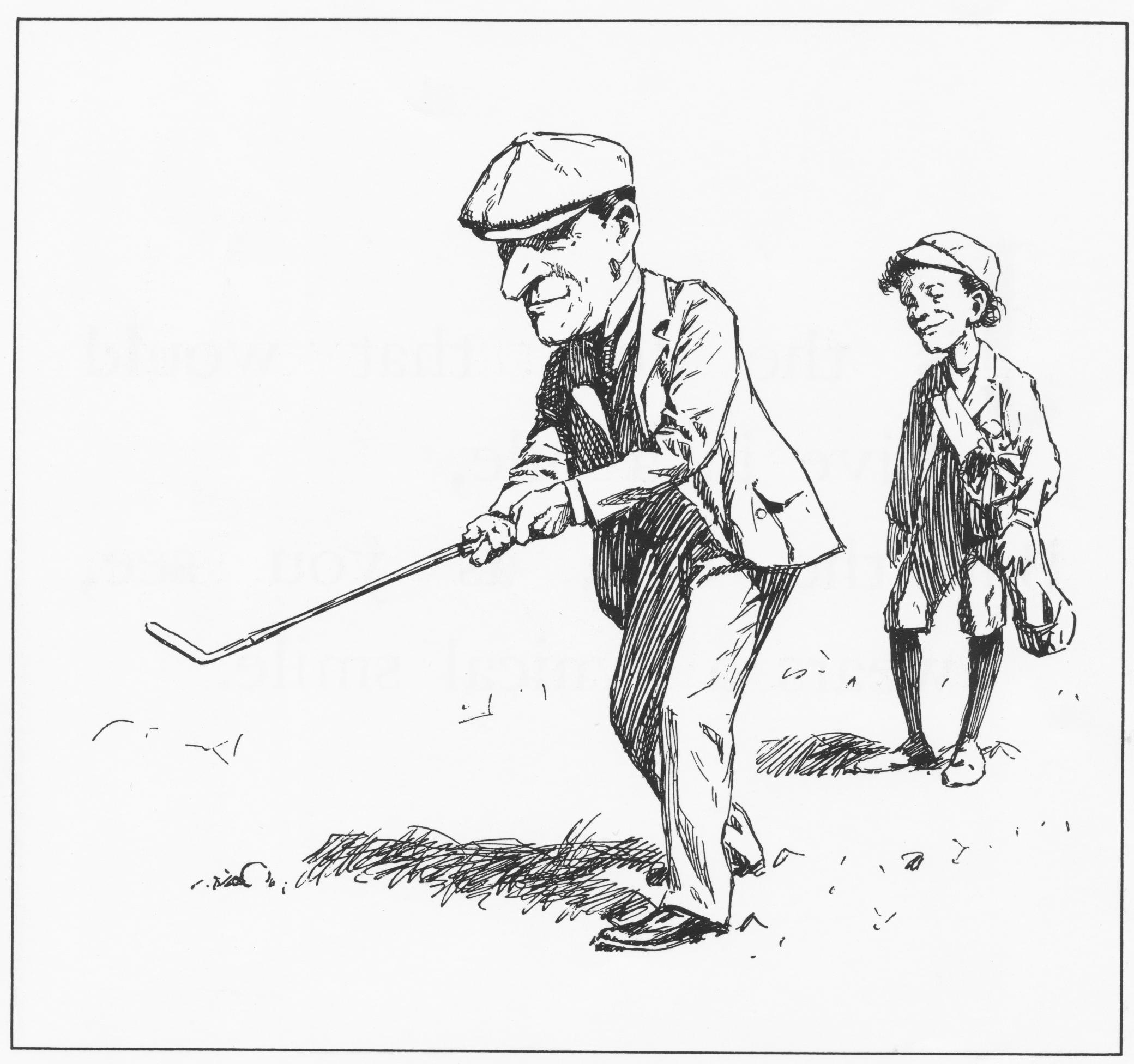
In my opinion, one of the best golf poets of the 19th-early 20th century, was the Scottish writer, poet and drama critic, Robert K. Risk. In 1919 he published a book of 36 golf poems called Songs of the Links with illustrations by H.M. Bateman, a famous British cartoonist. I was fortunate to win a copy of Risk’s book at auction three years ago. Risk was a golfer, as were virtually all of the golf poets of this time  Only a golfer, Risk in this case, could write lines such as these,

Here, with an open course from Tee To Tee,
 A Partner not too dexterous – like Thee—
Beside me swiping o’er Elysian Fields,
And Life is wholly good enough for Me.

Other British golfer-poets of Risk’s time included Sir Arthur Conan Doyle, Rudyard Kipling (born in India), Andrew Lang, better known for his children’s fairy tale books, Robert H. K. Browning (not that Browning) and John Thomson who wrote a wonderful short book called A Golfing Idyll under the pseudonym “Violet Flint.” The book, subtitled The Skipper’s Round with the Deil (Devil) On the Links of St. Andrews, was first published privately in 1892.

In my research I discovered one golf poet of the time, Harry Vardon, who may have borrowed the verse he offered to an auction during World War One. This story can be found in an earlier Post and also in my book.

Golf poetry was also being written in the United State and Canada during the late 19th and early 20th centuries. One of the best American golf poets was Grantland Rice, the first dean of American sports writing. Rice wrote hundreds of poems about many sports, wrote prose and poetry for a number of New York City papers and was editor an early golf magazine, American Golfer, in the 1920’s. Among the many golf poems Rice wrote, here is one of his shortest:

The bloke who lifts his well known dome
Will let it hang when he starts home.
And he who finds missed puts are rife
Is no companion for a wife.

Other American golfer-poets, contemporaries of Rice, include Charles “Chick” Evans, Jr., the great amateur player, Tom Bendelow, an important early American golf architect, who wrote a parody of “Casey at the Bat” called “Hoo Andra Foozled Oot,” Ring Lardner, one of American’s best short story writers, the Chicago Tribune columnist Bert Leston Taylor, and a New York lawyer, Norman Levy.

I also discovered three Canadian poets: Edward Atherton, who wrote a song called “Far and Sure” in 1901; W. Hastings Webling; and a Montreal judge, writer and poet, Robert Stanley Weir, who was most famous for writing in 1908 the first English lyrics to O Canada, Canada’s national anthem.

Outside of Scotland, England, the United States and Canada, I have found only one golf poet. His name was Barton “Banjo” Paterson from Australia. The poem he wrote is called “The Wreak of the Golfer” but he was much more famous for writing “Waltzing Matilda.”

If you know of any golf poetry by poets from other countries, for example, Ireland, India or France, please leave a comment with the reference or poem. And to read poems by most of the poets mentioned above, please consult my book.

Note: Part 2, focuses on the question: who reads golf poetry?

post

A Poem for Michelle Wie Upon her Graduation from Stanford

Last Summer, at the time of the U.S. Women’s Open, an Internet headline read “It’s Open Season on Michelle Wie . . .”  The story included the statement that, “school [Stanford] was too much of a distraction for Wie . . . “ In fact, Ms. Wie has had her critics almost from the time she began playing competitive golf more than eleven years ago. Her detractors would have liked her to satisfy their plans. She had her own ideas and has carried them out exceedingly well.

Now that Ms. Wie is graduating from Stanford this month (fairness requires me to admit that long ago I earned two degrees from the university), I thought she deserved poetic recognition for her achievements and best wishes for a great post-graduate career in golf and otherwise.

  FOR MICHELLE WIE

Michelle Wie, Michelle Wie,
Will your critics ever see,
That a Stanford ed has done for you,
What winning on the tour could  never do.

If you’re a star, the critics said —
Play the game — get ahead,
Full time’s required, if not more;
A degree from Stanford won’t help your score.

But a different scorecard you have kept,
Not just at golf are  you  adept,
Your student days deserves acclaim;
Golf, scholarship and fun have been your game.

But now Degreed, you can roll,
Through tourney gates in your Kia Soul.
Ready to play; give it your all —
Dispatching your critics with an educated ball.

Leon S White, PhD
Stanford, ’58, ‘59

post

Golfpoet.com’s Top Ten

First, I would like to thank all of you for supporting golf poetry by visiting golfpoet.com. We have passed the three year mark and you have registered more than 60,000 page visits. Together we have made golf poetry, mostly poems written before 1920, a little more visible to the golfers of today.

Response to the Blog also encouraged me to complete my book, Golf Course of Rhymes — Links between Golf and Poetry Through the Ages with a Foreword by Robert Trent Jones, Jr.

The Blog now has more than 120 Posts. Of that number, I though it might be interesting to list the Top Ten at this point. They are as follows:

1.  Golf Ball Poetry

2.  A Golf Poem You Can Relate To

3.  Doug Sanders’ British Open Miss for the Ages

4.  An Old Golf Magazine and a Poem for Old Golfers

5.  Lying in Golf Poetry

6.  Golf Ball Poetry Continued

7.  If Johnny Cash Had Been a Golfer

8.  Attitudes Toward Women Golfers in the Early Days (Part 1)

9.  The Importance of Golf – A Sentimental View from the Past

10. Twines — Two Line Golf Poems from Twitter

If any of these titles look interesting, please take a look and enjoy.

Finally, I would encourage you to send links from this Post/ Blog to any of your golfing friends who might enjoy the experience a reciting golf poetry. Thanks.

post

Golf Gods and Goddesses and a New Year Ode

Nobel Prize Winner Daniel Kahneman, in his best selling book, Thinking, Fast and Slow, includes the following formula:  Success = Talent + Luck. In golf, the player contributes the talent, but what about luck?

These days luck, good or bad, is often attributed to “the golf gods.” These gods go nameless and as far as I can tell influence the success of all golfers regardless of talent level. In a few cases, lapses in talent are also attributed to the golf gods: for example, from Golf.com in June 2011 — “[Tiger’s] latest setback seems like the golf gods kicking a guy when he’s down.”

During earlier times, at least in Scotland, luck was the province of golf goddesses, not gods. We know this from the poetry of the time. From the first book solely about golf, The Goff, published first in 1743, the author, Thomas Mathison, pleads,

‘O thou GOLFINIA, Goddess of these plains,
Great Patroness of GOFF, indulge my strains;

A second goddess, Golfina, appears in John Kerr’s book, The Golf-Book of East Lothian (1896),

“Then, clad in white, and wearing a gutta-percha crown, tipped with golden balls, her sceptre a long spoon, entered the fair Golfina, Goddess of the Royal and Ancient Game, . . .”

The goddess Golfina is also the subject of a poem by Robert K. Risk that appeared in his book, Songs of the Links published in 1919.

       TO GOLFINA

A New Year Ode
Above the clubhouse portal
Crowned with green turf she stands,
Who gathers all men mortal
In sacrificial bands;
.        Her iron face is sweeter
.        Than Love’s, who fears to meet her,
.        To men who daily greet her
With supplicating hands.

She waits for each and other,
She waits for all men born,
Who straight forget their mother,
Their sins, their wives forlorn;
.        Their food they swiftly swallow,
.        Take wing for her and follow
.        O’er hedge, and hill, and hollow,
Till eve from early morn.

Forgetting loves that wither,
Desks, Pulpits, Stocks, and Rings,
Forgetting bores who blither,
And all disastrous things;
.        We may have done some task illk
.        Been cheated by a rascal,
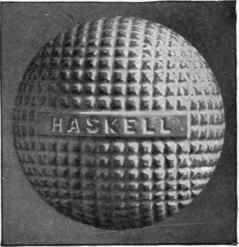
.        But let us tee a Haskell,
And debts and duns take wings.

Golfina may send sorrow—
Six down and five to play—
But we will win to-morrow,
Which is another day;
.        Though we have lost a fiver,
.        Or broken our pet driver
.        Golfina bates no stiver
The homage we must pay.

From enervated putting,
From topping on the tee,
Perpetual tut-tutting
At things which should not be,
.        Miscalculated pitches
.        That land us deep in ditches,
.        New golf-books that bewitch us,
Golfina, set us free!

I have not been able to determine the relationship between Golfinia and Golfina. Any ideas?

post

The Haskell-Gutty Controversy in Verse

“The Haskellisation of Golf” is the title of an article by the famous English amateur golfer and writer, Horace G. Hutchinson, that appeared in the October 17, 1902 issue of Golf Illustrated, a weekly golf magazine. Hutchinson discusses the question of whether the gutty ball should be replaced by the recently invented Haskell ball. For background see a previous Blog entry, Haskell on the Brain, https://golfpoet.com/2010/07/05/haskell-on-the-brain/.

At the same time, Hutchinson wrote his piece, a poet with the initials F.J.K. wrote a poem to the editor (they did such things 100 or so years ago) in which he versified on the pros and cons of switching to the new balls.

THE NEW BALLS                                                                                            

To the Editor of Golf Illustrated

Dear Sir,

Two of the questions of the day,
We read, in circles polished,
Are whether women ought to work,
Or kissing be abolished?

But though these interesting queries
Might be discussed for ages,
They pale and pall before the one
Appearing in your pages.

The merits of the rubber-filled
American invention
From golfers one and all demand
Their very best attention:

And week by week your paper has
An interesting series
Of answers published in response
To these important queries:

Whether, in driving from the tee,
The golfer finds his task ʾll
Be simpler if he once employs
A Kempshall or a Haskell?

And if he finds that owing to
These aids so adventitious
His skill improves all around, or fate
Is, as before, capricious.

And does the new ball benefit
Our mediocre players,
And help them to attain the art
Of Braid, or Herd, or Sayers?

And if, supposing this is true,
Another finds it hard on
His excellence, a player like
Taylor or a Vardon?

And further with what liveliness
This substitute for gutta
Behaves when struck with iron clubs,
Or aluminium putter?

And yet, again, if general use
Will spoil our English courses,
And whether, this being so, there are
Remedial resources?

These questions of the day,
Vìde GOLF ILLUSTRATED
(With which, cf. the title page,
“Golf” is incorporated.

And there one finds set forth, in turn,
Assertion and denial
Of faults and merits in the ball
By those who’ve given it trial.

One hears that certain clubs demand
Restrictive legislation,
To save the gutty from the Trans-
Atlantic innovation.

Now I, unmasked, advise each man
To try, in strict seclusion,
This full-of-rubber novelty,
And draw his own conclusion.

About the distance of his drive
He’ll wax enthusiastic,
But later on he’ll wish his ball
Was rather less elastic.

About the cost he may well feel
Supremely apprehensive,
Seeing that every ball is so
Atrociously expensive.

So, if he thinks with me, he will
Abide no rubber filling,
But use an English ball, for which
He’ll pay an English shilling!

F.J.K.

Of course, issues surrounding the capabilities of golf balls continue. Recently John Solheim, Chairman and CEO of Ping, suggested that instead of a single Ball Distance Rating (BDR) limit (how far a ball can go) there should be three. In addition to the current BDR, there would one shorter and one longer. (See  Golf Digest article) Then we would have to endure ads for the longest short ball, the longest long ball, etc. I’d rather go back to the Haskell!

post

A Not So Happy New Year from Golf Illustrated 1900

New Years 1900 for the English was not all happiness. The second Boar War was under way between the British Empire and the two independent Boer republics, the  Orange Free State and the Transvaal Republic. The war did not end until 1902 when the Boer republics became British colonies. These colonies later became part of the Union of South Africa.

Golf Illustrated, a new English golf weekly, greeted 1900 by beginning its January 5th edition with a poem and a few hopeful and sober remarks.

A gude (good) New Year an’ health an’ cheer,
Tae ilka (To every) gowfin’ loon,
An’ may we steer o’ hazards clear,
In life and gowf each roun’.

*             *             *

Another round in the great game of life has now commenced. Let us hope that 1900 will have fewer bunkers in store for us than 1899.

*             *             *

“Ring out the Old, Ring in the New!” seems to be a singularly appropriate sentiment this particular New Year time. We have a long and heavy score to wipe off in South Africa before we can settle down in peace and comfort of mind to our ordinary avocations.

*             *             *

We have made the mistake, as common in Golf as in life, of under-estimating our adversary, who, instead of being a third-rate performer, has turned out to be a veritable Colonel Bogey.

*             *             *

The game, however is yet young. We have now fairly got the measure of our man, and a few more holes will put a very different complexion on affairs.

*             *             *

“Ring out the Old, Ring in the New!”

*             *             *

By the time the Championships are here, there ought to be some golfers in Pretoria.

A golf related footnote to the war: Freddie Tait, a highly regarded amateur, winner of the Amateur Championship in 1896 and 1898, fighting as a member of the second battalion of the Black Watch, died in battle on February 7, 1900. To honor his memory, The Freddie Tait Cup is awarded annually to the leading amateur in the South African Open.

post

Marketing Golf Poetry

Marketing golf poetry—talk about a tough assignment. That’s what I have been doing with this Blog for almost three years. And now with my book as well. I have had some success with about 54,000 Blog page views and a spot on some of the top 50 golf blog lists.

But just recently, I zeroed in on what I’m “selling.” Let me explain it this way. Products and services are now thought of by marketers as means to an end. And the end has to be a great, memorable, unique, (you put in the adjective) experience. For example, a golf course wants to create an unforgettable experience for its customers. A club maker isn’t selling you clubs; he’s selling you the experience of playing your best golf with them.

So old readers and new, I am not selling golf poetry on this Blog or in my book. I am selling a unique and exhilarating golf experience —the experience of reciting golf poems. And you know what? You won’t get that golf experience any other way on the course or off. For some, reading poetry out-loud will take as much courage as playing a fairway wood over water. For others it may come easier. But whatever your predisposition, this much I know. Unlike golfers of an earlier generation, you have had little or no opportunity to enjoy this aspect of the game. Here is your chance.

You might begin with the opening stanza from a poem called “The Lay for the Troubled Golfer” by Edgar A. Guest (born in England in 1881), a writer for the Detroit Free Press for more than sixty years. This is a poem you just have to read out loud.

 His eye was wild and his face was taut with anger and hate and rage,
And the things he muttered were much too strong for the ink of the printed page.
I found him there when the dusk came down, in his golf clothes still was he,
And his clubs were strewn around his feet as he told his grief to me:
“I’d an easy five for a seventy-nine—in sight of the golden goal—
An easy five and I took an eight—an eight on the eighteenth hole!

Not all golf poems, or poems in general, are that dramatic, so reading experiences will be different. But just as with hitting different golf shots, each experience can be rewarding.

Let’s try one more, this one the first two stanzas from a poem in an earlier Post called “St. Andrew’s Law by Robert Browning.” Robert H. K. Browning (not the famous poet) was a Scottish writer, golf magazine editor and golf historian who was active in the first half of the 20th century.

 When prehistoric swipers sliced, and blamed the sloping tee,
They got so riled, Saint Andrew smiled, and “Blasphemers,” said he,
“Henceforth the lightly made excuse shall give you no resource;
Ye may not win to act or use of falsehood on the course.

“Let Peter judge his fisher folk, whose unexamined scales
Their easy consciences provoke to all-unswallowed tales;
But ye the prickly whin shall test, the bunker shall condemn:
The gods of golfing love to jest–but do not jest with them.

If you are having fun, come back to my Blog from time to time and choose from the many poems I have posted. And if you like, look at my book, Golf Course of Rhymes – Links between Golf and Poetry Through the Ages, on Amazon. If you do you can recite the rest of Guest’s poem, “The Lay for the Troubled Golfer.”

post

Golf Twines from Earlier Times (1898)

I began writing golf twines (two line golf poems for Twitter) in November of 2009. Two line poems are formally called “couplets” and, of course, they have a long history in poetry.

For example, Shakespeare wrote :  “Double, double, toil and trouble;/ Fire burn and caldron bubble” which in read by the three witches in his play, Macbeth.  (This is actually a golf twine now where Shakespeare is referring to Tiger’s scores on the 11th and 12th holes during the second round of the 2011 PGA Championship!)

I was hoping that my golf twines would catch on, and other Twitterers would write them as well. So far no such luck. But then I found William G. Van Tassel Sutphen, a Victorian-era fiction writer, editor of the original “Golf” magazine and author of The Golfer’s Alphabet, originally published in 1898. In The Golfer’s Alphabet, Van Tassel Sutphen wrote 27 golf twines, but he was just a little early for Twitter.

Sutphen, wrote a twine for each letter of the alphabet and added one more for the symbol “&”. His twines were illustrated by A. B. Frost. Frost (1851-1928), was considered one of the great illustrators in the “Golden Age of American Illustration”.

Below is an example:

The caption reads:

.                                                     I is for Iron that we play to perfection,
.                                                     So long as no bunker is in that direction.

And who says golf has changed!

Here are a few others from the book:

C is for Card, that began with a three,
And was torn into bits at the seventeenth tee.

H is for Hole that was easy in four,
And also for Hazard that made it six more.

N is the Niblick, retriever of blunders,
And now and again it accomplishes wonders.

And,

W in a Whisper: “Between you and me,
I have just done the round in a pat 83.”

Sutphen’s book was reprinted in 1967 and is widely available on the net.

post

Golf and Skiing in Vermont: A Footnote to Keegan Bradley’s PGA Championship Victory

Rudyard Kipling

Bill Pennington, in today’s New York Times, notes that Keegan Bradley, a Vermont native, played golf in the summer and skied in the winter while growing up there. Rudyard Kipling, the famous English author and poet, is credited by a number of internet sources with also golfing and skiing in Vermont in the 1890’s. What appears to be certain is that in 1894 Arthur Conan Doyle, the creator of Sherlock Homes, visited Kipling at his temporary home outside Brattleboro at Thanksgiving time, and gave Kipling some help with his golf game. From Doyle’s diary, “I had brought my clubs and gave him lessons in a field while the New England rustics watched us from afar, wondering what we were at, for golf was unknown in America at the time.” [Actually the first permanent golf club, The St. Andrews Golf Club in Yonkers, N.Y., was formed in 1888. But golf may not yet have reached Vermont by 1894.]

Doyle is also said to have brought with him or sent Kipling skis. One internet source goes so far as to say that “according to legend, skiing was introduced to Vermont by Rudyard Kipling.”

The extent of Kipling’s interest in golf is not clear. Doyle, however, was an avid golfer. He was for many years a member of the Crowborough Beacon Golf Club in Sussex, England and was the club’s captain in 1910. He even wrote a golf poem, “A Lay of the Links,” that is included in my book, Golf Course of Rhymes – Links between Golf and Poetry Through the Ages.

Kipling’s poetry also includes references to golf. One of his poems called “Verses on Games” includes the stanza:

Why Golf is art and art is Golf
We have not far to seek–
So much depends upon the lie,
So much upon the cleek.

Clearly, Kipling understood golf.