post

Sunday Golf

The New York Times headline read “Ban on Sunday Golf May Wreck A Club.” The date May 22, 1905. The story concerned membership loss at the North Valley Golf Club of Greenwich. Because it had been closed on Sundays since it began in 1900, 35 of its 50 members had resigned. The paper noted that “A resolution forbidding the use of the grounds Sunday was passed (in 1902) and several good churchmen joined, among them a clergyman.” But by 1905 the club was in dire straits.

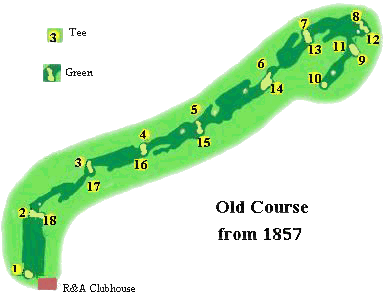
In Scotland, in 1618, the official (royal) line, first voiced by King James VI, was that golf on the Sabbath was acceptable, so long as it was not during the times of service, because Sunday was the only day the great mass of people would have free to play. It was not a view shared by the Kirk [the Church of Scotland]. Indeed Sunday golf at St Andrews only began at all during the Second World War and is still not permitted on the Old Course, though this now has more to do with preserving the course rather than religious strictures.

From a Google search, it looks like today only a handful of golf courses in the U.S., Canada and Great Britain are still closed on Sundays.

A poem, “Sunday Golf,” in the August 1903 issue of “The Golfer” magazine provides a colorful perspective of an irreverent golf poet on Sunday play more than 100 years ago.

Sunday Golf

A Sabbath well spent brings a week of content,
And health for the work of tomorrow;
But a Sabbath profaned whatever be gained,
Is a certain forerunner of sorrow

***************************************

An excellent rule for the wise and the fool,
An object right worthy attainment;
But the point as you see, where we don’t quite agree,
Is the question, What is profanement?

When the Sabbath began, twas created for man,
In the Bible this clearly is stated;
But our Puritan throng think this must be all wrong,
The man was for the Sabbath created.

It makes a man smile that except for this isle,
There is nobody going to Heaven;
Yet, if some folks are right, ’tis the inference trite,
To which we’re remorselessly driven.

For you’ll nowhere else find people so strict of mind
In the matters of Sunday observance;
And an innocent game nowhere else meets with blame,
Or excites any social disturbance.

Then, aye, let us pray that there may come a day,
When the bitter dispute may be ended;
And Sunday employment in wholesale enjoyment,
Be no longer condemned but commended.

The poem was signed “Common Sense.”

post

A Poetic Response to the Rise of Medal Play in 1912

Controversies in golf are usually associated with change in the rules, equipment or form of play. Currently, the groove rule change is front and center. In early times, controversies arose when the switch began from the feathery to the gutta percha ball in 1848 and with the switch from hickory to steel shafts in the 1920’s. The R & A banned the Schenectady putter in 1911. This was the putter that Walter Travis used to become the first American to win the British Amateur Championship in 1904.

Golf controversies today are reported by the traditional media, newspapers and magazines, but also by the traditional media’s dot.com outlets and by the social media, blogs and tweets. The impact of Internet golf reporting has shifted the focus to reporting stories bit by bit in real time with immediate commentary by “followers.” The opportunities to place a hot story in its historical context and search for humorous and ironical dimensions are few. Twitter has trumped poetry as the means for story telling.

But, of course, this has not always been true. For example, in the early 20th century most amateur golf in Great Britain was played under the rules of match play. But the introduction of the score card and pencil stub made medal or stroke play scores easy to record. And by 1912 medal play was on the rise. Robert K. Risk, a Scottish poet and writer and a golf traditionalist, believed that match play defined golf and that this shift harmed the character of the game.

In voicing his opposition to the increase in medal play he was not limited to a time deadline or to 140 characters. Instead, he took his time and fashioned a poem of depth and imagination and biting wit. His poetical protest did not stem the tide of medal play, but does survive as an interesting contrast to how golf controversies are aired today.

“Medalitis,” Risk’s poem, was originally published in the English humor magazine Punch on October 2, 1912. Please be patient as you read it. If you have time, a second reading will help to fully enjoy Risk’s work.

Medalitis

In the full height and glory of the year,
When husbandmen are housing golden sheaves,
Before the jealous frost has come to shear
From the bright woodland its reluctant leaves,
I pass within a gateway, where the trees,
Tall, stately, multi-coloured, manifold,
Draw the eye on as to some Chersonese,
Spanning the pathway with their arch of gold.

A river sings and loiters through the grass,
Girdling a pleasance scythed and trimly shorn;
And here I watch men vanish and repass
To the last hour of eve from early morn;
Dryads peer out at them, and goat-foot Pan
Plays on his pipe to their unheeding ears;
They pass, like pilgrims in a caravan,
Towards some Mecca in the far-off years.

Blind to the woodland’s autumn livery,
Blind to the emerald pathway that they tread,
Deaf to the river’s low-pitched lullaby,
Their limbs are quick and yet their souls are dead;
Nothing to them the song of any bird,
For them in vain were horns of Elfland wound,
Blind, deaf and stockfish-mute; for,in a word,
They are engaged upon a Medal Round.

Making an anxious torment of a game
Whose humours now intrigue them not at all,
They chase the flying wraith of printed fame,
With card and pencil arithmetical;
With features pinched into a painful frown
Looming misfortunes they anticipate,
Or, as the fatal record is set down,
Brood darkly on a detrimental 8.

These are in thrall to Satan, who devised
Pencil and card to tempt weak men to sin,
Whereby their prowess might be advertised —
Say, 37 Out and 40 In;
Rarely does any victim break his chains
And from his nape the lethal burden doff —
The man with medal virus in his veins
Seldom outlives it and gets back to Golf.

post

The “Rubaiyat’s” Contribution to Golf Poetry

To write a parody of a poem, you would take the basic characteristics of the verse (for example, its rhyming scheme and basic idea) and then rework them for comic or ironic effect.

Now suppose that you are a young golfer and poet around the turn of the 20th century. Being literate, you are aware that Omar Khayyam’s poem, Rubaiyat, is being parodied left and right. So one day, after being around the golf course until early evening, you pick up a copy of the poem (it was easy to do then). Reading through the verses, you are struck by the stanza 27,

Myself when young did eagerly frequent
Doctor and Saint, and heard great Argument
.     About it and about;  but evermore
Came out by the same Door where in I went.

If your name was Henry Boynton, a graduate of Amherst with a Masters of Arts, then, looking at the stanza you might have thought about all the controversies regarding the fundamental of golf being discussed by golfers such as Jamie Anderson and Jamie Braid and all the other Jamies of the time. And this might have led you to write (as part of a book, The Golfer’s Rubaiyat),

Myself when young did eagerly frequent
Jamie and His, and heard great argument
.     Of Grip and Stance and Swing; but evermore
Found at the Exit but a Dollar spent.

Little did Boynton know, but he himself would be parodied by later golfing poets.

In the July 1910 issue of  The American Golfer, a poet named Jack Warbasse wrote,

Myself when young did eagerly frequent
Travis and Braid, and read great argument
.     About the Grip and Stance; but evermore
Play’d out by the same Stump where in I went.

And then in 1919, a Scottish writer, poet and drama critic Robert K. Risk published a book of collected poems, Songs of the Links, that included the poem “The Golfaiyat of Dufar Hy-Yam.” In that poem we have,

Myself when you did eagerly frequent,
Club-makers’ Shops, and heard great Argument
.     Of Grip and Stance and Swing; but evermore
Learned and Bought little I did not repent.

Finally, in 1946, J. A. Hammerton, a Scottish statesman and author, published a book, The Rubiayat of a Golfer, in which he wrote,

Myself when young would hopefully frequent
Where Pros and Plus Men had great argument
.     On Grips that overlapped, on Swing and Stance
But came away less hopeful than I went.

So what have we learned? First, that there are limits to the golfing parodies of stanza 27 of the Rubaiyat. And second, Instruction about grip, stance and swing has been confusing for a long time!

post

Links Between Golf and Life

Robert Chambers was a Scottish author, poet, journal editor and publisher, born in 1802. He was the anonymous author of the Vestiges of the Natural History of Creation, published in 1844  and described as bringing together,

“various ideas of stellar evolution and progressive transmutation of species governed by God-given laws in an accessible narrative which tied together numerous speculative scientific theories of the age. ” (from Wikipedia)

Chambers, who was also a golfer, wrote a number of other books including one titled, A Few Rambling Remarks on Golf. Also, he and his brother William for many years edited CHAMBER’S JOURNAL of POPULAR LITERATURE,L SCIENCE, AND ART. One entry in 1877 titled “The Royal Game of Golf” included the following,

The fascinations of the game have enlisted in the ranks of its votaries men of all classes, many of them famous on other fields, who have made their reminiscences of their beloved pursuit mediums for many a bright word-picture in prose and verse.

Robert Chambers was clearly one of these men.

Late in his life, Chambers moved to St. Andrews where he enjoyed a “luxurious and  ‘learned leisure.’ All task-work was at an end.” While living in the shadows of the Old Course, Chambers envisioned a series of “half-comic, half-moralizing sonnets, which were intended to be nine in number,” one for each of the first nine holes. He completed only three before he died in 1871. However, his son and a friend added the other six. The entire poem, “The Nine Holes of St. Andrews in a Series of Sonnets” can be found in Robert Clark’s book Golf: A Royal and Ancient Game. Below is the first hole sonnet written by Robert Chambers.

I. THE FIRST OR BRIDGE HOLE.

Sacred to hope and promise is the spot —
To  Philp’s and to the Union Parlour- near,
To every golfer, every caddie dear —
Where we strike off — oh, ne’er to be forgot.
Although in lands most distant we sojourn.
But not without its perils is the place ;
Mark the opposing caddie’s  sly grimace,
Whispering :”‘He’s on the road !”  “He’s in the burn !”

So is it often in the grander game
Of life, when, eager, hoping for the palm,
Breathing of honour, joy, and love, and fame,
Conscious of nothing like a doubt or qualm.
We start, and cry :  “Salute us, muse of fire !”
And the first footstep lands us in the mire.

[Philp was Hugh Philp a still famous club maker with a shop near the first hole and the Union Parlour was the clubhouse at the time.]

post

Golf Poetry from the Captain of the Leven Thistle Golf Club, 1886

In last week’s Post, I included a poem from a book, Divots for Dubs. The book  can be found in only four libraries in the U.S. Last Monday, I received a book in the mail called Golf Songs and Recitations that I bought from a book seller in England. No libraries carry this book!

What I actually bought was a 1988 reproduction of the original which had been published first in 1886 and then printed again in 1895. This very small (6 1/2″ x 4″) 32 page “book” was written by David Jackson, then Captain of the Leven Thistle Golf Club.  In the book’s Introduction, Jackson says he composed the songs and verses in the book because he had,

heard very few Songs in honour of the Game, and [he] … often thought it a pity that such a popular recreation should be so little celebrated by the Poets.

The first poem in the book is called “Ode to Golf.” In it Jackson describes his love of golf in words that still resonate more than 120 years later. I am including the complete poem since I don’t believe you will find it any where else on the web or in any other book. I think you will enjoy it.

ODE TO GOLF

Oh, Golf, thou art a pleasure dear,
That cheers us on from year to year;
That soothes the heart, and cools the brain,
When stirred with grief, or seared with pain.
Whene’er the wintry snows are over,
Around the Greens we fondly hover;
All blythe of heart as busy bees,
We swing our Clubs, and seek our tees,
The smiling sea, the sunny sky,
The song of larks that heavenward fly,
The flowers that spring to meet the eye
Proclaim the Golfing season nigh.

To Swing, then Drive, To Putt, and Hole,
To some may seem absurd and droll;
To me it is a joy, a pride—
Worth twenty other games beside.
Where is the rival to the game
Of royal and of ancient fame;
Or what is such a cheery houff
As just a friendly match at Gouff?
And when at last, in good old age,
No more at Matches we’ll engage,
We’ll turn to memory’s page and fain
We’ll fight our battles ower again;
And leave to youth the active sport,
The miss, the drive, the miles, the short,
The sclaff, the foozle, the weel sent hame,
The ups and downs of this dear game.

Then fill a bumper, fill it high,
Hurrah for Golf, may Golf ne’er die,
But still from age to age increase—
A game of friendship, love, and peace!

post

Golf Widows in Prose and Poetry

Mrs. Pastern was a woman with an air of bereavement, who 20 yrs. ago would have been known as a golf widow. Mr. Pastern was the brigadier of the golf club’s locker room light infantry, who would shout: “Bomb Cuba! Bomb Berlin!”

This quote is from a description of the story “The Brigadier and the Golf Widow” by John Cheever that appeared in The New Yorker in November 1961.

Actually the term “golf widow” goes back to at least 1890 where an illustration titled “A Golf Widow” appeared in Horace Hutchinson’s famous Badminton Book Golf.

Montrose (a town in Scotland) is … the site of the first recorded ‘golf widow’. She was ‘sweet Mistress Magdalene Carnegie’ who married the son of the 4th Earl of Montrose, James Graham. His diaries record that he played golf with his future brother-in-law, the Laird of Lusse, on the 9th November 1629, the day before his wedding,and then a few days later he sent to St Andrews for new clubs and repairs to his old ones as well as playing more golf. However his controversial lifestyle caught up with him in 1650, after he had become 5th Earl himself, when he was hung, drawn and quartered in Edinburgh at the Grassmarket as a traitor, when he backed the wrong side in the English Civil War.

In June 1915, Grantland Rice published a poem, “The Golf Widow Speaks” in The American Golfer.

THE GOLF WIDOW SPEAKS

You have kicked in with a serum for the Great White Plague;
You have uppercut the Typhus on the jaw;
You  have copped an anaesthetic
To relieve the diptherethic
And the rest of it you’ve cut out with a saw
But tell me, gentle doctors, ere the mortal coil is off,
Is there nothing you’ve discovered in the medicated trough
That may curb the raging fever of the game called “goff”?

You have cantered into Gangrene with a knock-out punch;
You have hammered Scarlet Fever to the ropes;
You have even found the answer
To a mild degree of Cancer,
And you’ve killed the drug enticement of the dopes.
But tell me, learned doctors, is there nothing you can do
For hydrophobic horrors in the heads of husbands who
Can only rave of Stymies and a Perfect Follow Through?

More next week.

post

Golf Poems on Twitter: Golf Twines

twitter_logo_header

Golf Course of Rhymes, through  golf stories linked to golf poetry, is intended to give golfers a different kind of golfing experience.  And since most of the poetry was written by previous generations of golfers, the verses also serve as a bridge to link today’s golfers closer to golfing’s past.

I have been using Twitter and Facebook to spread the word about new Posts .  But reading Twitter Power by Joel Comm I have learned that announcements aren’t enough.

So I have a new idea. Beginning today I am adding occasional Golf Twines to my Twitter time line.  Golf Twines are two line poems that meet Twitter’s 140 character limitation. The two lines can rhyme or not. For example,

To hit a ball both straight and long/Just try to hum a little song. (LSW)

A Wie win/Would be big. (LSW)
(You have to say this one out-loud in a Scottish accent to make it work.)

Some of the Golf Twines will come from the golf poetry I have collected. Often a poem, as a whole, may not work, yet it could have a couple of great lines – a publishable Twine. Other Golf Twines will hopefully come from my “pen.” In keeping with Twitter brevity, attribution , if any, will be by initials, as in the examples.  Needless to say, the Twitter site are open for your Golf Twines as well. And if the idea catches on, we might start a community of Golf Twiners.

So let the Golf Twining begin.

post

Poetry and Golf Club Maintenance

Sapolio Golf Ad

Golf’s rise in popularity in the early years of the 20th century coincided with early efforts in mass marketing and advertising of brand names. One of the first products with brand names was soap. These names included Ivory, Pears, Colgate and Sapolio. An early marketing genius (not the humorist) named Artemas Ward(1848 – 1925) made Sapolio a household name by depicting the product in fanciful scenes and using parodies of well known poems to sing its praises. Time Magazine described Sapolio as “probably the world’s best advertised product” in its heyday.

Sapolio was the WD-40 of its day. One ad identified ways to use Sapolio in every room in the house. Ward or a colleague found it could be used to clean golf clubs. The above ad to spread that message appeared in the February 1901 issue of the magazine Golf. Appropriately the verse is a parody from the poem “Comin Thro’ The Rye” by the famous Scottish poet Robert Burns (1759 – 1796). Ward may have been a duffer but he was no dummy.

I don’t know how often Sapolio was advertised in golf magazines, but I did find a later reference in the June 1909 issue of The American Golfer. A subscriber (could it have been Ward?) wrote,

“There are some golfers who think that clean irons are desirable; among these there are a few who have wondered whether there is not some better way of cleaning than to set a caddie or one’s self to chasing sandpaper up and down.

“I have found that a little hot water and sapolio applied with a brush right after through playing, and then the irons wiped with liquid vaseline or Glycerinum Petria, which I guess is liquid vaseline, will do the work and please the most exacting. The Glycerinum will also do on the shafts and wooden heads with more good to the varnish than harm.”

This is one of the oddest links between golf and poetry so far.

post

WATSON AT TURNBERRY – THE 2009 OPEN

Photo Credit AP

Photo Credit AP

I’m giving myself a two stoke penalty for breaking my rule of posting only on Mondays. But Tom Watson’s performance at Turnberry deserves at least one poetic response.  So I offer the following:

WATSON AT TURNBERRY – THE 2009 OPEN

From the tee at eighteen
He looked down towards the home hole
Like a pitcher with a one run lead
Looks toward home plate needing one more out.

As he drove his ball
We knew what the magic number was
When the camera showed a safe white speck
We exhaled in unison and subtracted one.

Now it was an eight iron to the green
Or was it a nine?
A question to be answered twice
The first time by Watson alone.

He was thinking nine but hit the eight
And as we watched with growing anxiety
The ball bounced hard and rolled too far
We held our breath and subtracted one.

Again a choice: to chip or putt
“One of the best chippers of all time”
The words of an old pro in the booth
But the third stroke would be a putt.

From off the green the ball raced up
Then by the hole a good eight feet
He said he had seen grain
Down to one, we saw trouble.

Once more a putt to win the Open
But this was not a kid with a dream
This was a Champion Golfer five times over
Yet now we feared the worst.

While he took two short practice strokes
We lost interest in counting
And as the ball rolled weakly off his putter
We lost all hope as well.

“I made a lousy putt,” Watson’s words
“Then it was one bad shot after another”
A self-stated epitaph marked the close:
“The Old Fogy Almost Did It.”

And so the golf writers lost their story
To an illustrious sage from an earlier time
It wouldn’t be about Watson winning or losing
But how he had played the Game.

And did he ever!

Leon S White
July 22, 2009

post

Golf and the Need for Self-deception

Bernard Darwin

Bernard Darwin

Herbert Warren Wind, himself an outstanding golf writer, described Bernard Darwin as “the greatest writer on golf the world has ever known.” Darwin (1876 – 1961), was a grandson of Charles Darwin. He was trained in law at Cambridge where he also played golf.  He disliked the practice of law but loved golf. So despite having no formal training, he began what would become an illustrious career writing about golf. He covered the sport for The Times of London from 1907 to 1953 and for Country Life from 1907 to 1961, the first writer ever to cover golf on a daily basis, instead of an occasional feature.

Darwin wrote more than 20 books on golf. In one, simply called Golf, he wrote,

“Is there any other game in which the player is so constantly wondering what is the matter with him and so regularly finding a cure which he believes will heal him for ever, only to suffer a dreadful relapse next day? I can hardly think there is since so few other games give the same opportunity for solitary practice, and it is the solitude above everything else that promotes this pleasant  form of self-deception.”

Robert Risk, a Scottish writer and poet, published a book of 36 poems in 1919 called Songs of the Links that included a poem “The Golfer’s Discontent” that expands on Darwin’s observation. The last stanza is acutely perceptive.

The evils of the Golfer’s state
Are shadows, not substantial things—
That envious bunkers lie in wait
For all our cleanest, longest swings;
The pitch that should have won the round
Is caught and killed in heavy ground.

And even if at last we do
That 80, coveted so long,
A melancholy strain breaks through
The cadence of our even-song—
A 7 (which was “an easy 4”)
Has “spoilt our 77 score.”

And thus, with self-deception bland,
We mourn the fours that should have been,
Forgetting, on the other hand,
The luck that helped us through the green;
Calmly accepting as our due
The four-hole which we fluked [luckily stroked] in two.

The drive that barely cleared the sand,
The brassy-shot which skimmed the wall
The useful “kick,” the lucky “land” —
We never mention these at all;
The only luck that we admit
Is when misfortune comes of it.

And therefore, in a future state,
When we shall all putt out in two,
When drives are all hole-high and straight,
And every yarn we tell is true,
Golf will be wearisome and flat,
When there is naught to grumble at.