post

Golf Gods and Goddesses and a New Year Ode

Nobel Prize Winner Daniel Kahneman, in his best selling book, Thinking, Fast and Slow, includes the following formula:  Success = Talent + Luck. In golf, the player contributes the talent, but what about luck?

These days luck, good or bad, is often attributed to “the golf gods.” These gods go nameless and as far as I can tell influence the success of all golfers regardless of talent level. In a few cases, lapses in talent are also attributed to the golf gods: for example, from Golf.com in June 2011 — “[Tiger’s] latest setback seems like the golf gods kicking a guy when he’s down.”

During earlier times, at least in Scotland, luck was the province of golf goddesses, not gods. We know this from the poetry of the time. From the first book solely about golf, The Goff, published first in 1743, the author, Thomas Mathison, pleads,

‘O thou GOLFINIA, Goddess of these plains,
Great Patroness of GOFF, indulge my strains;

A second goddess, Golfina, appears in John Kerr’s book, The Golf-Book of East Lothian (1896),

“Then, clad in white, and wearing a gutta-percha crown, tipped with golden balls, her sceptre a long spoon, entered the fair Golfina, Goddess of the Royal and Ancient Game, . . .”

The goddess Golfina is also the subject of a poem by Robert K. Risk that appeared in his book, Songs of the Links published in 1919.

       TO GOLFINA

A New Year Ode
Above the clubhouse portal
Crowned with green turf she stands,
Who gathers all men mortal
In sacrificial bands;
.        Her iron face is sweeter
.        Than Love’s, who fears to meet her,
.        To men who daily greet her
With supplicating hands.

She waits for each and other,
She waits for all men born,
Who straight forget their mother,
Their sins, their wives forlorn;
.        Their food they swiftly swallow,
.        Take wing for her and follow
.        O’er hedge, and hill, and hollow,
Till eve from early morn.

Forgetting loves that wither,
Desks, Pulpits, Stocks, and Rings,
Forgetting bores who blither,
And all disastrous things;
.        We may have done some task illk
.        Been cheated by a rascal,
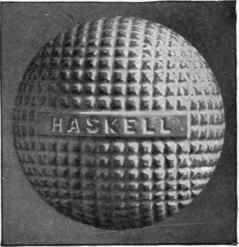
.        But let us tee a Haskell,
And debts and duns take wings.

Golfina may send sorrow—
Six down and five to play—
But we will win to-morrow,
Which is another day;
.        Though we have lost a fiver,
.        Or broken our pet driver
.        Golfina bates no stiver
The homage we must pay.

From enervated putting,
From topping on the tee,
Perpetual tut-tutting
At things which should not be,
.        Miscalculated pitches
.        That land us deep in ditches,
.        New golf-books that bewitch us,
Golfina, set us free!

I have not been able to determine the relationship between Golfinia and Golfina. Any ideas?
post

The Haskell-Gutty Controversy in Verse

“The Haskellisation of Golf” is the title of an article by the famous English amateur golfer and writer, Horace G. Hutchinson, that appeared in the October 17, 1902 issue of Golf Illustrated, a weekly golf magazine. Hutchinson discusses the question of whether the gutty ball should be replaced by the recently invented Haskell ball. For background see a previous Blog entry, Haskell on the Brain, https://golfpoet.com/2010/07/05/haskell-on-the-brain/.

At the same time, Hutchinson wrote his piece, a poet with the initials F.J.K. wrote a poem to the editor (they did such things 100 or so years ago) in which he versified on the pros and cons of switching to the new balls.

THE NEW BALLS                                                                                            

To the Editor of Golf Illustrated

Dear Sir,

Two of the questions of the day,
We read, in circles polished,
Are whether women ought to work,
Or kissing be abolished?

But though these interesting queries
Might be discussed for ages,
They pale and pall before the one
Appearing in your pages.

The merits of the rubber-filled
American invention
From golfers one and all demand
Their very best attention:

And week by week your paper has
An interesting series
Of answers published in response
To these important queries:

Whether, in driving from the tee,
The golfer finds his task ʾll
Be simpler if he once employs
A Kempshall or a Haskell?

And if he finds that owing to
These aids so adventitious
His skill improves all around, or fate
Is, as before, capricious.

And does the new ball benefit
Our mediocre players,
And help them to attain the art
Of Braid, or Herd, or Sayers?

And if, supposing this is true,
Another finds it hard on
His excellence, a player like
Taylor or a Vardon?

And further with what liveliness
This substitute for gutta
Behaves when struck with iron clubs,
Or aluminium putter?

And yet, again, if general use
Will spoil our English courses,
And whether, this being so, there are
Remedial resources?

These questions of the day,
Vìde GOLF ILLUSTRATED
(With which, cf. the title page,
“Golf” is incorporated.

And there one finds set forth, in turn,
Assertion and denial
Of faults and merits in the ball
By those who’ve given it trial.

One hears that certain clubs demand
Restrictive legislation,
To save the gutty from the Trans-
Atlantic innovation.

Now I, unmasked, advise each man
To try, in strict seclusion,
This full-of-rubber novelty,
And draw his own conclusion.

About the distance of his drive
He’ll wax enthusiastic,
But later on he’ll wish his ball
Was rather less elastic.

About the cost he may well feel
Supremely apprehensive,
Seeing that every ball is so
Atrociously expensive.

So, if he thinks with me, he will
Abide no rubber filling,
But use an English ball, for which
He’ll pay an English shilling!

F.J.K.

Of course, issues surrounding the capabilities of golf balls continue. Recently John Solheim, Chairman and CEO of Ping, suggested that instead of a single Ball Distance Rating (BDR) limit (how far a ball can go) there should be three. In addition to the current BDR, there would one shorter and one longer. (See  Golf Digest article) Then we would have to endure ads for the longest short ball, the longest long ball, etc. I’d rather go back to the Haskell!

post

Marketing Golf Poetry

Marketing golf poetry—talk about a tough assignment. That’s what I have been doing with this Blog for almost three years. And now with my book as well. I have had some success with about 54,000 Blog page views and a spot on some of the top 50 golf blog lists.

But just recently, I zeroed in on what I’m “selling.” Let me explain it this way. Products and services are now thought of by marketers as means to an end. And the end has to be a great, memorable, unique, (you put in the adjective) experience. For example, a golf course wants to create an unforgettable experience for its customers. A club maker isn’t selling you clubs; he’s selling you the experience of playing your best golf with them.

So old readers and new, I am not selling golf poetry on this Blog or in my book. I am selling a unique and exhilarating golf experience —the experience of reciting golf poems. And you know what? You won’t get that golf experience any other way on the course or off. For some, reading poetry out-loud will take as much courage as playing a fairway wood over water. For others it may come easier. But whatever your predisposition, this much I know. Unlike golfers of an earlier generation, you have had little or no opportunity to enjoy this aspect of the game. Here is your chance.

You might begin with the opening stanza from a poem called “The Lay for the Troubled Golfer” by Edgar A. Guest (born in England in 1881), a writer for the Detroit Free Press for more than sixty years. This is a poem you just have to read out loud.

 His eye was wild and his face was taut with anger and hate and rage,
And the things he muttered were much too strong for the ink of the printed page.
I found him there when the dusk came down, in his golf clothes still was he,
And his clubs were strewn around his feet as he told his grief to me:
“I’d an easy five for a seventy-nine—in sight of the golden goal—
An easy five and I took an eight—an eight on the eighteenth hole!

Not all golf poems, or poems in general, are that dramatic, so reading experiences will be different. But just as with hitting different golf shots, each experience can be rewarding.

Let’s try one more, this one the first two stanzas from a poem in an earlier Post called “St. Andrew’s Law by Robert Browning.” Robert H. K. Browning (not the famous poet) was a Scottish writer, golf magazine editor and golf historian who was active in the first half of the 20th century.

 When prehistoric swipers sliced, and blamed the sloping tee,
They got so riled, Saint Andrew smiled, and “Blasphemers,” said he,
“Henceforth the lightly made excuse shall give you no resource;
Ye may not win to act or use of falsehood on the course.

“Let Peter judge his fisher folk, whose unexamined scales
Their easy consciences provoke to all-unswallowed tales;
But ye the prickly whin shall test, the bunker shall condemn:
The gods of golfing love to jest–but do not jest with them.

If you are having fun, come back to my Blog from time to time and choose from the many poems I have posted. And if you like, look at my book, Golf Course of Rhymes – Links between Golf and Poetry Through the Ages, on Amazon. If you do you can recite the rest of Guest’s poem, “The Lay for the Troubled Golfer.”

post

Tee It Forward

                                                                       TEE IT FORWARD

    Guidelines for Selecting Tees

Driver Distance Recommended
18 Hole Yardages
275 6,700 6,900
250 6,200 6,400
225 5,800 6,000
200 5,200 5,400
175 4,400 4,600
150 3,500 3,700
125 2,800 3,000
100 2,100 2,300


Barney Adams, the founder of Adams Golf, has had a lot of good ideas. His latest is a program called “Tee It Forward.” The goal is to make golf more fun and faster. The basic notion is that golfers should play from tees that match their driving capabilities. So, looking at the chart above, if your drives average 200 yards, you should be playing from tees such that “your” golf course is 5200 to 5400 yards long. Shorter tees for shorter drivers; longer tees for longer drivers. Makes sense. Both the United States Golf Association and the PGA of America have endorsed the program and will try to get golf courses to adopt it.

A few weeks ago I decided to tee it forward and the experience inspired me to write a poem. I’m a decent player, but at age 75 the white tees have become a challenge. Teeing it forward did several things: first, it caused me to be more relaxed hitting tee shots since I no longer had to hit them as hard as possible; second,  it got me to hit different clubs from the fairway since my tee shots often landed further down the fairway than before; and, third, it improved my chances of hitting greens in regulation since I was using shorter clubs on approach shots. Better scoring is certainly not guaranteed, but birdie chances and even the outside chance of an eagle (on a par 5) are now more than dreams.

Of course, ego issues will keep some players from moving up. As I wrote in a Twine:

“Tee It Forward” with the frank admission
That your driver distance is a lengthy supposition.

Most important is that course managers endorse and promote the program. Why not, if they recognize that it will be more fun for most who try it and faster too. Course managers would do well to encourage newer players to tee it forward as well.

Now on to the poem:

TEE IT FORWARD

I played the closer tees today —
Nothing bad happened.
Actually,
One under
After three —
Not my usual score.

I teed it forward today —
Hitting eights,
And wedges
To the green.
Like —
Golf on TV.

I teed it forward today —
For the fun of it.
Unhampered
By ego —
Energized
By the experience.

I teed it forward today —
An experiment,
Kind of
Interesting —
Longer drives,
When not needed.

I teed it forward today —
Blew one hole
Completely.
A big number
Lurking —
No matter which tee.

So —

Tee it forward?
Seems right for me —
How about you?
Just move up.
Guaranteed —
Nothing bad will happen.

And who knows,
You could be —
Under after three.


Leon S White
September 4, 2011

post

Golf Twines from Earlier Times (1898)

I began writing golf twines (two line golf poems for Twitter) in November of 2009. Two line poems are formally called “couplets” and, of course, they have a long history in poetry.

For example, Shakespeare wrote :  “Double, double, toil and trouble;/ Fire burn and caldron bubble” which in read by the three witches in his play, Macbeth.  (This is actually a golf twine now where Shakespeare is referring to Tiger’s scores on the 11th and 12th holes during the second round of the 2011 PGA Championship!)

I was hoping that my golf twines would catch on, and other Twitterers would write them as well. So far no such luck. But then I found William G. Van Tassel Sutphen, a Victorian-era fiction writer, editor of the original “Golf” magazine and author of The Golfer’s Alphabet, originally published in 1898. In The Golfer’s Alphabet, Van Tassel Sutphen wrote 27 golf twines, but he was just a little early for Twitter.

Sutphen, wrote a twine for each letter of the alphabet and added one more for the symbol “&”. His twines were illustrated by A. B. Frost. Frost (1851-1928), was considered one of the great illustrators in the “Golden Age of American Illustration”.

Below is an example:

The caption reads:

.                                                     I is for Iron that we play to perfection,
.                                                     So long as no bunker is in that direction.

And who says golf has changed!

Here are a few others from the book:

C is for Card, that began with a three,
And was torn into bits at the seventeenth tee.

H is for Hole that was easy in four,
And also for Hazard that made it six more.

N is the Niblick, retriever of blunders,
And now and again it accomplishes wonders.

And,

W in a Whisper: “Between you and me,
I have just done the round in a pat 83.”

Sutphen’s book was reprinted in 1967 and is widely available on the net.

post

Attitudes Toward Women Golfers in the Early Days (Part 3)

Gillian Kirkwood (Kirkwoodgolf.com.uk), an expert on the history of women’s golf, wrote the following about the pioneering British women golfers in the late 19th Century:
These early ladies were really the suffragettes of their time, they forged the way for us to follow.   They fought tooth and nail for womens’ golf to be recognised  and taken seriously.   I think they might be disappointed that some attitudes to women golfers have not changed much in the intervening 100 years.
In two previous Posts (in May 2009), I focused on poems displaying condescending attitudes towards women golfers around the beginning of the 20th century. Now I think I have found the poem that would head this list. Its title is “Love and Golf” and its was written by A. D. Godley. It appeared in his book Verses to Order published in London in 1892. Godley was a classical scholar at Oxford University.

            LOVE AND GOLF

Hear me swearing, fairest Phyllis!
–Golfers all know how to swear–
Though, of course, your presence still is
Most attractive  everywhere,
Links were ne’er designed for lovers:
Do not, Phyllis, deem me rude,
When I hint that man discovers
Charms at times in solitude.

Lips like yours should never utter
Ugly words that golfers speak–
“Dormy,” “stimy,” “mashy,”  “putter,”
Driver,” “brassy,” “bunker,” “cleek”!
Sooner read–though Cultured Woman
Is a thing I hate and shun–
Horace, that distinguished Roman,
Than Horatius Hutchinson.

Though, in hours of deep dejection,
When the disappointing ball
Takes, if hit, the wrong direction,
Sometimes can’t be hit at all,–
Though whate’er the golfer says is
Justified by reason due,
Still I hold his Saxon phrases
Most unsuitable for you.

Tennis be your sole endeavous
If you must aspire to fame!
But at golf–believe me, never
Can you hope to play the game.
There, your “swing” but courts the scoffer,
Boor and clowns your “driving” mock;
Fate, who made the clown a golfer,
Meant you, Phyllis! for a “crock.”

Meet me then by lawn or river,
Meet me then at routs or rinks,
Meet me where the moonbeams quiver,
Anywhere–but on the links!
Thus of you I’ll fondly ponder
O’er the green where’er I roam,
(Absence makes the heart grow fonder),
Only, Phyllis, stay at home.

This definitely needs a response from Phyllis, even at this late date!
post

Magnets of the Fairway

I play golf on a town-owned 9-hole course called Pine Meadows in Lexington, MA. Over the past 27 years I’ve gotten to know the course well. The layout includes  several attractions or should I say “attractors,” that generally reek havoc with players’ drives: the tree on the 8th fairway, the pond that cuts across the 5th and 9th holes and the sand trap in the middle of the first fairway (until it was removed).

The other day on the 8th tee, I watched golfers hit their balls where they always seem to hit them —  towards the imposing tree.  And on the 9th, the pond was collecting balls as usual. As we all know, this doesn’t just happen at my course.  So I concluded that such a ubiquitous phenomenon is worthy of poetic reflection. My effort is called “Magnets of the Fairway.

 MAGNETS OF THE FAIRWAY

Magnet are mostly made of steel
In golf: sand, water or wood.
When looking at these fairway lures,
The pre-shoot does no good.

On tees with trees control is lost
No matter how you bat it.
The only way to miss a tree
May be to aim right at it.

Sand traps also play a role
Attracting errant shots.
The magnet-makers in this case—
The golf-inventing Scots.

I wish I had a dollar bill
For every tree branch hit.
I’d use the sum to bribe the Keep
To grass each sandy pit.

A third attraction, stream or pond,
On fairways, far from rare.
The only way to circumvent—
Stay totally unaware.

For a holiday trip, sand and trees,
Even a water-fall.
But when you find them on a course,
They’re just magnets to draw your ball.

Leon S White
July 7, 2011


post

A Golf Controversy Regarding the Swing

The question, “How do you swing a golf club?” , has no simple answer today or in the past. Almost 70 years ago, J. A. Hammerton wrote this verse that appeared in The Rubaiyat of a Golfer:

Myself when young would hopefully frequent
Where Pros and Plus Men had great argument
On Grips that overlapped, on Swing and Stance
But came away less hopeful than I went.

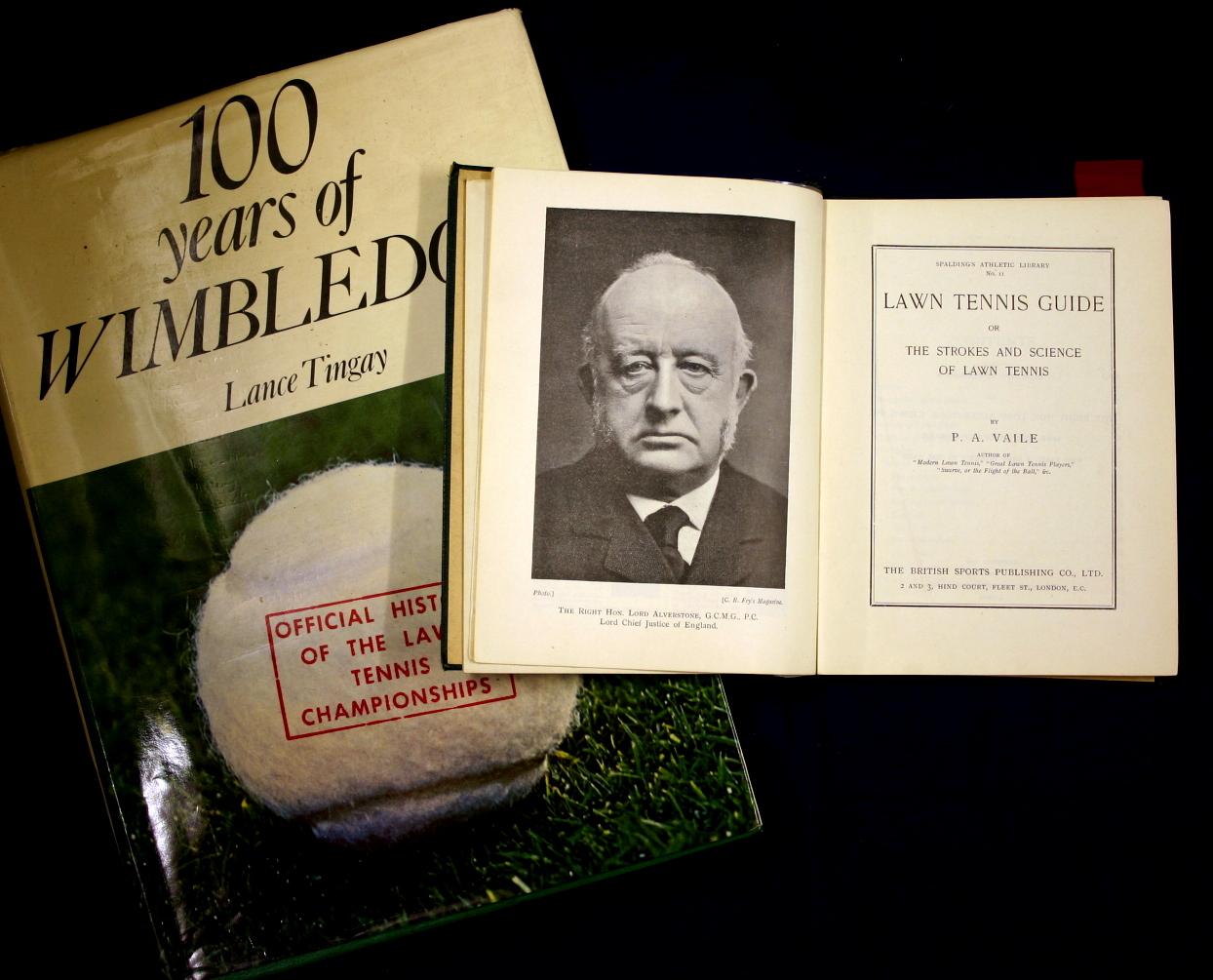
As golf became popular in the United Kingdom and then in the U.S. and other countries around the turn of the 20th Century, golf books became the primary source of swing instruction. Books were written by the major golf professionals of the time and by other self-proclaimed experts as well. One of the most prolific writers on golf and golf instruction in the early 1900’s was a New Zealander named Pembroke Adolphus (sometime Arnold) “Percy” Vaile.  Joseph Murdoch’s book, The Library of Golf, lists eight books by P.A. Vaile. (worldcat.org includes 130 entries for Vaile including a number on Tennis about which he also claimed expertise! See illustration above.)

In one of Vaile’s golf books, The New Golf, published by E.P. Dutton & Co. in 1916, Vaile almost lashes out against the idea that the left hand is dominant in the golf swing:

“The hoariest old tradition that ever fastened on to golf was the power of the left. It was more than a tradition. It was a fetich. Authors and journalists worshiped at its shrine.”

Vaile goes on to attack Vardon, Taylor and Braid (“The Great Triumvirate”) as well as Horace Hutchinson, the great amateur and leading golf writer of the day for their “moldy old idea[s].” Vaile first put forth his ideas in a newspaper article maybe eight years earlier. At that time he was attacked. In his words,

” I was in the thick of it. Anybody who bursts up any useless old tradition, or even gives it a bump, in London, is a fool, a faddist, a theorist, or a revolutionist. If he does not recognize this before he disturbs any of the dust of centuries, and if he is not prepared to accept the position kindly and patiently-and temporarily-he deserves all that is coming to him-and that is much.”

And in those days, attacks were not limited to prose:

THE LEFT HAND’S LAMENT
(Picked up on the links at
St. Andrews)

Since first by Heaven’s august decree
The Royal Ancient Game was planned,
I always was allowed to be
The Master Hand.

To Me did text-books all allot
The part of propulsative strength.
The raking drive, the brassie shot–
I gave them length.

The Right Hand was –poor thing!–designed
To guide the club, and that was all;
Mine was the power that lay behind
The far-hit ball.

Now come there one upon the scene,
Whose heresy fair turns me pale–
The Arius of the golfing green–
A wretch name Vaile.

He says our Vardons, Braids, and Whites
Don’t golf’s dynamics understand;
Their view of Me’s all wrong; the Right’s
The Master Hand.

If Fate would let me but devise
Some torture for this villain bold,
Who thus would revolutionize
Golf’s credos old–

Oh! then to ball of rubber core
I’d change him for a tidy spell,
And drop him in “The Swilcan” or
“The Burn” or “Hell”;

I’d lose him in the rock-strewn sand
Whence few topped spheres ejected come,
Of Musselburgh’s notorious Pand-
Emonium.

Clearly, todays controversies  – one plane vs. two; stack and tilt; Tee It  Forward – are mild in comparison.

post

Indoor Golf in Chicago Now and Then

From the current issue of “GolfTime Magazine,” a biannual guide to golf in the Chicago area:

Experience Chicago’s Most Accurate and Realistic Indoor Golf Facility!

Experience a new paradigm in year-round indoor golf facilities at Play 18 in downtown Chicago’s Loop.  Located at 17 N. Wabash, just a few blocks from Millennium Park, Play 18 aims to offer golf enthusiasts full game play and practice facilities with sophisticated golf technologies, amenities, membership packages and more – all 12 months of the year, rain or shine!

We all know that golf has a long history. But the folks at Play 18 may not know that indoor golf was played in Chicago and nearby more than 100 years ago.  According to Robert Pruter, a major golf instructional school, O’Neil & Fovargue Indoor Golf School (185 Wabash Ave), opened in 1910.  (Whether 185 was North or South Wabash, if the Indoor Golf School existed today it would be a very short walk from there to Play 18!)

But a student of golf poetry would have found reference to the Indoor Golf School, not in Mr. Pruter’s article, but in a poem called “Winter Golf” by Bert Leston Taylor (1866-1921), the great Chicago Tribune columnist.

WINTER GOLF

“All the benefits of outdoors winter golf
in the tropics, at the Indoor Golf School” – AD

Within the grimy Loop’s environs,
The rubber pill may be addressed,
A man may swing his golfing irons,
And let his fancy do the rest.

The murmur in the street below,
The elevated’s boom and roar,
Will sound–if fancy have it so–
Like surf upon a tropic shore.

The air within the driving stall
Does not suggest a Stilton cheese,
To one whose mind is on the ball
‘Tis fragrant as a tropic breeze.

We, upon whom the spell is laid,
For tropic things care not a whoop,
Imagination’s artful aid
Will bring the tropics to the Loop.

The sun, the breeze, the fields, the rest–
Of them let railway folders sing.
We know, who are by golf obsessed,
The Pill’s the thing! the Pill’s the thing.

With its continued relevance, Taylor’s poem may deserve a spot on the wall at Play 18.

post

Short Golf Poems – Less Than a Foot

Two line golf poems, such as the Twines I occasionally write for Twitter, are short. But what about really short golf poems?

The widely acknowledged shortest general poem is:

FLEAS

Adam
Had ’em.

I would offer as a possible shortest golf poem:

BACKSWING

Low
Slow.

A three word entry might be:

DUFFER’S GOLF

A profane
Game!

And in the four word category, a familiar refrain uttered by many after a series of bad shots:

A GOLFER’S LAMENT

Can’t hit
For sh–.

If you would like to share your two, three or four word golf poems, please leave a reply. It shouldn’t take long.

[And if you are looking for a unique gift, please consider my book, Golf Course of Rhymes – Links between Golf and Poetry.” Robert Trent Jones, Jr. wrote the foreword.  Thanks.]