post

Casey, Tiger and Two New Seasons

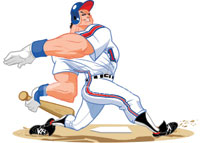
A while ago I wrote a parody on the poem “Casey at the Bat” by Earnest Thayer called “Tiger on the Mat.” When I wrote the poem I naively believed that everyone knew the original, but sadly I was wrong. Now with baseball season beginning and Tiger returning, I thought I would give golf/baseball fans another chance to read (better yet recite) one of the greatest sports poems ever written.  In addition, I found a poem by Gantland Rice written in response to a fan who had never heard of the Casey poem. Rice whose golf poems have appeared several times in my Blog, gives you an idea of how engaging sports poetry can be in his response to the “cove who never heard of “Casey at the Bat.”

So, given this momentous week, Go Red Sox, and yes, Go Tiger.  I hope they both look better this November than last.

He Never Heard of Casey!by Grantland Rice ©
Published: New York Herald Tribune (06-01-1926)
I knew a cove who’d never heard of Washington and Lee,
Of Caesar and Napoleon from the ancient jamboree,
But, bli’me, there are queerer things than anything like that,
For here’s a cove who never heard of “Casey at the Bat”!

He never heard of Mudville and its wild and eerie call,
“When Flynn let drive a single, to the wonderment of all,”
For the stormy roar of welcome that “recoiled upon the flat
As Casey, mighty Casey, was advancing to the bat.”

“There was easy in Casey’s manner,” from the Ernest Thayer style,
“There was pride in Casey’s bearing,” and his tanned face wore a smile,
And when they thundered “Attaboy!” of course he tipped his hat,
But here’s a cove who never heard of “Casey at the Bat”!

“Who is Casey?” Can you beat it? Can a thing like this be true?
Is there one who’s missed the drama that ripped Mudville through and through?
Is there a fan with soul so dead he never felt the sway
Of these famous lines by Thayer in the good old Thayer way?

“Ten thousand eyes were on him as he rubbed his hands with dirt;
Five thousand tongues applauded as he wiped them on his shirt;
Then while the writhing pitcher ground the ball into his hip,
Defiance gleamed in Casey’s eye, a sneer curled Casey’s lip.”

The drama grew in force and flame, and Berserk went the mob,
With Casey representing more than Hornsby, Ruth, or Cobb;
And as the pitcher cut one loose as if fired from a gat –
Say, here’s a guy who never heard of “Casey at the Bat!”

“The sneer is gone from Casey’s lip, his teeth are clenched in hate;
He pounds with cruel violence his bat upon the plate.”
And as the pitcher shot one through to meet the final test
There’s one low and benighted fan who never heard the rest.

Ten million never heard of Keats, or Shelley, Burns, or Poe;
But they know “the air was shattered by the force of Casey’s blow”;
They never heard of Shakespeare, nor of Dickens, like as not,
But they know the somber drama from old Mudville’s haunted lot.

He never heard of Casey! Am I dreaming? Is it true?
Is fame but wind-blown ashes when the summer day is through?
Does greatness fade so quickly and is grandeur doomed to die
That bloomed in early morning, ere the dusk rides down the sky?

Is there nothing left immortal in this somber vale called Earth?
Is there nothing that’s enduring in its guarding shell of worth?
Is everything forgotten as the new age stumbles on
And the things that we once cherished make their way to helengon?

Is drifting life but dust and dreams to fade within a flash,
Where one forgets the drama of the Master and the Ash?
Where one has missed the saga with its misty flow of tears,
Upon that day of tragedy beyond the trampling years?

“Oh! Somewhere in this favored land the sun is shining bright;
The band is playing somewhere, and somewhere hearts are light;
And somewhere men are laughing, and somewhere children shout,
But there is no joy in Mudville – mighty Casey has struck out!”

Rise, De Wolf Hopper, in your wrath, and cut the blighter down!
Although Wang may be forgotten in the passing of renown,
There’s a grave crime committed which should take you to the mat,
For here’s a cove who never heard of “Casey at the Bat”!

I had an epic written which I thought would never die,
Where they’d build a statue for me with its head against the sky;
I said “This will live forever” – but I’ve canned it in the vat,
For here’s a guy who never heard of “Casey at the Bat”!

He Never Heard of Casey! by Grantland Rice ©
post

A Springtime Exchange Between a Golf Poet and his Editor

Robert K. Risk's book, Songs of the Links (1919), includes the following timely exchange between Risk, the golf poet, and and Garden G. Smith (1860-1913) the editor of Golf Illustrated, the British weekly, for many years and an important contributor to the literature of the game. (Risk's poem has been slightly shortened.)

TO THE EDITOR

Bid me write and I will write
Of club and ball and tee,
Trusting the matter I indite
Will be approved by thee.

Bid me to stay my pen and I
Will muzzle it with grace,
Regarding not impatiently
Regretted "lack of space."

But when you hint that I should do
Some verse concerning Spring,
That, I must frankly caution you,
Is quite another thing.

Although not disinclined to sing,
No poet can ignore
That all that can be sung of Spring
Has been well sung before.

Therefore, should I to platitude
And outworn phrase incline,
The brickbats thrown by readers rude
Are yours, dear sir, not mine.

In Spring we walk the daisied links
Where lively lambkins leap—
Too few of them, one sadly thinks,
Will ever grow to sheep.

In Spring a brighter glitter shines
On the well-burnished cleek,
But still we do 5-holes in 9's
Though playing thrice a week.

In Spring the chronic topper dreams
Of getting down to scratch,
Of being picked in all Club teams,
And winning every match.

In Spring we cease to argufy
About the "best-length hole,"
Which simply means the one that I
Enjoy—and you can't hole.

......

'Tis Spring that whets our appetite
For Three weeks' solid golf,
Though ere the third week is in sight
We shall be direly "off."

In Spring the poet is supposed
Keenly his lyre to tune;
But here these verses are foreclosed,
For I am off to Troon.

And here is the editor Garden G. Smith's response:

THE EDITOR

WITH APOLOGIES TO HIS READERS

'Tis bitter sad the poets should
There work neglect for sport,
Wile Mr. Risk plays golf at Troon,
I am two verses short.

May bunkers trap his longest shots,
May rabbit holes annoy him;
And if this here occurs again
I'm blowed if I'll employ him.

post

Six Tweets to Better Putting

J. H. Taylor putting

There seems to be general agreement that the first printed book of golf instruction was The Golfer’s Manual, By a Keen Hand, written by H. B. Farnie and published in 1857. Since then instruction has grown to be one of the major products of the golf industry. These days it is still packaged in books, but also in magazines, newspapers, advertisements, blogs, videos, YouTube clips and tips. In addition, instruction is sold to individuals and groups by thousands of teaching pros.

But in today’s busy world, there is a need for the “short and sweet” in golf instruction. With that in mind I offer a 12 line verse that packages the essence of what you need to know to become a better putter. And if you are put off by poetry, just think of this guide as six putting tweets.

Six Tweets to Better Putting

Line up and trust when putting
Head still a must when putting

A rhythmic swing
Is just the thing when putting

Get rid of fear
At least be near when putting

All are agreed
The first rule is speed when putting

Consistency
The foremost key when putting

The best advice
Don’t think twice when putting.

Leon S. White, March 2010

post

Golf’s “Don’t Ask, Don’t Tell”

This week’s poem is by an English golfing poet though his name is unknown. It appeared in a book called Mr. Punch on the Links which consists of golf stories, cartoons, and poems from the British magazine “Punch.” The book was published around 1930.  “Punch,” a magazine of humour and satire, ran from 1841 until its closure in 2002.

The poem provides a gentle warning to two kinds of golfers; the first who is only too willing to tell it all after a match and the second who give the first the opportunity.

The Retort Imaginary

SIR, for the information you’ve imparted,
The prompt outspokenness of your reply,
Ranging from that fine drive with which you started
To the long putt by which you won the bye,
With details of the bunkers, whins and banks
Which you surmounted, pray accept my thanks.

I’ve no excuse now, with the facts before me,
For ignorance, no reasonable ground
For doubt as to the hole that saw you dormy,
Or where your victim finally was drowned.
‘Twas kind to give a confidence so free
To a mere casual listener like me.

You’ve told me of the pair in front that beckoned
For you to pass, then found the ball and played
(At the fourth hole) which made you miss your second;
You’ve told me of the stymies you were laid,
And indicated just exactly where
You lifted from the ground under repair.

That chip that got a bad kick at the seventh;
The ninth (the short hole), where you hit the pin;
That run-up shot that won you the eleventh;
The thirteenth where the ball just trickled in—
You’ve made it all quite clear, and it was nice
To know you’ve cured that tendency to slice.

I’m quite convinced you’ve done the best you can, Sir;
Ungrudgingly you’ve given me, I know,
A comprehensive categoric answer
To my brief question of an hour ago;
But it was mere politeness, all the same,
That made me say, “Well, Jones, how goes the game?”

post

Sunday Golf

The New York Times headline read “Ban on Sunday Golf May Wreck A Club.” The date May 22, 1905. The story concerned membership loss at the North Valley Golf Club of Greenwich. Because it had been closed on Sundays since it began in 1900, 35 of its 50 members had resigned. The paper noted that “A resolution forbidding the use of the grounds Sunday was passed (in 1902) and several good churchmen joined, among them a clergyman.” But by 1905 the club was in dire straits.

In Scotland, in 1618, the official (royal) line, first voiced by King James VI, was that golf on the Sabbath was acceptable, so long as it was not during the times of service, because Sunday was the only day the great mass of people would have free to play. It was not a view shared by the Kirk [the Church of Scotland]. Indeed Sunday golf at St Andrews only began at all during the Second World War and is still not permitted on the Old Course, though this now has more to do with preserving the course rather than religious strictures.

From a Google search, it looks like today only a handful of golf courses in the U.S., Canada and Great Britain are still closed on Sundays.

A poem, “Sunday Golf,” in the August 1903 issue of “The Golfer” magazine provides a colorful perspective of an irreverent golf poet on Sunday play more than 100 years ago.

Sunday Golf

A Sabbath well spent brings a week of content,
And health for the work of tomorrow;
But a Sabbath profaned whatever be gained,
Is a certain forerunner of sorrow

***************************************

An excellent rule for the wise and the fool,
An object right worthy attainment;
But the point as you see, where we don’t quite agree,
Is the question, What is profanement?

When the Sabbath began, twas created for man,
In the Bible this clearly is stated;
But our Puritan throng think this must be all wrong,
The man was for the Sabbath created.

It makes a man smile that except for this isle,
There is nobody going to Heaven;
Yet, if some folks are right, ’tis the inference trite,
To which we’re remorselessly driven.

For you’ll nowhere else find people so strict of mind
In the matters of Sunday observance;
And an innocent game nowhere else meets with blame,
Or excites any social disturbance.

Then, aye, let us pray that there may come a day,
When the bitter dispute may be ended;
And Sunday employment in wholesale enjoyment,
Be no longer condemned but commended.

The poem was signed “Common Sense.”

post

A Poetic Response to the Rise of Medal Play in 1912

Controversies in golf are usually associated with change in the rules, equipment or form of play. Currently, the groove rule change is front and center. In early times, controversies arose when the switch began from the feathery to the gutta percha ball in 1848 and with the switch from hickory to steel shafts in the 1920’s. The R & A banned the Schenectady putter in 1911. This was the putter that Walter Travis used to become the first American to win the British Amateur Championship in 1904.

Golf controversies today are reported by the traditional media, newspapers and magazines, but also by the traditional media’s dot.com outlets and by the social media, blogs and tweets. The impact of Internet golf reporting has shifted the focus to reporting stories bit by bit in real time with immediate commentary by “followers.” The opportunities to place a hot story in its historical context and search for humorous and ironical dimensions are few. Twitter has trumped poetry as the means for story telling.

But, of course, this has not always been true. For example, in the early 20th century most amateur golf in Great Britain was played under the rules of match play. But the introduction of the score card and pencil stub made medal or stroke play scores easy to record. And by 1912 medal play was on the rise. Robert K. Risk, a Scottish poet and writer and a golf traditionalist, believed that match play defined golf and that this shift harmed the character of the game.

In voicing his opposition to the increase in medal play he was not limited to a time deadline or to 140 characters. Instead, he took his time and fashioned a poem of depth and imagination and biting wit. His poetical protest did not stem the tide of medal play, but does survive as an interesting contrast to how golf controversies are aired today.

“Medalitis,” Risk’s poem, was originally published in the English humor magazine Punch on October 2, 1912. Please be patient as you read it. If you have time, a second reading will help to fully enjoy Risk’s work.

Medalitis

In the full height and glory of the year,
When husbandmen are housing golden sheaves,
Before the jealous frost has come to shear
From the bright woodland its reluctant leaves,
I pass within a gateway, where the trees,
Tall, stately, multi-coloured, manifold,
Draw the eye on as to some Chersonese,
Spanning the pathway with their arch of gold.

A river sings and loiters through the grass,
Girdling a pleasance scythed and trimly shorn;
And here I watch men vanish and repass
To the last hour of eve from early morn;
Dryads peer out at them, and goat-foot Pan
Plays on his pipe to their unheeding ears;
They pass, like pilgrims in a caravan,
Towards some Mecca in the far-off years.

Blind to the woodland’s autumn livery,
Blind to the emerald pathway that they tread,
Deaf to the river’s low-pitched lullaby,
Their limbs are quick and yet their souls are dead;
Nothing to them the song of any bird,
For them in vain were horns of Elfland wound,
Blind, deaf and stockfish-mute; for,in a word,
They are engaged upon a Medal Round.

Making an anxious torment of a game
Whose humours now intrigue them not at all,
They chase the flying wraith of printed fame,
With card and pencil arithmetical;
With features pinched into a painful frown
Looming misfortunes they anticipate,
Or, as the fatal record is set down,
Brood darkly on a detrimental 8.

These are in thrall to Satan, who devised
Pencil and card to tempt weak men to sin,
Whereby their prowess might be advertised —
Say, 37 Out and 40 In;
Rarely does any victim break his chains
And from his nape the lethal burden doff —
The man with medal virus in his veins
Seldom outlives it and gets back to Golf.

post

Golf Poetry in a 1921 New York City Restaurant Ad

The American Golfer must have had a lot of New York City subscribers in 1921. Otherwise, why would the Rogers Restaurant (45th and 6th Ave, Tel. 2070 Bryant) have run an ad on page 29 of the March 26th edition? And why did the ad promote Rogers with a rhyme? We did see that Spalding ran an ad with poetry seven years earlier. And I have pointed out in previous Posts that poetry was included in most of the early issues of golf magazines.

So here is what the Rogers ad said.

You’ll never be doon
If ye’ll take yer spoon
When drinkin’ soup at Rogers
Na need to seek with mashie or cleek
Or the rest of yer artful dodgers
And I’m telling ye Mack
Yer lips ye’ll smack
At the grand food they’ll provide; er
Clams, yams, and Virginia hams
They’ll make ye a powerful driver.

The poem was signed “Sandy,” presumably Sandy Rogers. The poem/ad seems to be a poor attempt to speak in a Scottish dialect to the local golfers. But I can’t imagine that “clams, yams, and Virginia hams” brought many golfers to the door!

Historical Note: Near to Rogers, on 45th street, was the site of the Hesper Club, a gambling house run by Herman “Beansie” Rosenthal, a mobster who in 1912 blew the whistle on the extortion attempts of Lt. Charles Becker of the NYPD. Becker had Rosenthal killed in a notorious hit that sent Becker to the chair in 1915.

I’m not sure of the Hesper Club survived Rosenthal’s death or if Rosenthal had been a golfer. But I assume that by 1921 the neighborhood was a little safer.

post

The “Rubaiyat’s” Contribution to Golf Poetry

To write a parody of a poem, you would take the basic characteristics of the verse (for example, its rhyming scheme and basic idea) and then rework them for comic or ironic effect.

Now suppose that you are a young golfer and poet around the turn of the 20th century. Being literate, you are aware that Omar Khayyam’s poem, Rubaiyat, is being parodied left and right. So one day, after being around the golf course until early evening, you pick up a copy of the poem (it was easy to do then). Reading through the verses, you are struck by the stanza 27,

Myself when young did eagerly frequent
Doctor and Saint, and heard great Argument
.     About it and about;  but evermore
Came out by the same Door where in I went.

If your name was Henry Boynton, a graduate of Amherst with a Masters of Arts, then, looking at the stanza you might have thought about all the controversies regarding the fundamental of golf being discussed by golfers such as Jamie Anderson and Jamie Braid and all the other Jamies of the time. And this might have led you to write (as part of a book, The Golfer’s Rubaiyat),

Myself when young did eagerly frequent
Jamie and His, and heard great argument
.     Of Grip and Stance and Swing; but evermore
Found at the Exit but a Dollar spent.

Little did Boynton know, but he himself would be parodied by later golfing poets.

In the July 1910 issue of  The American Golfer, a poet named Jack Warbasse wrote,

Myself when young did eagerly frequent
Travis and Braid, and read great argument
.     About the Grip and Stance; but evermore
Play’d out by the same Stump where in I went.

And then in 1919, a Scottish writer, poet and drama critic Robert K. Risk published a book of collected poems, Songs of the Links, that included the poem “The Golfaiyat of Dufar Hy-Yam.” In that poem we have,

Myself when you did eagerly frequent,
Club-makers’ Shops, and heard great Argument
.     Of Grip and Stance and Swing; but evermore
Learned and Bought little I did not repent.

Finally, in 1946, J. A. Hammerton, a Scottish statesman and author, published a book, The Rubiayat of a Golfer, in which he wrote,

Myself when young would hopefully frequent
Where Pros and Plus Men had great argument
.     On Grips that overlapped, on Swing and Stance
But came away less hopeful than I went.

So what have we learned? First, that there are limits to the golfing parodies of stanza 27 of the Rubaiyat. And second, Instruction about grip, stance and swing has been confusing for a long time!

post

Links Between Golf and Life

Robert Chambers was a Scottish author, poet, journal editor and publisher, born in 1802. He was the anonymous author of the Vestiges of the Natural History of Creation, published in 1844  and described as bringing together,

“various ideas of stellar evolution and progressive transmutation of species governed by God-given laws in an accessible narrative which tied together numerous speculative scientific theories of the age. ” (from Wikipedia)

Chambers, who was also a golfer, wrote a number of other books including one titled, A Few Rambling Remarks on Golf. Also, he and his brother William for many years edited CHAMBER’S JOURNAL of POPULAR LITERATURE,L SCIENCE, AND ART. One entry in 1877 titled “The Royal Game of Golf” included the following,

The fascinations of the game have enlisted in the ranks of its votaries men of all classes, many of them famous on other fields, who have made their reminiscences of their beloved pursuit mediums for many a bright word-picture in prose and verse.

Robert Chambers was clearly one of these men.

Late in his life, Chambers moved to St. Andrews where he enjoyed a “luxurious and  ‘learned leisure.’ All task-work was at an end.” While living in the shadows of the Old Course, Chambers envisioned a series of “half-comic, half-moralizing sonnets, which were intended to be nine in number,” one for each of the first nine holes. He completed only three before he died in 1871. However, his son and a friend added the other six. The entire poem, “The Nine Holes of St. Andrews in a Series of Sonnets” can be found in Robert Clark’s book Golf: A Royal and Ancient Game. Below is the first hole sonnet written by Robert Chambers.

I. THE FIRST OR BRIDGE HOLE.

Sacred to hope and promise is the spot —
To  Philp’s and to the Union Parlour- near,
To every golfer, every caddie dear —
Where we strike off — oh, ne’er to be forgot.
Although in lands most distant we sojourn.
But not without its perils is the place ;
Mark the opposing caddie’s  sly grimace,
Whispering :”‘He’s on the road !”  “He’s in the burn !”

So is it often in the grander game
Of life, when, eager, hoping for the palm,
Breathing of honour, joy, and love, and fame,
Conscious of nothing like a doubt or qualm.
We start, and cry :  “Salute us, muse of fire !”
And the first footstep lands us in the mire.

[Philp was Hugh Philp a still famous club maker with a shop near the first hole and the Union Parlour was the clubhouse at the time.]

post

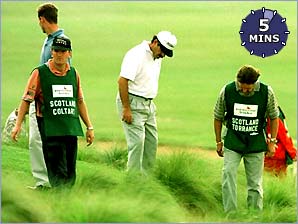
Lost Golf Balls

A recent story of the CNN website describes lost golf balls as “humanity’s signature litter.” The article begins,

Research teams at the Danish Golf Union have discovered it takes between 100 to 1,000 years for a golf ball to decompose naturally. A startling fact when it is also estimated 300 million balls are lost or discarded in the United States alone, every year. It seems the simple plastic golf ball is increasingly becoming a major litter problem.

Some balls, of course, are recovered. Many are washed, repackaged and sold on eBay, or other sites such as lostgolfballs.com.

To help golfers find their lost balls, two nuclear scientists, apparently in their off hours, have invented ball-finding glasses. According to website, visiballusa.com,

Visiball Golf Ball Finding Glasses have become golf’s must have accessory, with more than 250,000 golfers saving time, money, strokes and frustration. Developed and patented by two nuclear scientists, Visiball Golf Ball Finding Glasses incorporate special optical filters that make white objects appear to glow.

But I’m most impressed with Natalie Rogers’ lament, titled “It’s a Shame,” that appeared in the March 1966 issue of Golf Magazine.

It’s a Shame

We live in an age of computers and space ships,
With daily a new guided missile,
But why doesn’t someone invent a golf ball
That will come from the woods when you whistle”

Now there’s a real challenge for those two nuclear scientists.