“Golf Course of Rhymes” began in December of 2009, when I decided to share what I was learning about the history of golf poetry and to publish my golf poems on the Internet. I had no idea if the poems would attract readers. Now as the Blog begins its 18th year, I can report the following: The Blog has had more than 59,000 visitors from 164 countries. It has also led me to write and publish two books, Golf Course of Rhymes – Links Between Golf and Poetry Through the Ages and If Golf Ball Could Talk - Collected Golf Poems.

New Year’s Greetings to My Readers in 164 Countries

Thank you all for stopping by
To read a poem or two;
Among each country’s visitors
More than 30 from Peru.

The United States is first in line
While only one from Granada;
And one as well from Kyrgyzstan
Cape Verde and Rwanda.

Moving farther up in numbers
There are golfers who let fly
From countries that you might not guess
Djibouti and Brunei.

Other countries, Germany, France,
Belgium, Italy, Spain,
Russia, Poland, Serbia,
Venezuela and Ukraine.

Uganda, Bermuda, Denmark,
Sri Lanka and Uzbekistan;
The Isle of Man, Angola
China and Japan.

Of course, the U.K.’s golfers come
They hardly miss a day;
And Canada’s, Australia’s, and India’s,
For sure some from Bombay.

If your country is among the many
That I just could not include;
All poems have their limits,
Please do not think me rude.

The total one hundred and sixty-four
I never would have guessed;
Golf poetry lives because of you,
Happy New Year, all the best.

Leon S White, PhD

New Year’s Greetings to My Readers
January 7, 2026 by Leave a Comment
The Ball (Again)
October 11, 2024 by Leave a Comment
I began this blog in December 2008 to introduce golfers to a golf history they were not likely to have encountered – poetry about golf. I also wanted to share golf poetry that I was writing. Now, after more than 15 years, the blog has grown to maybe 250 or so entries and lately interest seems to be increasing. Understanding that blog readers have limited time to spend on the internet, and recognizing that many entries have been read rarely, I have decided to re-introduce some of the poetry that you might have missed and would enjoy. I’ll begin with a poem I wrote in 2013 called “The Ball.”
The poem was inspired by one written by Raymond Carver (1938-1988), a famous American short story writer and also a poet. His poem was called “The Car.” It begins,
The car with a cracked windshield.
The car that threw a rod.
The car without brakes.
The car with a faulty U-joint.
And continues in a similar fashion for 44 additional lines!
Using Mr. Carver’s poem as a model, I wrote a more modest poem of 20 lines:
THE BALL
The ball with a smile.
The ball with dimples.
The ball with two colors.
The ball with a liquid center.
The ball with mud on it.
The hard wooden round ball.
Old Tom’s featherie ball.
The Woodley Flyer ball.
The balata ball.
The three piece ball.
The ball that missed the tree.
The ball that hit the spectator.
The ball that hung on the edge.
The ball that sits on the tee.
The ball that lands in a trap.
The ball lofted in the air.
The ball lost in the gorse.
The ball left on the range.
The ball belted with a driver.
The ball signed by Tiger.
Leon S White, PhD
(“The Ball” is included in my book, “If Golf Balls Could Talk,” available on Amazon for $6.95.)
Swing It
September 12, 2024 by Leave a Comment
My older son has been trying to improve his golf swing and add distance to his shots, a common goal among golfers. He has been focusing on using the count, one and two, to control the rhythm of his swing and it’s working. I, on the other hand, gave up my clubs and picked up the guitar several years ago with the goal of playing jazz standards. Most jazz standards are written with four beats to the measure. So, as I have often done, I put these swing thoughts into a poem.
Swing It
Swing’s the thing in jazz and golf,
With rhythm is how you do it.
In jazz the count is 1,2, 3, 4;
In golf you 1 and 2 it.
Leon S White, PhD
A book of my poetry, If Golf Balls Could Talk, is still available on Amazon. But it may disappear if it continues to go unsold!!! Please consider giving it as a gift to a literate golfer. Thanks.
Have You Met Him
March 15, 2023 by 1 Comment
Thanks for visiting again or for the first time. As you may know (from reading this Blog) I’ve recently published a book called If Golf Balls Could Talk – Collected Golf Poems (available on Amazon). Here is a poem from the book that tells a familiar story:
HE TALKS A GOOD GAME
He talks a good game
You know the guy
He judges each swing
With a critical eye.
He talks a good game
Awash with advice
He’s off to the races
When he sees you slice.
He talks a good game
He studies the pros
He is eager to tell you
All that he knows.
He talks a good game
Can he turn a phrase
He talks a good game
But it’s not how he plays.
He talks and he talks
With eyeballs that glisten
But even the duffers
No longer listen.
If you’ve met this guy, you are welcome to share the experience in the comments section.
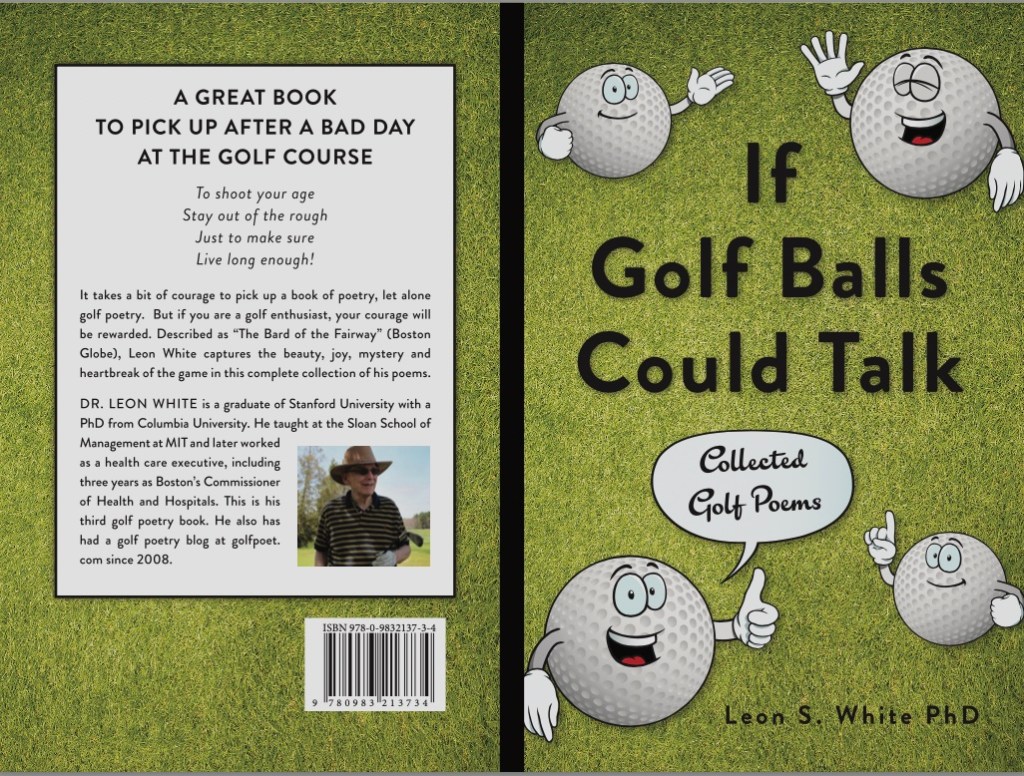
New Book on Amazon: If Golf Balls Could Talk
September 5, 2022 by Leave a Comment
Recently I decided it would be a good time to collect my poetry together in a single volume. If Golf Balls Could Talk is the result. I recognize that it takes a bit of courage to buy a book of poetry, let alone golf poetry. But your presence on this Blog is a good start. And, by being here, you must be a golf enthusiast, and so I think your courage will be rewarded.
Hooks and Slices
May 8, 2018 by Leave a Comment

Two years ago I published a group of poems under the title, Opposites in Golf. All of the the book’s poems focus on golf terms and their opposites. The fun is in the poetic path I take to get from one to the other. In order to give my poems wider availability, I have decided to share them my Blog. So here is the first with more to come.
HOOKS AND SLICES
What is the opposite of hook?
Eye you say with a fishy look.
Fish reminds of hook and line,
Then bait’s the answer to assign.
A hook is also a cager’s shot;
A jumper might oppose or not.
But with golf, what the duffer fears –
Get rid of a hook and a slice appears.
( Note: For non-basketball fans, a “cager” is a basketball player and “hooks” and “jumpers” are descriptive of two kinds of basketball shots.)
If you need an inexpensive present for an avid golfer, the book is available on Amazon for $4.50. (https://www.amazon.com/Opposites-Golf-Portrayed-Poetry-Opposed/dp/0983213712/ref=sr_1_1?s=books&ie=UTF8&qid=1525799821&sr=1-1&keywords=Opposites+in+golf)
Women and Golf, 1914
April 17, 2018 by Leave a Comment

In the early 20th Century, for the most part, golf was a men’s game. One famous amateur golfer/writer of the times, Horace Hutchinson, went so far as to assert, “Constitutionally and physically women are unfitted for golf.”
I recently came across a old golf book, Rhymes of a Duffer (1914), by Philip Q. Loring. Loring apparently was as odds with Hutchinson. At least he was willing to let a woman into the conversation:
So, I have to confess she was quite apropos
When the maiden remarked as she started to go;
“Excepting direction and distance, I’d say,
That drive was as good as I’ve seen today.”
With Thanks to Richard Wilber
October 17, 2017 by Leave a Comment
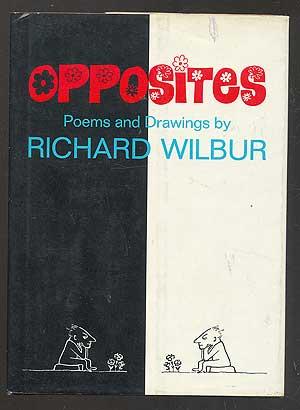
Last year I published a book called Opposites in Golf. The 32 poems in the book were all based on the idea of taking a word (in my book the word was related to golf) and then going on a poetic search for its opposite. The idea was originated by the great American poet, Richard Wilber. Wilber passed away a few days ago at age 96.
One of Wilber’s shortest opposites poem may also be one of his best,
What is the opposite of two?
A lonely me, a lonely you.
In my book, I also included a two line poem,
What’s the opposite of flub?
To hit it flush with any club.
When I first began to write opposites poems, I sent a few to Mr. Wilber. He wrote back, “Tennis has always been my game …but I see enough golf … to understand you very well, and to know that a number of words like putt and tee are waiting to claim your attention.” And they did and here’s one of them,
What is the opposite of tea?
It’s coffee we would all agree.
But avid golfers might start yelling,
Insisting on a different spelling.
For them,
A tee is wooden; its top is round
To place a golf ball above ground.
Remove the tee and then alas,
A tee’s opposite must be grass.
May Mr. Wilber’s memory be an abiding blessing.
Roughly Speaking
August 7, 2017 by Leave a Comment
Last week I mentioned my book, Opposites in Golf. It consists of a series of 32 poems. Each takes a golfing term or expression and then embarks on a poetic adventure seeking its opposite. Here is an example.
ROUGHLY SPEAKING
What is the opposite of rough?
Smooth an answer, not too tough.
But golfers might say, “Wait a minute,
Rough, we’d rather not be in it.
The fairway that is our suggestion.
The opposite of rough, no question.”
Leon S White, PhD
Please come back next week for another golf poem to remember when you are in the rough!
Help With Your Putting
May 23, 2017 by Leave a Comment

We’re back to four line poems with a focus on putting.
I’m sure that most of you have missed a putt and then later thrown down a second ball on the same spot and made that one. The poem below suggests a way to incorporate this experience into your putting routine.
Putting Help
To improve your putting without a doubt
And avoid the usual pain and chagrin
Pretend you’ve already putted and missed
Your “second try” will always go in.
Leon S White, PhD
With Father’s Day coming soon, let me suggest the most unexpected and entertaining gift you could select: One of my two soft-cover books, Golf Course of Rhymes – Links between Golf and Poetry Through the Ages or Opposite in Golf – Portrayed in Poetry as Opposed to Prose. Both are available on Amazon. Thanks for taking a look.

 Golf Course of Rhymes
Recent Comments